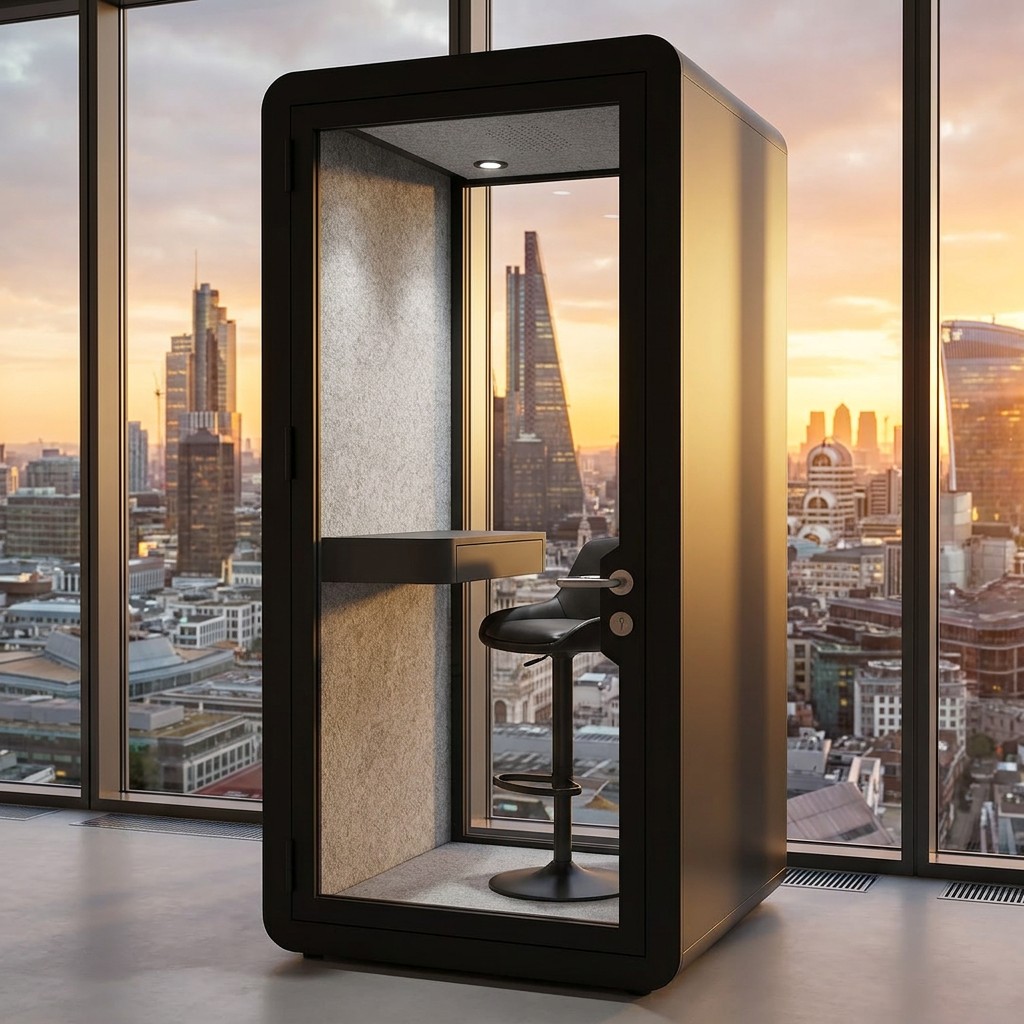
Office Pod Acoustics: Understand the Metric Before Comparing the Claim
A useful acoustic comparison starts with the tested object, not the largest number in a brochure. A lining’s absorption rating, a glass panel’s sound-insulation result and a complete booth’s speech-reduction result answer different questions. Match the report to the proposed model and configuration, then decide whether the intended office location needs a separate assessment.
This glossary explains evidence for office calls, meetings and focused work. It does not assign unverified acoustic ratings to MobileX models. The terms soundproof booth and acoustic booth describe a product category or intended use; neither means that all sound is blocked or that a conversation is guaranteed confidential.
Start with the object that was tested
Ask whether the evidence concerns a material sample, an installed building element, a complete enclosure or the proposed location. Do not let a report for one of these stand in for all the others. A proposed change to the door, glazing, lining or ventilation arrangement needs a documented assessment of whether the quoted result still applies.
| Evidence level | What it can help compare | What to request | What it does not establish by itself |
|---|---|---|---|
| Absorptive material or lining | Absorption under the reported mounting and test conditions | Material identity, specimen, mounting, frequency results and reported rating | Whole-booth sound insulation, privacy or call quality |
| Wall, door or glazing assembly | The tested assembly’s airborne sound-insulation result | Construction, frame, seals, dimensions and laboratory method | The result for a booth that adds other surfaces, openings and joints |
| Complete furniture enclosure | The specified whole-product result under its stated method | Exact model, configuration, drawing revision and complete report | A guaranteed sound level at every proposed desk or listening position |
| Installed location | Suitability for the agreed activity and nearby listeners | Assessment scope, positions, operating conditions and agreed criteria | Suitability for an unassessed location or a different activity |
For example, a supplier might provide an absorption sheet for the lining and a separate glass report. Both can be useful, but the two documents do not combine into a whole-pod rating. Keep the complete-enclosure evidence field unresolved until the relevant evidence is provided.
STC and Rw: identify the assembly and method
STC: Sound Transmission Class
STC is a single-number classification used with airborne sound-transmission measurements. ASTM E413 describes the classification; ASTM E90 addresses laboratory testing of building partitions and elements. In that context, STC characterizes the tested assembly, not every enclosure containing that material. An STC rating is not a promise that each sound becomes quieter by that number of decibels.
Ask for the test report, assembly construction and measurement method. A partition tested in a laboratory is not the same object as a pod with its door, floor, roof and ventilation paths. ASTM E90 also notes that laboratory results can differ from in-building performance where other transmission paths are present. See the official scopes of ASTM E413-22 and ASTM E90-23.
Rw and spectrum adaptation terms
Rw is the weighted sound reduction index used in the ISO sound-insulation rating framework. ISO 717-1 covers airborne sound-insulation ratings for buildings and building elements and addresses different source spectra. Where a report includes C or Ctr, retain the full expression, method and stated frequency information. Do not turn a reported Rw, Rw + Ctr or STC into a different rating through a convenient rule of thumb. The ISO 717-1:2020 public scope explains the rating framework.
A label such as “Dw” without its full symbol, definition and referenced method is insufficient for comparison. Request the original notation from the report rather than assuming what the abbreviation means.
Whole-product speech reduction is a different question
ISO 23351-1:2020 describes a laboratory method for comparing furniture ensembles and enclosures by their reduction of an occupant’s speech level. It compares sound-power measurements with and without the product. Its stated scope concerns complete ensembles or enclosures, not individual items such as an absorber, screen or chair.
This distinction makes the report identity important. Ask whether the tested enclosure matches the proposed model, door and ventilation arrangement, and whether the supplier can identify any differences. A result under this laboratory method is not interchangeable with STC or Rw and does not provide a site-specific confidentiality guarantee.
A generic “noise reduction” number still needs a defined quantity and test conditions. Do not subtract it from an office sound-level reading to predict the occupied interior. The source, receiving position, background, weighting and operating state may differ. Record what the number actually measures before using it in a decision.
NRC and reverberation: what happens inside
NRC: Noise Reduction Coefficient
NRC is an absorption rating, not a sound-insulation or confidentiality rating. When comparing lining data, ask for the material, mounting and test report, including the frequency-dependent absorption results. The ASTM C423 public scope describes reverberation-room absorption measurements and cautions that practical conditions can differ from laboratory conditions.
Do not read a lining’s NRC as the proportion of all sound prevented from leaving a booth. The installed area, other surfaces and configuration still matter. A material datasheet also does not prove that the quoted pod includes that same material.
Reverberation time
Reverberation concerns sound decay within a space after the source stops. It is a different question from transmission to a neighboring space. ISO 3382-2:2008 describes measurement of reverberation time in ordinary rooms, including reporting procedures. Ask for the applicable method and report rather than accepting an unexplained “ideal” range.
No universal reverberation-time target or MobileX measurement is asserted here. A person making video calls, a small group speaking around a table and a recording task may need different evaluations. Microphones, loudspeakers and processing also affect remote participants’ experience; an absorption rating alone cannot establish call quality. Use the recording procurement brief for recording-specific tasks rather than treating an office booth as a certified studio.
Materials and openings belong in the evidence trail
Frame material, glass type and lining describe construction. They do not independently establish the assembled booth’s acoustic result. Ask the supplier to identify the proposed parts and explain which report, if any, covers their combined configuration.
- Glazing and doors: identify the complete proposed assembly, including frame and seals. A glass thickness or photograph is not a whole-door rating.
- Joints and connections: obtain the applicable assembly and inspection information. Do not assign a fixed decibel penalty to an unspecified gap.
- Ventilation: record openings, equipment and operating state in the test configuration. Do not assume that an airflow figure proves acoustic performance, or that an acoustic report proves ventilation adequacy.
- Materials and other requirements: request separate evidence for emissions, fire behavior or other project requirements. An acoustic result is not a certificate for these subjects.
If a proposed option is outside the tested configuration, ask the supplier to explain the evidence gap before comparing it as an equivalent. This is a request for documentation, not an instruction to modify a seal, block a ventilation path or alter installed equipment.
Speech privacy needs the intended location
Describe the intended conversation category without collecting its sensitive content. Identify nearby seats, circulation routes and potential listening locations. Record expected door use and relevant operating conditions. Visual shielding, acoustic transmission and remote-meeting audio are separate issues.
ASTM E2638-24 concerns objective speech-privacy measurements for a closed room with listeners outside. Its public scope includes the room boundaries and background noise at receiving locations. It does not address determined or electronically assisted eavesdropping and does not set a universal criterion for adequate privacy. The method’s applicability and the project’s acceptance criteria need appropriate professional judgment.
For confidential work, use a competent acoustic professional to agree the assessment scope and interpret the results. A phone recording, a showroom impression or “I cannot make out the words” is not a substitute for that assessment. The site-specific privacy guide develops the procurement questions.
A comparison sheet for acoustic evidence
Use the following buyer worksheet for each offered configuration. Leave unsupported fields unresolved. Do not rank options by comparing numbers from different methods.
| Record | Option A | Option B | Decision needed |
|---|---|---|---|
| Manufacturer, model and drawing revision | To complete | To complete | Does each report identify the proposed product? |
| Tested object and configuration | To complete | To complete | Material, assembly, enclosure or site? Note proposed differences. |
| Report issuer, identifier, date and method | To complete | To complete | Can the report and its scope be checked? |
| Reported quantity, units and result | To complete | To complete | Are the metrics and conditions comparable? |
| Door, openings and operating state | To complete | To complete | What is covered and what remains unverified? |
| Intended location and task | To complete | To complete | Is a separate site assessment needed, and who arranges it? |
Send the intended activities, preferred model, layout, adjacent uses and required evidence with your project enquiry. Ask MobileX to identify the available documents for the exact configuration and to state any unresolved requirements. Compare the office booth models or meeting booths for product selection; this glossary supplies the evidence vocabulary, not replacement specifications or a universal performance promise.
Common terminology questions
What is STC (Sound Transmission Class)?
STC is a single-number sound-insulation classification associated with a specified test method and assembly. It is not a guarantee of complete speech privacy or a universal decibel reduction for an office pod.
What is NRC (Noise Reduction Coefficient)?
NRC summarizes sound absorption, not sound insulation. Check the tested material and mounting; a lining’s rating does not establish the acoustic performance of the complete booth.
What is RT60 (Reverberation Time)?
RT60 describes a 60-decibel sound-level decay time after the source stops, with measurement and evaluation conditions that must be stated. It concerns decay within a space, not the sound insulation of its boundaries. No model-specific result or universal target is supplied here.