Office Pods for Confidential Conversations: Plan a Site-Specific Privacy Review
Choose an office pod for confidential conversations by reviewing the proposed product, its exact configuration and the place where it will be used together. Start with the type of conversation and the positions from which someone might overhear it. Then agree what evidence and professional assessment are needed before authorizing that use. A product photograph, an isolated decibel claim or a quiet demonstration cannot establish that a sensitive discussion will remain private at your site.
This is a purchasing and planning decision for facilities teams, HR, designers and project buyers. The useful question is not simply whether a pod is "soundproof." It is whether the proposed arrangement can meet the organization's defined privacy needs, under the conditions in which people will actually use it.
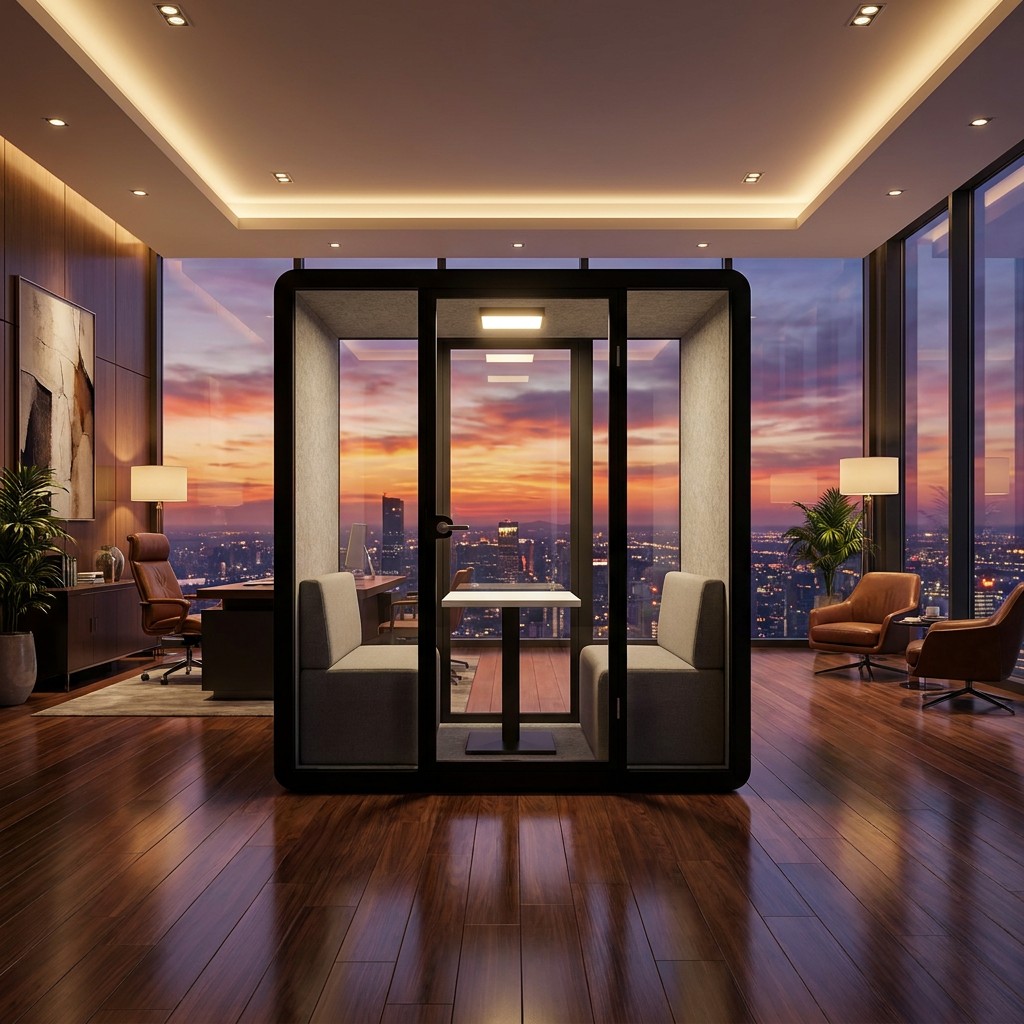
What should the privacy purchase actually deliver?
For ordinary calls, buy a usable enclosed call position and evidence relevant to speech leaving it; do not pay for a “confidential” label as a substitute for that evidence. For conversations where nearby people understanding the words would be unacceptable, make the intended listener positions and approval basis part of the project from the start. If the required assurance cannot be established, use another assessed room for that activity rather than relying on a more expensive pod or a larger model name.
Routine calls: separate the speaker from the shared workplace
A person taking a routine call usually needs a convenient single-person position, a device surface and a workable seat or standing arrangement. A headset keeps the far-end conversation off a room loudspeaker, but the person still speaks into the enclosure. Noise cancellation in a headset or meeting app is not proof that colleagues outside cannot understand that voice. Buy the enclosure and call equipment for their separate jobs.
Here the operational choice may be a compact call space close to the team rather than a larger meeting pod. Compare how it fits the calling task and the surrounding desks. This is not permission to use it for sensitive discussions: the organization must still decide which conversations belong there.
Face-to-face discussion: buy the occupied arrangement
For an interview or one-to-one discussion, a two-person layout is a starting point only when the two seats, table, documents and normal entry work together. A larger layout is worth considering when a third participant regularly attends or when equipment makes the smaller arrangement impractical. Extra capacity solves an occupancy or working-space problem; it does not establish a higher privacy rating.
Consider this planning example: a two-person pod faces a staffed waiting area, while an alternative position faces a less frequently occupied circulation area. The models may be identical, yet the relevant potential listeners and periods of occupancy differ. Neither location can be declared private from the plan alone, but the comparison changes the brief and the positions that need evaluation. It is more useful than selecting a four-person pod simply because the discussion is important.
Sensitive use: compare a complete evidence-and-space proposal
Compare a pod proposal with another suitable room when the requirement includes information that must not be understood outside. Include visual exposure, normal door opening and remote-call audio as separate matters; solving one does not settle the others. A larger enclosure, opaque finish or premium furniture may answer a real requirement, but none is a substitute for the speech-privacy evidence described below.
Budget the product, furniture and relevant equipment separately from location changes, installation and the agreed site assessment. Identify who pays for corrective work and any repeat assessment if the installed arrangement does not meet the agreed basis. An offer including only the pod is not equivalent to one including those project services. This does not imply MobileX supplies acoustic consultancy or guarantees a site outcome.
The practical decision is therefore not “ordinary pod or confidential pod” based on a label. It is whether the proposed call position, meeting layout or assessed room has the working space, evidence and project scope required for the conversations assigned to it. The following review turns that choice into documented locations, relevant reports and an explicit approval decision.
Describe the use without sharing the conversation
Give the project team a generic activity description: a one-to-one staff discussion, a supplier negotiation, or a remote meeting involving commercially sensitive information. State the number of participants, whether speech comes from people or loudspeakers, and whether someone may need to enter or leave during the session. Do not send actual personnel details, recordings or confidential documents to explain the requirement.
Ask the organization's responsible decision-maker to define what kind of information exposure the space must address and who will approve its use. A place for routine calls and a room for highly sensitive discussions should not inherit the same acceptance decision just because both have a door.
Identify whether the concern is incidental overhearing by nearby workers or a security scenario requiring specialist advice. If the latter matters, involve the organization's security lead as well as an appropriately qualified acoustics professional. Avoid describing an ordinary office pod review as a secure-room certification.
Keep three privacy questions separate
Visual exposure: can someone see the screen, documents or people through glazing, or when the door opens? Use the glass orientation and screen-privacy guide for this part of the layout. A screened view does not establish speech privacy.
Speech reaching people outside: which nearby positions matter, and what acoustic evidence is appropriate for the enclosure in that setting? This is the focus of the site-specific review below. An attractive interior finish or a general noise-reduction label does not answer it.
Remote meeting audio: what is picked up by the microphone, played through the speaker and sent to remote participants? IT or AV staff should address that separately, including the organization's meeting and device practices. The video-call camera, audio and lighting checks cover equipment experience, not an acoustic privacy assessment for listeners outside.
Keep these outcomes separate in the purchase discussion. A clear remote call can coexist with an unresolved local privacy concern, while changing the glass treatment may leave the acoustic question untouched.
Mark the relevant positions and operating conditions
Use a plan of the proposed installation, not just the pod's dimensions. Mark the intended seats inside and the nearby desks, waiting areas, adjacent rooms and circulation routes outside. Include places where someone may remain for a period, as well as locations people pass through. Label the positions so an assessor can refer to them consistently.
Add the door orientation and describe normal entry and exit. Ask how the intended privacy requirement will be handled when the door is open; evidence for a closed configuration should stay attached to that condition. Note nearby doors and other features that the assessor may need to inspect rather than trying to decide the sound paths yourself.
Describe the surrounding activity during busy and quieter periods, along with the intended operation of building services, pod ventilation and meeting equipment. Ask the acoustics professional which conditions need assessment. Do not arrange the review only during a convenient noisy period or alter necessary ventilation to make the result appear more favorable.
National Research Council Canada research on closed-room speech privacy links assessment to both transmitted speech and ambient noise at a potential listener's position. That supports recording the surrounding environment; it does not supply a universal pass value for this purchase.
Record gaps honestly. If the final site is unavailable, identify which plans and assumptions have been reviewed and which checks must wait until installation. A supplier showroom and the proposed workplace are different settings.
Ask for evidence that answers the right question
Request the complete applicable report, not only a badge or a number copied into a quotation. Ask the supplier to identify the tested product, configuration, report issuer, date and method. Have the person assessing the evidence compare those details with the proposed order, including doors, panels, openings, services and any changes made for the project.
Scroll horizontally to compare all columns.
| Evidence offered | What it can contribute | What to resolve before relying on it |
|---|---|---|
| Product photograph or demonstration | Shows the arrangement and helps identify questions about use | The image is not a test report; record which configuration and site still need review |
| General acoustic claim in a brochure | Identifies a claim that the supplier should explain | Request its method, units, conditions and matching report; do not compare unqualified numbers |
| Laboratory report for an entire enclosure | Provides results for the tested product under its stated method and conditions | Check that the ordered configuration matches; identify what remains to be assessed at the installation |
| Report for a glass panel or another component | Documents that particular component and test | Ask what evidence addresses the complete enclosure; do not extend the component result to the whole pod |
| Site-specific acoustic assessment | Addresses the installation, receiving positions and conditions documented in the assessment | Agree the applicable method, acceptance basis, limitations and authorized use with the responsible professionals |
For example, ISO 23351-1:2020 describes a laboratory comparison of speech-level reduction by complete furniture ensembles and enclosures. Its stated scope excludes individual workstation components. A result under that method is not a site-specific approval for confidential use.
Keep the reported metric and test method together. Do not relabel a speech-level-reduction result as STC or Rw, or convert between them for a quotation comparison without an applicable technical basis. If suppliers provide different forms of evidence, ask the acoustics professional to explain what can actually be compared.
MobileX's factory and quality information is a starting point for requesting configuration-specific documents. Ask which relevant reports are available for the proposed unit. This guide does not claim that a MobileX model has passed a particular confidentiality test.
Agree the professional review before treating it as acceptance
For sensitive use, appoint someone with relevant competence in architectural acoustics and speech-privacy assessment. Provide the use brief, drawings, proposed configuration and available reports. Ask that person to identify the appropriate assessment approach, relevant locations and conditions, and any evidence still needed.
ASTM E2638-24 addresses speech privacy for closed rooms and listeners outside them. Its public scope excludes determined eavesdropping and electronically aided listening, and it does not prescribe a universal adequacy criterion. Whether it suits a particular pod installation, and how the organization's requirements should be expressed, are questions for the responsible professional and client.
Agree who commissions the assessment, who supplies product information, who resolves any findings and who can approve the intended use. Keep the technical findings distinct from the organization's final decision about which conversations belong in the space. Do not assume that purchasing the enclosure also purchases acoustic consultancy or an approval service.
An informal demonstration can reveal an issue worth investigating, but a phone recording, a subjective listening check or a comment that "nothing was understandable" is not a substitute for the agreed professional evaluation. Use appropriate non-sensitive material for any demonstration; do not expose real conversations to test privacy.
Ask the final assessment to identify the installed configuration, relevant positions, operating conditions, assessment method, results and limitations. It should make clear what was evaluated and what was not. Leave thresholds, instrumentation and measurement procedures to the qualified team rather than copying a generic online test into the purchase specification.
If the proposal falls short, compare the alternatives
Change the location when the surrounding arrangement creates an avoidable exposure concern. For example, in a hypothetical plan, a pod entrance faces a regularly occupied waiting area. An alternative location may change the relationship to potential listeners, but it still needs review; moving a symbol on the plan is not proof of privacy. Check circulation, access and services at the new position as well.
Review the configuration when the supplier and assessor identify a product-related issue or a mismatch between the proposal and its evidence. Ask what change is feasible, which documents it affects, and what should be reassessed. Do not instruct site staff to block vents, alter door hardware or add unapproved materials as an acoustic workaround.
Use another suitable room or limit the intended activity when the required assurance cannot be established for the pod. A different room also needs assessment against the intended use; an existing meeting-room label is not evidence by itself. Record who decides the interim arrangement so users are not left to guess whether a sensitive conversation is appropriate.
These are different purchasing outcomes. Compare the evidence, operational effect, responsibility and project implications of each, rather than treating a higher price as a privacy guarantee. For broader decisions about open versus enclosed space, the study-space comparison addresses that earlier choice. For ordinary task suitability, use the calls versus focused desk work guide.
Prepare a brief for the supplier and assessor
Copy the following fields into a project enquiry. Keep personal information and sensitive discussion content out of the attachments.
- Intended conversation category and participants: [generic activity; people and equipment]
- Privacy decision owner and assessment contact: [project roles]
- Proposed pod, configuration and quantity: [references or options under consideration]
- Installation plan: [inside seats; labeled outside positions; adjacent uses; door orientation]
- Operating conditions: [relevant busy and quiet periods; services; entry and exit]
- Evidence available or requested: [report reference; tested configuration; method; unresolved gaps]
- Responsibilities and decision point: [assessment; product information; corrective work; approval of use]
- Project location and constraints: [destination; site availability; required project date]
Use the office pod range to identify configurations for discussion, then send the non-sensitive project brief to MobileX POD. Ask the supplier to confirm the proposed supply and available documentation, while the relevant project professionals address the site-specific evaluation. That produces a clear next decision: proceed with an evidenced arrangement, revise the proposal, or select a more suitable space for the conversation.