Music Practice Booths: Choose for the Instrument, Not the Seat Count
A music practice booth is worth buying when it lets you do the required practice while controlling the sound that reaches other people. Start by deciding whether the instrument can be played through headphones, whether its acoustic sound must remain part of the exercise, and whether pedals or impacts create a separate vibration problem. An office phone booth is not automatically a suitable music booth, even when the player and instrument fit inside.
For a musician, teaching studio or school, the useful shortlist may include a quieter instrument setup in an existing room, a purpose-designed practice enclosure, or access to a suitable rehearsal room. Compare these routes against the same playing task. Do not pay for a larger enclosure before establishing what it needs to contain.
Start with what must be heard, and by whom
Separate three outcomes. Keeping playing from disturbing others concerns sound leaving the practice space. Hearing the instrument without outside distractions concerns sound entering it. Getting a useful sound inside concerns reflections and, when recording, what the microphone captures. A solution to one of these does not establish the other two.
Interior absorption can change the room’s response, but it is not a substitute for sound isolation. Adding soft panels to a room does not by itself make full-volume practice acceptable next door. Likewise, a room that sounds less reverberant to the player may still transmit music to another occupant. Specify the listening location that matters: a nearby desk, an adjacent teaching room or the room below, rather than simply asking for a quiet booth.
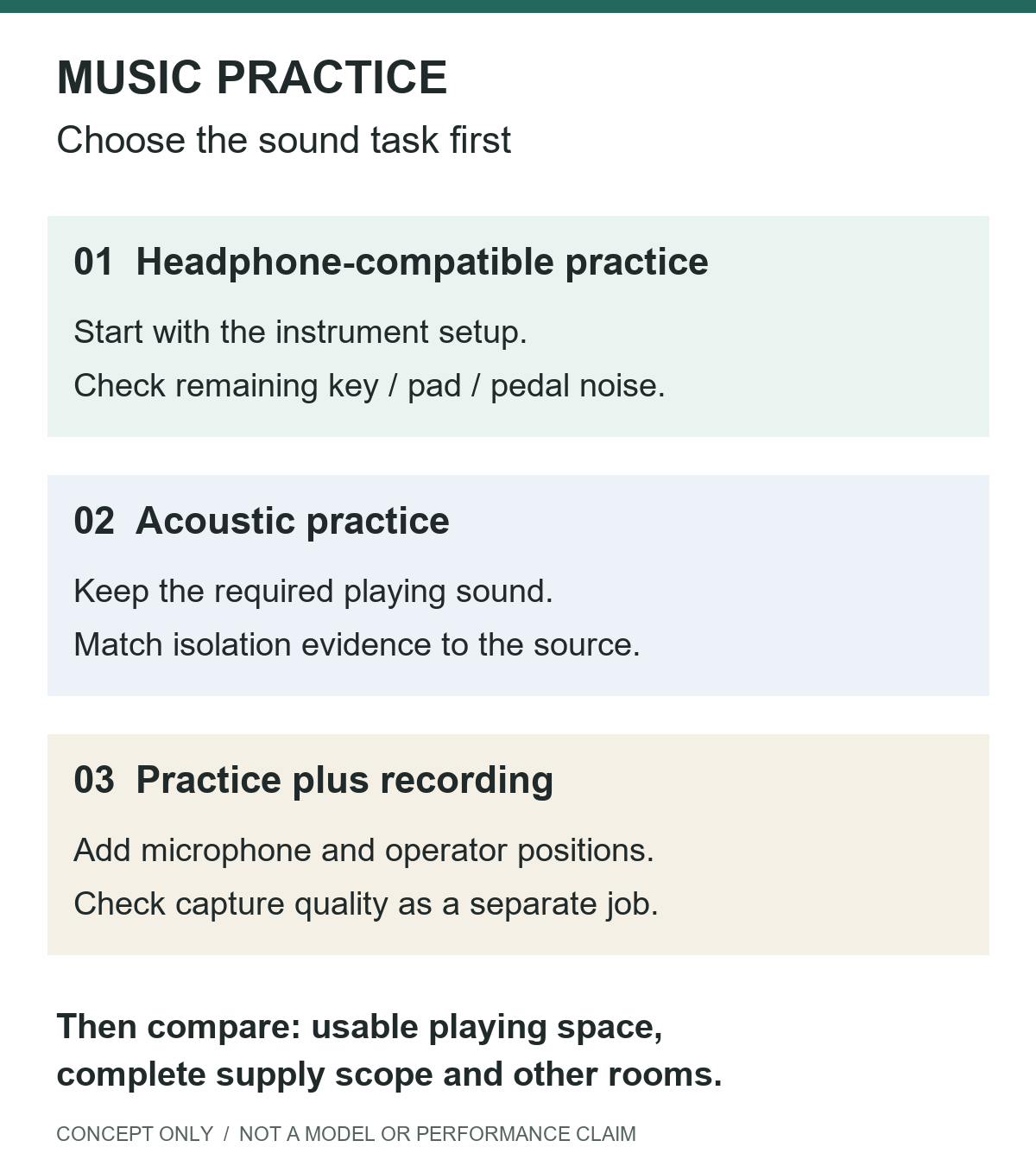
Choose the practice route before the enclosure
| Required practice | First route to compare | What can rule it out |
|---|---|---|
| Keyboard or electric-instrument work that can use headphones | The intended instrument and headphone setup in a suitable existing room; add an enclosure only for a remaining space or separation need. | The exercise requires an acoustic instrument or amplifier sound; key, pad or pedal noise still disturbs another room. |
| Acoustic instrument or singing at the required playing level | A practice enclosure supported by relevant source/configuration evidence, compared with a suitable rehearsal room. | The offer relies only on an office-speech figure or cannot accommodate the musician’s movements and instrument. |
| Drums, amplified bass or forceful pedal work in a shared building | A specialist proposal addressing both airborne sound and the relevant building/floor relationship. | No evidence addresses the actual source and receiving rooms; the proposal assumes headphones remove all disturbance. |
| Teacher and student playing together | A two-person playing layout, including both instruments, stands and entry, rather than a two-seat conversation layout. | The extra person fits only by moving an instrument into the doorway or losing the required playing position. |
Headphones are a different practice method, not an acoustic upgrade to an enclosure. They can be a sensible first route when the instrument and lesson permit them. They are not an equivalent substitute when the purpose is to work on the response of an acoustic instrument, play with another musician in the room, or rehearse the intended amplifier sound.
Electronic instruments also have a physical side. Roland’s guidance for its TD-02K and TD-02KV explains that the pedals retain sound and vibration. That example is a reason to include mechanical operation in the assessment, not a claim that every electronic kit behaves alike or that a particular mat will resolve your building’s problem. Do not order an enclosure on the assumption that a headphone connection eliminates all noise.
Why a speech rating does not settle a music purchase
A music source is not interchangeable with standardized speech. ISO 23351-1 describes a laboratory method for speech-level reduction of complete furniture ensembles and enclosures. Its result should not be relabeled as a drum, bass or instrument-practice rating. Ask what the offered evidence actually measured before comparing the numbers on two quotations.
WhisperRoom’s practice guidance notes that low-frequency sound from drums, bass and amplified instruments is particularly difficult to isolate, and that the result depends on the source, enclosure and building. Its practice products illustrate a specialist purchase category; their construction, test results and applications are not MobileX capabilities.
MobileX has a factory-confirmed noise-reduction claim of up to 35 dB for MP1, MP1+, MP2 and MP3. That remains a factory product fact within its stated scope. It does not establish an instrument-specific result, silence in a neighboring room, a particular test standard or a guaranteed reduction at your site. Subtracting that number from an instrument’s advertised sound level is not a valid forecast of what a neighbor will hear.
For a demanding source, request frequency-related evidence and a review of the intended installation, not merely a larger headline figure. A performance demonstration is useful only when the instrument, playing level, enclosure configuration, ventilation state and listening positions are identified. A quiet spoken sentence or an edited promotional clip cannot establish the outcome of the planned rehearsal.
Measure the playing envelope, not just the instrument
Draw the musician in the position used during practice. Include the full keyboard and bench movement; the guitar body and neck while turning; a bow’s travel; a wind instrument held in its playing position; or the drum kit with sticks, pedals and the drummer getting on and off the seat. These are layout examples, not minimum-clearance prescriptions.
Next add the stand, sheet music or tablet, headphones, amplifier if required, and any microphone. Check the door in use and the route for carrying the instrument in its case. A large instrument may fit inside yet be difficult to bring through the clear opening or turn into position. An external booth footprint cannot answer either question.
MobileX’s published internal reference dimensions are 880 x 920 x 2080 mm for MP1, 1120 x 1080 x 2080 mm for MP1+, 1880 x 920 x 2080 mm for MP2 and 1880 x 1520 x 2080 mm for MP3. Use the applicable drawing to identify measurement orientation. These are enclosure references, not clear door openings, furnished movement space or evidence that an instrument fits. A meeting model’s extra space does not establish better instrument isolation.
The MobileX office pod range is a reference for the standard office products. For a music enquiry, a project-specific enclosure review must establish feasibility, layout and evidence before an order. A custom-size route does not mean a music-rated configuration is already available.
When another room is the better purchase
Keep a suitable existing room when the required practice can take place there, the surrounding uses remain compatible and the instrument setup does not need to be moved for every session. Compare paid access to a rehearsal room when occasional full-volume practice would otherwise require a substantial permanent installation. That alternative buys usable practice time rather than an enclosure, so include availability, travel and equipment access in the comparison.
A booth becomes more useful when frequent practice needs a consistently available, dedicated location and an evidenced proposal can meet the sound and space brief. It is not the right purchase when the decisive instrument or floor-transmission question remains unanswered, or when adding it makes the host room impractical. Do not resolve those failures by blocking ventilation, wedging the door open during occupied practice, or improvising a floor platform without a reviewed design.
Planning example: a student practising keyboard fingering with headphones may first need a stable playing position and a workable household schedule. A brass player rehearsing normal acoustic tone in the same room has a different sound-containment requirement. One player’s successful arrangement is not evidence for the other’s purchase. Neither example describes a completed MobileX project.
Compare offers for the same finished practice task
Separate the enclosure price from the items that make it usable. Compare the specified shell and door, any source-appropriate floor arrangement, interior treatment, occupied ventilation, lighting, electrical provision, furniture and instrument supports. Identify which of these are included, optional or supplied by the musician. A furnished office-pod price is not a complete music-practice price.
Then include freight, unloading, the actual route into the building, assembly, local connections and any required floor or building review. Record the equipment that remains outside, where cases are stored, who installs the instrument and who checks the finished arrangement. Include the agreed acoustic assessment or demonstration and the remedy process if the delivered scope does not meet the contract. More money is justified by a relevant performance or usability requirement, not simply by more decorative treatment.
For recorded music, add microphones, their supports, monitoring, recording equipment and the operator’s position as a separate production scope. The recording-pod equipment and producer-layout guide handles that workflow; a practice-only purchase need not include a recording system.
The next decision should be concrete: use a lower-output practice method, keep or book a suitable room, or obtain a source-specific enclosure proposal. Send a music-practice project enquiry with the instrument and playing method, people inside, equipment layout, intended location and the surrounding rooms that need protection. MobileX can review the proposed enclosure scope; instrument-specific suitability must be established for the offered configuration, not inferred from its office model name.