Compact Recording Booths Compared: WhisperRoom 4848 S and Studiobricks One
If you are choosing between a WhisperRoom MDL 4848 S and a Studiobricks One for solo recording, start with the space you need inside and the room you can give up outside. The 4848 S offers a wider, roughly square interior; the One has a narrower exterior and a deeper-than-wide interior. Either can leave the shortlist before an acoustic comparison if the intended working position or the installation space does not fit.
This is a model-and-scope comparison using manufacturer information read on October 21, 2026, including Studiobricks’ September 2025 technical sheet. It is not a side-by-side sound test, a dealer offer or a claim that MobileX supplies either brand.
Compare the working width, not the model nickname
| Model | Published exterior | Published interior | First space decision |
|---|---|---|---|
| WhisperRoom MDL 4848 S | 127 x 127 x 210.82 cm 4 ft 2 in x 4 ft 2 in x 6 ft 11 in |
116.84 x 116.84 x 203.2 cm 3 ft 10 in x 3 ft 10 in x 6 ft 8 in |
More published internal width, but a wider exterior than the One. |
| Studiobricks One | 106 x 138 x 226 cm | 90 x 120 x 210 cm | A narrower outside footprint, with less internal width and more internal height. |
Dimensions above are width x depth x height; the Studiobricks sheet calls depth length. Inch conversions use 2.54 cm per inch. These are published envelopes, not measurements of a completed recording setup.
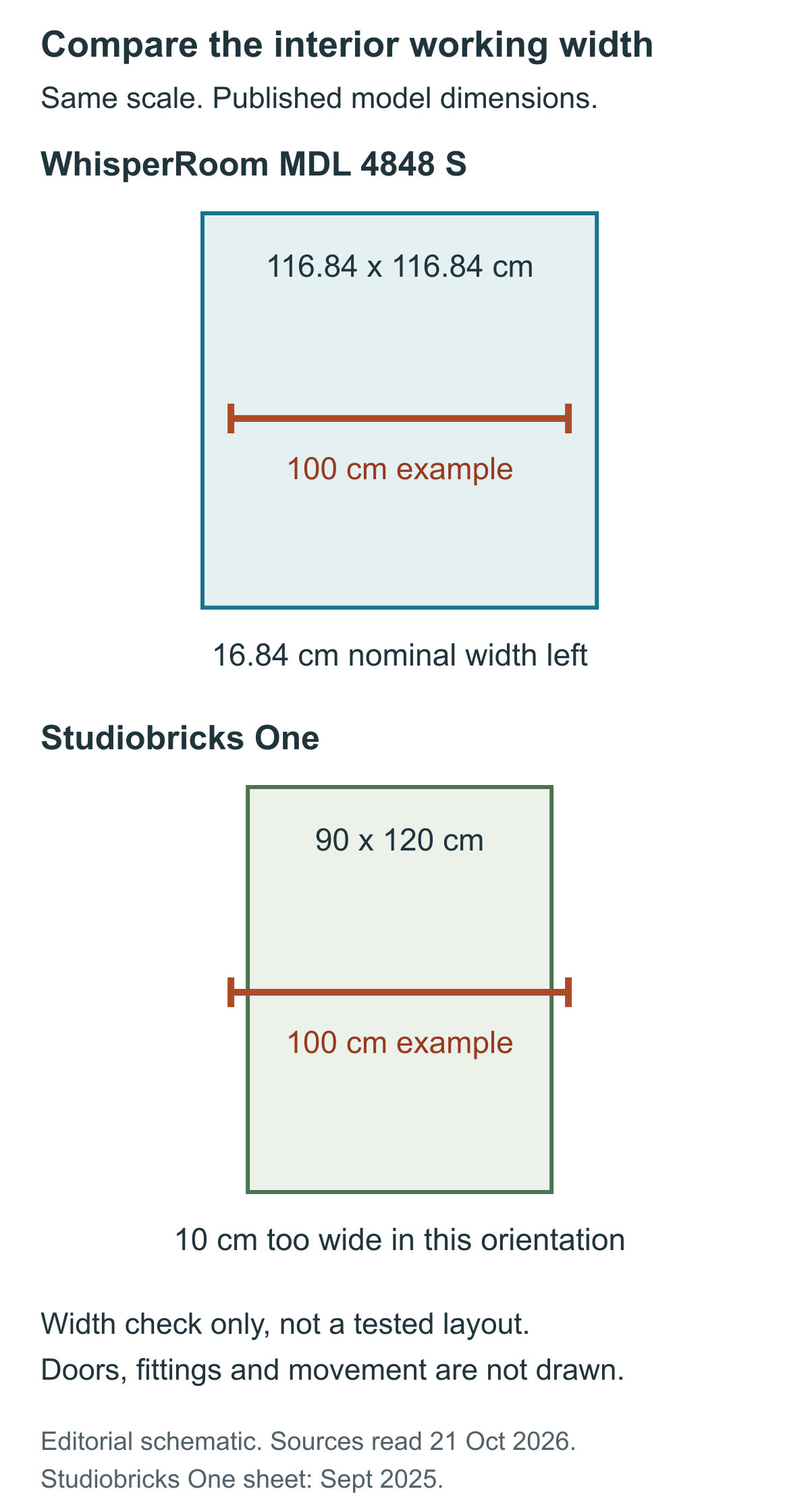
Hypothetical width check: suppose your fixed arrangement needs 100 cm across, including the desk or stand and the movement you actually make. Subtraction gives 16.84 cm of nominal width left in the 4848 S and a 10 cm shortfall across the One’s 90 cm side. The latter arrangement must be changed or rejected; the former has passed only this one-dimensional check. Neither result proves that a chair, door movement, microphone arm and usable depth will all fit.
Turning a setup through 90 degrees changes which dimension it uses. It does not move the door or make cables, treatment and access disappear. Lay out the equipment in its operating position before treating that rotation as a solution. If the task needs two simultaneous performers or broad instrument movement, do not force it into a solo-booth shortlist merely because a person can stand inside.
Keep installation space separate from the box
WhisperRoom states that ventilation adds 5.5 inches to exterior dimensions and that vent configurations vary. That is not a universal extra strip on all four sides. The completed shell height alone does not establish the clearance needed to assemble it.
Studiobricks’ sheet specifies a 232 cm minimum ceiling and 5 cm minimum distance from room walls. A 230 cm ceiling therefore falls outside that published standard installation condition, despite being above the booth’s 226 cm exterior. Do not select it for that hypothetical room without a documented alternative. Conversely, the shorter WhisperRoom shell does not by itself prove that it can be assembled there.
For either option, draw the installed equipment envelope, access and service space on the host-room plan. If the enclosure would obstruct an essential route or cannot be brought in and assembled, remove that configuration from the comparison before paying for recording accessories.
Buy the accessories that replace something you need
The 4848 S page lists one ventilation system, two cable passages and three acoustic-foam sheets. Basic LED lighting is listed separately from the optional Studio Light; the desk is an option. A photograph with upgrades is not the base supply list.
The One technical sheet lists wall and ceiling absorbers, ventilation, a cable tunnel, LED lighting and carpet in its standard configuration. The current product page presents the VO Edition as a separate accessory kit: desk, microphone arm, pop filter, interface shelf, headphone and monitor supports, and a corner bass trap.
Choose a furnished recording package when its supports and working arrangement replace items you would otherwise have to buy and install. Keep the base configuration in contention when you already own suitable equipment and can arrange it within the usable interior. A bundled arm or shelf has no purchasing value if your equipment cannot use it; omitting it does not automatically create a refund. Neither a booth nor an accessory package should be assumed to include the microphone, recording interface or computer.
Do not select an acoustic winner from these dimensions
The 4848 S is described as single-wall; Studiobricks describes the One as double-wall. Wall count, nominal area and an isolated headline rating cannot establish which quoted configuration will solve your particular noise problem. Comparable test conditions and the relevant noise path are still needed for that decision.
If unwanted room reflections are the problem rather than outside noise, use the vocal-booth sound and usable-space guide to decide whether the existing room can be improved first. For the distinction between shell isolation, internal sound and equipment noise, use the recording-space task and equipment brief. A new enclosure is not automatically the necessary purchase.
Compare a usable installation, not two starting prices
Use one destination and one scope: the exact enclosure, selected accessories, freight, taxes or import costs where applicable, unloading and carrying, assembly, site preparation and the equipment required for the first usable recording session. Keep costs already common to both options outside the difference; include equipment you can retain as a purchase you do not need to repeat.
For example, a lower enclosure price can cease to be lower once a missing work surface, suitable supports and paid handling are included. That is a calculation to make from matching quotations, not a reason to assume either brand is cheaper. Do not subtract a US-dollar list price from a euro starting price, or treat a supplier’s dispatch estimate as the date the room is ready to record.
Your shortlist should now say why each model survives: a working layout that fits, an executable installation plan, an accessory scope you will use, and evidence appropriate to the noise problem. Send that layout and scope with the destination and available site resources. This produces a useful quotation request without pretending that the comparison is a MobileX configuration or performance recommendation.