Choosing a Vocal Recording Booth: Dry Sound, Reflections and Useful Space
Buy a vocal recording booth for the raw sound you can actually capture in it, not just for a noise-reduction claim or walls covered with soft material. If your existing quiet room produces the sound you need, a new enclosure may be unnecessary. If surrounding activity prevents recording, an enclosure may help with that separate problem, but its interior must also suit the voice, microphone and working position.
A useful purchase comparison separates three outcomes: keeping unwanted sound out of the recording space, limiting sound transmitted to other people, and shaping reflections inside the space. Success at one does not establish success at the others. This guide focuses on the third outcome and how it changes the choice of room, treatment and enclosure.
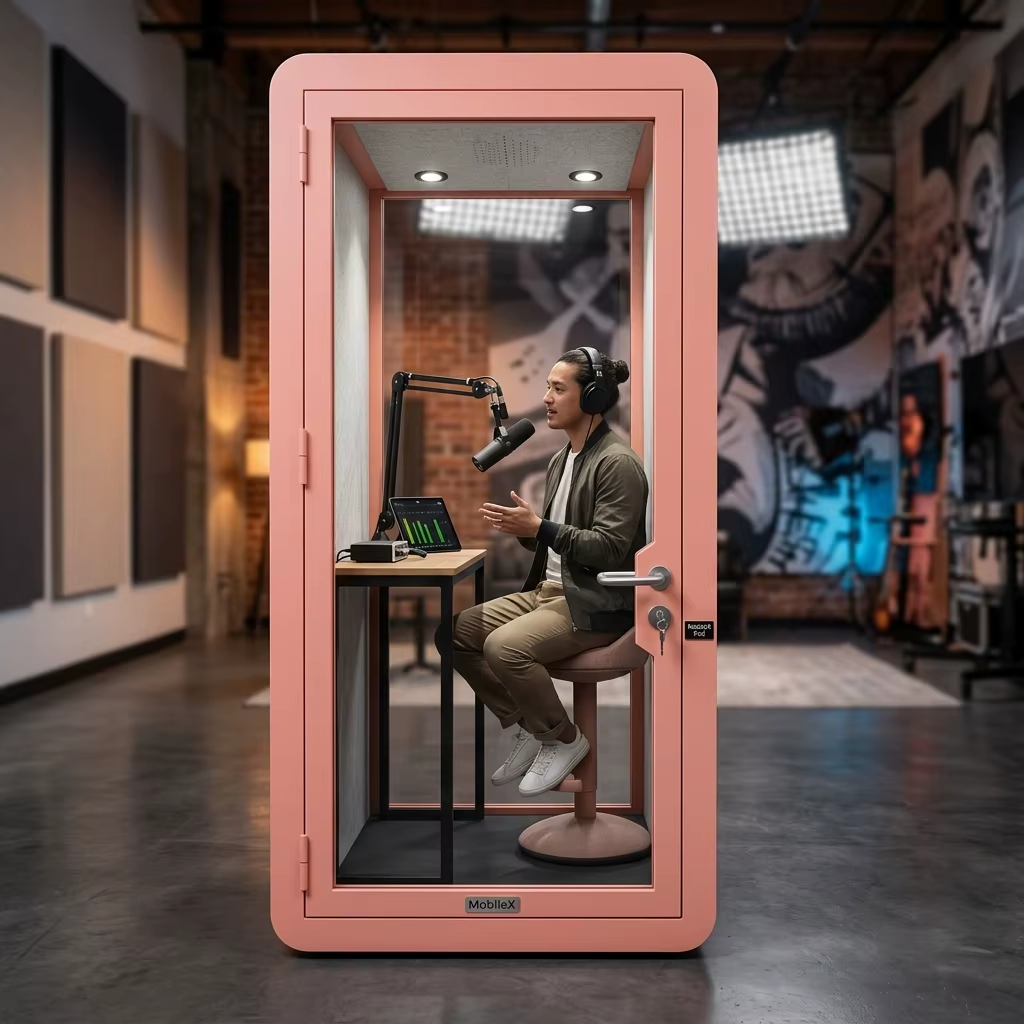
Define the sound before buying the finish
A dry recording has little audible room ambience. It can suit close voice-over and vocal production where the producer wants to add the final space later. A more live room contributes its own sound, which may suit the performance. Neither is automatically the correct choice for every voice or programme.
Neumann distinguishes vocal booths treated for a dry sound from tracking rooms whose reflections contribute to the recording. It also explains that very short reflections in small rooms can colour the result. Therefore, a room that sounds impressively quiet to someone standing inside is not necessarily a room that produces the desired microphone signal.
Choose a short representative passage and a reference for the intended production style. A spoken training voice, an intimate sung vocal and a deliberately roomy performance are different briefs. Do not approve one demonstration as proof that every recording style will work.
Diagnose the symptom before purchasing a larger booth
| What the raw take reveals | A useful distinction | Purchase implication |
|---|---|---|
| Passing voices or traffic appear during a pause | Sound arriving from outside is different from reflections of the vocalist inside. | Compare the location and enclosure transmission evidence; additional interior lining alone is not the same scope. |
| The voice has a short tail or a persistent room character | Repeat with controlled position changes before attributing every tonal feature to the microphone. | Compare the usable recording position and interior acoustic provision, not only the outer shell. |
| The bass changes strongly as the performer moves closer | Directional microphones can exhibit proximity effect. | Try the intended working distance and microphone pattern before paying for a different enclosure to solve the wrong problem. |
| The result is acceptable only after heavy processing | The processed output and the captured signal answer different questions. | Decide whether that workflow is dependable for your production; retain the unprocessed comparison. |
| Fan or equipment sound remains during pauses | Operational noise is not solved by judging the empty room with equipment switched off. | Include the normal ventilation state and equipment location in the demonstrated package. |
These observations identify what to compare; they are not a diagnosis of a particular wall construction. Change one variable at a time. A different microphone, a moved performer and a new processing preset used together make it difficult to tell which purchase would actually help.
Do not mistake proximity effect for a room-size requirement
Neumann describes proximity effect as increased low-frequency response when a suitable directional microphone moves closer to a source. Its extent depends on the microphone’s operating principle and pattern. That is why a bass-heavy take cannot, by itself, prove that the booth is too small or that more absorption is required.
For a purchasing trial, record the intended performer at practical working positions while retaining the same microphone and settings. Use safe, comfortable listening levels and compare similar playback loudness. Keep the microphone distance in the notes. If the sound changes when the performer moves a little, determine whether the proposed desk, stand and script position can keep the chosen arrangement usable during a real session.
The aim is not to prescribe one microphone distance for every voice. It is to avoid buying more enclosure volume for a problem that the recording setup may resolve, or accepting an enclosure whose only successful microphone position cannot accommodate the person and equipment.
Choose among three complete purchasing routes
Keep the existing room when it is available at the required times, sufficiently quiet for the work and capable of the desired raw take. A stable microphone position, an appropriate support and a practical equipment arrangement may be the relevant improvements. More isolation is not automatically more recording quality.
Improve the interior acoustic provision when the space and surrounding noise are workable but the captured room sound is the limiting factor. Specify the outcome and the occupied recording position, rather than ordering a wall-covering percentage. The VocalBooth manufacturer sells an interior voice-over acoustic kit separately from its enclosure products, illustrating that treatment and enclosure selection can be distinct purchasing scopes. Its kit is not a specification for a MobileX pod.
Compare a new enclosed space when the existing room is unreliable, needed by others or unsuitable for the required separation. Evaluate its interior sound as well as its boundary performance. A purpose-built recording enclosure and an office pod with an agreed specialist interior proposal are not automatically equivalent packages.
If you are deciding between a microphone shield, a fabric enclosure and a complete enclosure, use the portable vocal booth comparison. Once the product form is clear, the remaining question here is whether its occupied recording area delivers a useful vocal take.
Compare a usable recording zone, not an empty floor area
Include the performer, chair if used, stand or boom, pop filter, script display, controls and headphone cable. The microphone position must remain usable when the script is visible and the performer moves naturally. Neumann’s recording setup guidance notes that nearby reflective objects, even a lyric sheet, can affect the result. A bare-room sample does not represent a crowded working position.
As an illustrative choice, a solo narrator using a compact script display may need less space than a standing singer with a floor stand and music stand. That is a difference in the working arrangement, not proof that one requires a particular MobileX model. More space is worth paying for when it enables the chosen capture position, movement or equipment; unused volume is not itself a recording guarantee.
Review the unprocessed take and the intended monitoring mix separately. A pleasing headphone effect can help a performer without being the sound printed into the recording. Keep the normal ventilation and equipment state throughout the comparison. Never make switched-off ventilation the condition for an acceptable routine session.
Put the acoustic outcome into the buying scope
Separate the enclosure, interior treatment, furniture, recording hardware and site work in the offer. Include design or assessment work, mounting, cable routes, delivery, assembly and the agreed demonstration or commissioning. Identify which items are supplied by the buyer and which supplier is responsible for resolving a failed agreed recording check. Do not assume a sample microphone or furniture set is included because it appears in an image.
The recording workspace guide covers the wider production and operator brief. For a MobileX enclosure proposal, use the custom project route with the occupied layout and required acoustic outcome. MobileX office speech figures are not measurements of raw vocal tone, reverberation or studio suitability.
Send the intended recording activity, equipment list and the comparison you need through the project enquiry. The useful commitment is a defined enclosure and recording arrangement supported by an agreed assessment, not a promise that any small lined booth will sound like a studio.