The Emotionally Intelligent Workspace: Why Bespoke Customizable Office Pods are the ESG Infrastructure of 2026
MobileX POD insights for modular office pods, lactation pods, outdoor kiosks and custom project buyers.
The Emotionally Intelligent Workspace
Date: June 12, 2026 | By MobileX Pod Strategy Team
As we navigate the midpoint of 2026, the corporate world has moved far beyond the “hybrid vs. office” debate. The central question today is no longer where we work, but how the environment interacts with our cognitive and emotional states. In an era defined by rapid technological acceleration and a heightened focus on environmental, social, and governance (ESG) standards, the physical workspace has transitioned from a passive container to an active participant in human performance.
An emotionally intelligent workspace is a design aspiration: providing different settings for different work and user preferences. MobileX office pods can form part of that plan, but the phrase does not identify a certified ESG system or a product that measures emotions.
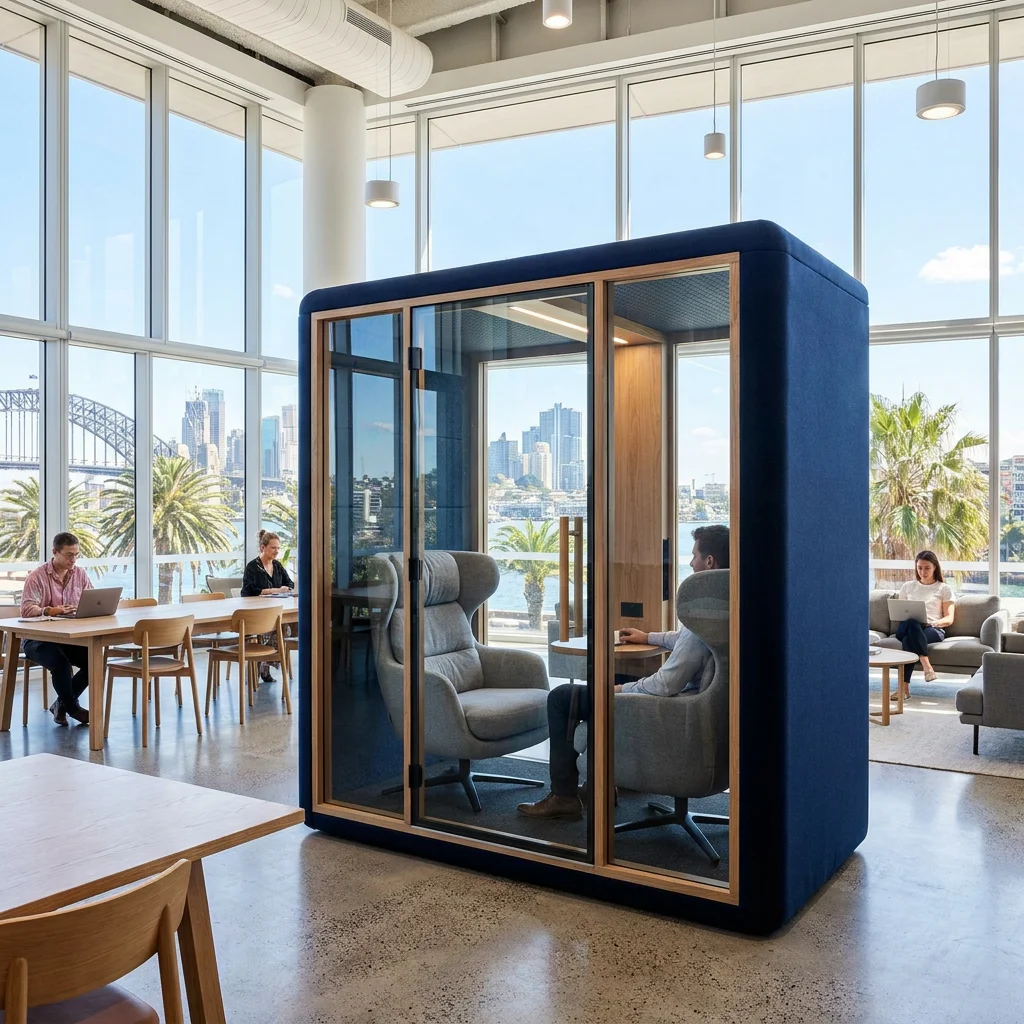
1. Environmental Controls: Design Intent and Supplied Functions
Lighting and airflow controls should be described by the functions supplied in the chosen configuration. The reviewed MobileX records do not establish biometric sensing of cortisol or heart-rate variability, or an AI system that adjusts the pod in response to those measurements.
For a negotiation or focused task, a user may prefer different light levels or fewer visual distractions. Treat that as a user requirement, not evidence that a pod detects stress or that a paint-color reference regulates emotion. Ventilation moves air; it should not be described as supplying oxygen-enriched air.
A rigid chassis provides a physical enclosure, not proof of an integrated computing or building-management system. Evaluate the included controls and their usability separately from proposed effects on fatigue, concentration or time spent in a flow state.
2. Neuro-Inclusive Zoning: Supporting Cognitive Diversity
Different people can have different preferences for sound, light and visual stimulation. Offer a choice of work settings rather than assuming one sensory environment suits everyone or assigning a fixed percentage of the workforce to a single need.
Neuro-inclusive zoning is a planning approach, not a guaranteed product outcome. MobileX supports discussions about finishes and RAL color references, but color choices should reflect the users and task; a blue or terracotta finish does not establish a predictable concentration or creativity effect.
3. Source Manufacturing and Configuration Control
MobileX POD is the export brand of Shenzhen MobileX Technology Co., Ltd., with its factory, office and showroom in Dongguan. Manufacturing and assembly requirements should be tied to the actual configuration; the reviewed sources do not establish a universal 0.05 mm or aerospace-grade tolerance.
Direct procurement provides a route to discuss size, layout, finishes and branding with the manufacturer. Keep those agreed choices in the project specification; the sales channel does not eliminate coordination risk or make every size and finish possible.
Compare the applicable component and assembly requirements.
Identify the selected finish and the parts it applies to.
Evaluate proposed dimensions against the usable layout and access.
4. Total Acoustic Wellness: The Technical Foundation
Factory test data confirmed for MobileX MP1, MP1+, MP2 and MP3 indicates noise reduction of up to 35 dB. This is not an STC, Rw or ISO 23351-1 rating, and it does not guarantee privacy at a particular site.
The Multi-Layered Defense:
- Internal lining: Identify the specified material and mounting; absorption data does not establish low-frequency isolation for the complete pod.
- Glazing: Compare the actual construction and test object; an interlayer does not establish zero resonance.
- Door seals: The specified perimeter details matter, but a seal type alone does not establish zero sound leakage.
For a confidential discussion or video meeting, assess the enclosure together with the proposed location and neighboring listeners. A structural shell or material list does not guarantee that every conversation remains private.
5. Sustainability: Planning for Reuse
Reuse and repair are relevant procurement considerations, but neither a material label nor a relocatable design establishes a ten-year service life. Compare construction, maintenance and written warranty terms without assigning all alternative furniture a two-to-three-year lifespan.
MobileX office pods can be disassembled and reassembled. Include transport, reassembly, inspection and replacement parts in reuse planning. A Scope 3 or lifecycle-carbon benefit needs its own assessment boundary and data; it cannot be calculated from relocatability alone.
6. The Economic Logic: Comparable Supply Scope
Factory-direct and dealer offers may include different services. Compare the required enclosure, furniture, equipment, delivery and installation responsibilities before identifying a saving; no fixed 30-50% advantage against equivalent competitors is established here.
A lower product price can leave room for other needs only after the omitted costs are included. It does not automatically double acoustic capacity, and an unconfirmed AI feature should not be treated as an available budget upgrade.
Conclusion: The Future is Bespoke
A pod can be one part of a workplace that offers settings for different tasks. Combine usable layout, appropriate controls and evidence relevant to the actual sound problem, rather than treating AI-driven wellness as an established MobileX capability.
Choose an enclosed pod when its use and layout justify the investment; retain an existing suitable room when it already meets the task. Design intent should be checked against users’ needs rather than treated as a promised emotional or cognitive outcome.
Frequently Asked Questions
What makes a MobileX Pod “Bespoke Architecture” rather than furniture?
MobileX supplies standard office pods and supports project customization of dimensions, finishes and agreed configuration. A bespoke structure does not itself establish biometric controls, integrated HVAC or a ten-year operating life.
How can lighting choices support different user preferences?
Specify the required light levels, glare control and user adjustment for the task. Preferences vary, and a RAL or Pantone paint reference is not a light measurement. The reviewed evidence does not establish a MobileX AI system that detects fatigue or automatically creates a therapeutic calm state.
What should a factory-direct comparison include?
Compare the agreed configuration and the delivery, installation and support responsibilities. Direct communication can clarify size and finish requests, but it does not establish a fixed saving or unlimited customization.
What does the confirmed MobileX acoustic statement cover?
Factory test data confirmed for MobileX MP1, MP1+, MP2 and MP3 indicates noise reduction of up to 35 dB. This is not an STC, Rw or ISO 23351-1 rating, and it does not guarantee privacy at a particular site.
Are the pods environmentally sustainable for ESG reporting?
Relocation and reuse can be included in a procurement assessment. An ESG or carbon claim still needs an identified method, boundary and supporting data; this article does not establish a certified environmental result or a ten-year carbon saving.
Need a custom modular pod solution?
Send your product type, size, quantity, destination country and customization needs. MobileX team will recommend a suitable model and quotation.