Can an Office Pod Use a Parcel Network? Check Every Package Before Choosing a Sales Channel
An office pod that can travel by freight is not necessarily suitable for a parcel delivery network. Choose a parcel route only when every finished package meets the selected service’s requirements and the carrier and retailer accept the shipment. If a package fails, compare freight delivery with a manufacturer-reviewed redesign. If essential package data is missing, keep parcel suitability unresolved.
This matters when a dealer can receive a large shipment at a warehouse but plans to dispatch individual products to customers. The inbound journey and the final customer delivery are separate purchasing decisions. An attractive factory price does not resolve the second journey.
Define the network before selecting the product
Write down the dispatch country, destination market, named carrier service, delivery method and the retailer’s own receiving conditions. Home delivery, a staffed collection point and a locker can have different limits even under the same carrier name. Record when the rules were checked and which account or contract will be used.
Ask who will confirm acceptance of the actual contents and packaging. A parcel booking form accepting dimensions is not, by itself, proof that the retailer accepts the SKU or that the shipment is eligible for every route. Keep restrictions, required labels, packing tests and any special handling conditions with that decision.
Flat-pack describes how a product is supplied for assembly; it does not identify its delivery network. Workpod’s Australian delivery information, for example, describes truck unloading equipment for flatpack pod boxes. A dismantled enclosure can still contain a large frame, panel or protected glass package. For the assembly decision itself, see flat-pack versus factory-assembled office pods.
Build a package schedule for the exact configuration
Use one row for every package in one complete saleable unit. Identify its contents, outer packed dimensions, gross weight, packing revision and whether the figures are measured or estimated. Include furniture, accessories and protective packing that will actually ship. Do not divide the total shipment weight by the number of boxes: one heavy package can disqualify an otherwise light set.
For each rectangular package, let L be its longest side and W and H the other two dimensions. Where a service uses length plus girth, calculate L + 2W + 2H. Keep the formula visible because sources sometimes use “girth” differently. Follow the selected service’s measurement and rounding instructions, including any irregular protrusions.
The outer shipping package is the object being screened, not the bare panel or the assembled pod. Allowing room for protection can change the result. Gross weight includes the package and its contents; a net product weight is not a substitute.
Compare named services, not a universal parcel limit
The following public examples were checked on 1 November 2026. The sources are DPD Nederland’s Parcel Measurements & Weight page and UPS’s United Kingdom Parcel Dimensions, Size Limits and Weight Guide. The pages did not state an effective date for these sections; the date here records our check. Reconfirm the applicable rules before booking.
Scroll horizontally on a narrow screen to see all four screening fields. These are size and weight examples, not complete acceptance criteria.
| Market and named service | Maximum gross weight per package | Maximum longest side | Maximum L + 2W + 2H |
|---|---|---|---|
| Netherlands — DPD Normal Parcel (NP) | 31.5 kg | 175 cm | 300 cm |
| Netherlands — DPD Parcel Points | 20 kg | 100 cm | 250 cm |
| United Kingdom — UPS Access Point drop-off or delivery | 20 kg | 97 cm | 300 cm |
Passing this table is only an initial screen. Confirm contents, packaging, route, account conditions and the retailer’s requirements separately. A surcharge must not be treated as permission to exceed a service’s acceptance limit. These examples do not establish that any MobileX product qualifies for any of the services.
Screen every package before pricing the route
The example below is hypothetical. Its three packages are invented to demonstrate the calculation; they are not a complete pod packing list or a MobileX configuration. All dimensions are outer packed sizes in centimetres, and the weights are gross weights.
Scroll horizontally to compare the final service column. “Pass” means only that these example dimensions and weight meet the listed numerical limits.
| Example package | L × W × H | Gross weight | L + 2W + 2H | DPD NL Normal Parcel | DPD NL Parcel Points | UPS UK Access Point |
|---|---|---|---|---|---|---|
| A — protected panel | 190 × 70 × 12 cm | 24 kg | 354 cm | Fail: length and combined size | Fail: weight, length and combined size | Fail: weight, length and combined size |
| B — hardware box | 90 × 40 × 25 cm | 18 kg | 220 cm | Pass: numerical screen only | Pass: numerical screen only | Pass: numerical screen only |
| C — desk package | 110 × 60 × 20 cm | 22 kg | 270 cm | Pass: numerical screen only | Fail: weight, length and combined size | Fail: weight and length |
Package B passing does not rescue package A. The whole set therefore cannot be treated as eligible for any listed service on this information. Package C also shows why a product can meet one service’s numerical limits and fail another’s. Removing contents from A could reduce weight while leaving its longest side and combined size unchanged.
Use three result labels in the real schedule: passes the numerical screen, fails a named requirement, or unknown. Missing gross weight is unknown, not zero. Record the remaining acceptance checks beside a numerical pass.
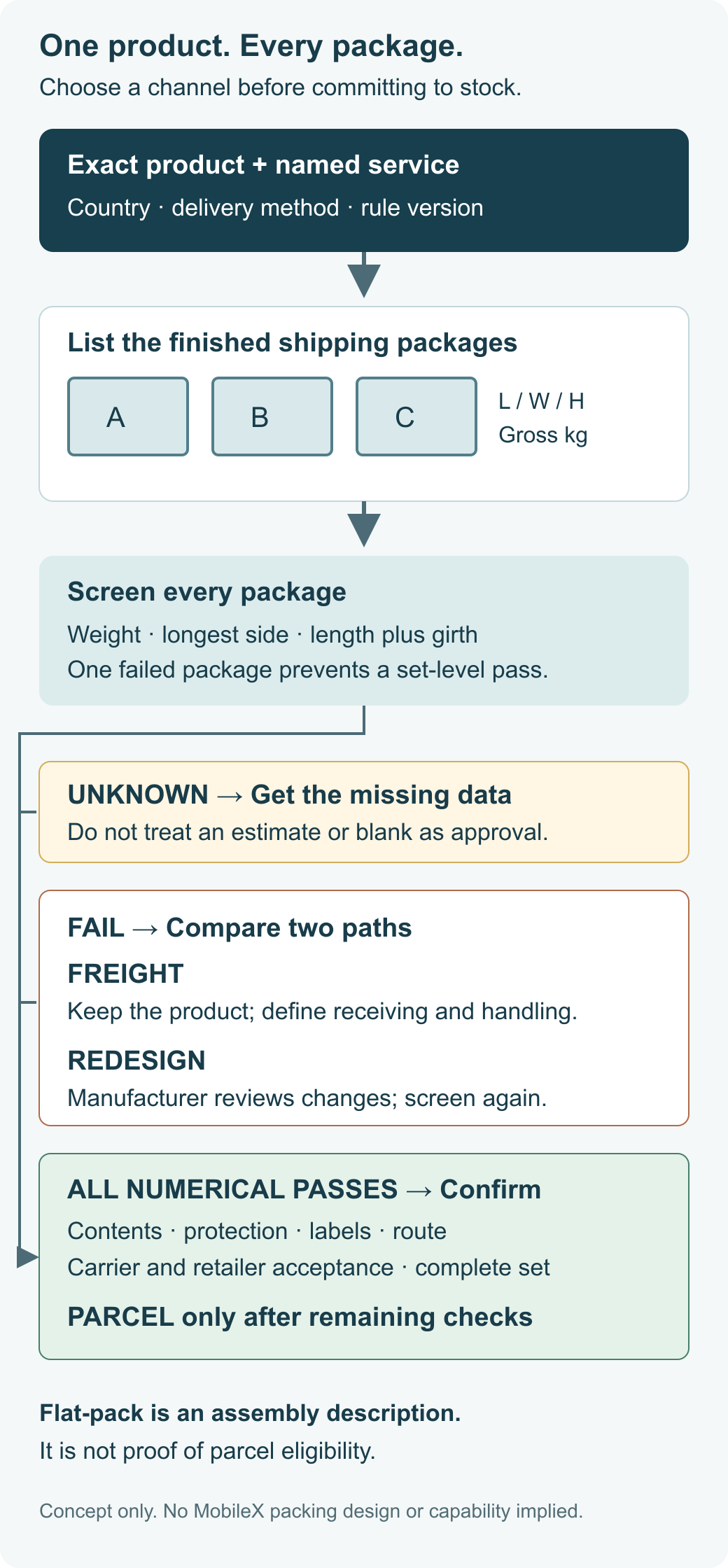
Choose between parcel, freight and redesign
Parcel: a complete set that the chosen channel accepts
Continue with parcel pricing when every package passes the applicable checks and outstanding carrier and retailer conditions are resolved. Confirm how the cartons stay associated as one customer order, what happens if they arrive separately, how missing or damaged parts are handled, and who completes assembly. Include the cost of every package rather than pricing only the largest one.
Freight: preserve the product and change the delivery arrangement
If a critical package cannot use the intended parcel service, compare a freight proposal for the same usable product. Specify unloading equipment, receiving location, appointment arrangements and the onward route inside the building. Freight to a dealer’s warehouse is not a promise of parcel delivery from that warehouse to the buyer. The shipping and installation checklist helps separate these responsibilities.
Redesign: change the saleable unit, then repeat the checks
If the retail channel is essential, ask the manufacturer whether a revised product and packing design is feasible. Identify the largest component that cannot be split under the proposed design. More boxes are not a solution until the parts, protective packing and assembly method support that arrangement.
A changed frame, panel joint or door assembly can create further questions about structure, acoustic performance, electrical arrangements, assembly time and serviceability. Have the responsible parties review the changes and the applicable evidence before treating the redesign as an equivalent product. This is a design project, not permission for the buyer to cut a delivered component.
Compare development cost, packing validation, minimum order arrangements, assembly support and returns against the value of entering the channel. If the revised product or economics no longer suit the buyer, keeping freight or rejecting that channel may be the better purchasing decision.
Compare the cost of a complete usable order
After the route is technically plausible, request a current quotation using the same configuration, package schedule and receiving endpoint. Compare transport, packing, applicable surcharges, unloading or handover work, installation and the agreed remedy for missing or damaged packages. Identify which items remain excluded or unpriced.
Dimensional weight can affect the charge even when actual weight passes the acceptance screen. A billable-weight calculation answers a pricing question; it does not make an oversized package eligible. A dealer should also compare a freight-stock model with a channel-ready individual SKU before committing to inventory. See dealer stock versus project orders for that separate commercial decision.
Send a brief that can produce a usable answer
- Product configuration and quantity, plus the countries of dispatch and final delivery.
- Named carrier service and retailer or sales-channel requirements, with the source and date checked.
- Every package’s contents, outer dimensions, gross weight and packing revision; mark estimates.
- Any failed or unknown condition, and whether freight remains an acceptable alternative.
- Who will receive, assemble, support and handle returns for the complete order.
For a MobileX proposal, request package data for the specific configuration and explain the intended channel through Contact MobileX POD. General export packing or flat-pack supply does not confirm parcel-network eligibility. The useful response is either documented suitability for the stated route, a defined freight alternative, or a scoped redesign assessment.