Temporary Lactation Spaces for Events: Plan Venue Access and the Operating Window
Plan a temporary lactation space around three separate windows: when contractors can install it, when people need to use it, and when the venue requires it to leave. A space delivered before an event is not necessarily ready when doors open, and the end of visitor service is not automatically permission to disconnect equipment or begin removal.
For event organisers and venue buyers, the first decision is whether an existing private room can remain accessible through the required service period. If it cannot, assess a temporary enclosure against the same access and operating requirements. Choose the location and service arrangement before committing to a product, collection slot or rental period. This article does not offer a MobileX rental service.
Start With Who Can Reach the Space, and When
Identify the intended users without asking them to disclose personal circumstances: event visitors, exhibitors, venue employees and contractors may follow different access schedules. A room inside the ticketed area may work for visitors during opening hours but be unavailable to staff before gates open. A room in a back-of-house corridor may be private yet inaccessible to a visitor without an escort.
Mark the route from the areas people will actually occupy. Ask the venue which entrances, lifts and corridors remain available during setup, public service and closing. Distinguish a route being physically open from the user having permission to use it. Include any credential or escort arrangement in the plan, together with the person who can resolve a failed entry.
Define the advertised service window from the intended event use, not simply from the equipment booking dates. Include late sessions, re-entry and any separate exhibitor activity where relevant. Do not infer the number of spaces or a waiting-time target from attendance alone; use the organiser's information about likely demand and agree how unavailability will be handled. For decisions about distributing several locations, use the facility location-coverage guide.
Keep Employee Duties and Visitor Access Separate
In the United States, the Department of Labor's PUMP Act employer guidance addresses covered employees at work. It describes a functional private space, other than a bathroom, available when needed; a temporarily designated space can be an option. An event's public opening hours do not replace the employer's assessment of its own covered employees' needs. This federal workplace guidance is not a blanket rule requiring the same facility at every public event.
Visitor rights also need their own review. As a specific example, New York State Civil Rights Law section 79-e protects breastfeeding in locations where the mother is otherwise authorised to be. Offering a private room should therefore not be presented as a direction that visitors must breastfeed only there. That provision is not a general event-room specification or a statement about every pumping arrangement.
Have the organiser and venue identify the rules that apply to their actual location, premises and users, with appropriate advice where needed. Keep any employee arrangement available beyond the visitor window if the responsible employer determines it is required. A product specification cannot settle these operational or legal responsibilities.
Compare an Existing Room With a Temporary Enclosure
An existing room can be a good option when it can be reserved for the intended use, has a workable approach and remains available for the full service period. Check what else the room normally does. A meeting room used for production briefings between sessions is not continuously available just because it appears on the visitor map.
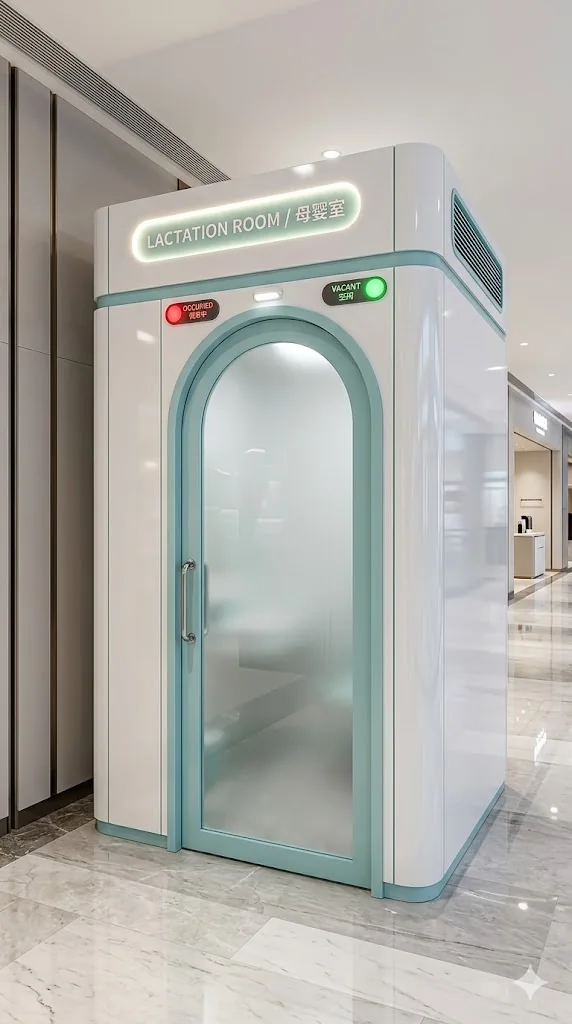
A temporary enclosure can provide a separately defined location when a suitable room is unavailable. It still needs venue-approved positioning, a workable delivery and assembly plan, the agreed site services and someone responsible for operation. Freestanding appearance does not establish that a unit can be moved intact or installed within a particular access slot. The supplier must confirm the selected configuration and preparation requirements.
Compare an existing room and a temporary enclosure.
| Decision | Existing room | Temporary enclosure | Evidence needed before committing |
|---|---|---|---|
| Availability | Can the venue reserve it throughout the required window? | Can delivery, assembly and checks finish before service starts? | Written room allocation or agreed readiness milestones |
| Public approach | Are credentials, corridors and lifts available to the intended users? | Does the proposed position have an approved approach without obstructing other uses? | Marked venue plan and access arrangements |
| Private use | Can the door, sightlines and interruptions be managed? | What door, interior and privacy provisions are included in the proposed configuration? | Actual layout and an operating arrangement, not a reference photo |
| Site services | Are the necessary services available during every required period? | Who provides and checks the connections and any separate equipment? | Venue information and the supplier's included-scope list |
| Daily closure | Can the room be secured and kept free of unrelated storage? | Who protects the enclosure and its contents while the event is closed? | Named overnight owner and reopening procedure |
| End of event | When is the room handed back to its usual use? | Who prepares, removes and collects the unit, and by which deadline? | Handover boundary, removal plan and any unresolved charges |
Do not decide solely by which option has the shorter equipment-hire period. Compare the complete usable service, including site work and return arrangements. Where renting is being considered, obtain availability and terms from the actual rental provider. The rent-or-buy comparison covers that commercial decision; this brief establishes the operating window the offer must meet.
Inflatable, pop-up or rigid pod: choose the enclosure as well as the dates
Once a separate enclosure is needed, compare how it becomes a usable space and how the complete setup leaves the venue. A small packed enclosure is useful for travelling events; a room that can stay fitted out may be more useful to a venue with continuing demand. Neither choice follows automatically from the word “portable”.
An inflatable enclosure can suit a short indoor event when its operating requirements fit the venue. For a concrete example, the Mamava pop-up user guide describes an indoor inflatable enclosure that needs power to remain inflated, directs the host to add a chair and table, and explains packing the enclosure back into a bin. In that arrangement, electricity supports the enclosure itself, not just the user’s equipment. Furniture and other amenities still need their own transport and handling. These details describe that product, not every inflatable design.
A tent or other pop-up package can suit an organiser seeking a temporary service that is assembled and removed for the event. The Pop-up MumPod product page describes a supplier-assembled event space with seating and a changing table. This is a different offer from an enclosure whose furniture the host supplies. A package with more included items may remove coordination work, while an enclosure-only offer can make sense when the venue already owns suitable furniture. Compare the delivered setup, not just the shelter. An outdoor listing for one product does not make another pop-up suitable outdoors.
A rigid modular pod deserves consideration when a venue wants the fitted space to remain between events. Keeping the agreed door, surfaces, furniture and services in place can avoid rebuilding the same temporary setup for each opening. The trade-off is a continuing footprint and a separate installation or relocation operation when the venue needs that area back. A modular assembly is not necessarily a fold-away product or a unit intended for frequent intact moves.
Compare the whole kit after the doors close
Include the enclosure, furniture, signs, loose equipment and their containers in the removal plan. An inflatable shell packed into one bin can still leave a chair, table and supplies to collect. A larger supplier-managed package may include that work, or quote it separately. A rigid pod that remains installed avoids event-by-event removal but continues to occupy the space. This can reverse which option is practical even before prices are compared.
Hypothetical comparison: a conference organiser has no suitable room and must clear the hall after its final session. A pop-up package is worth shortlisting if its complete setup, power arrangements and collection fit the venue. A conference centre with a recurring need and a dedicated position may instead compare purchasing a rigid pod that stays furnished between events. If that position must be cleared for every show, permanent ownership alone does not solve the handling problem. The useful distinction is whether the complete space travels or stays, not simply whether the buyer holds one event or many.
For a MobileX purchase discussion, use the existing lactation-pod enquiry route below and state which parts should remain assembled between uses, which furniture the venue already provides, and whether a continuing position is available. MobileX’s project-based enclosure and interior configuration can then be compared with the actual temporary alternatives, rather than with an incomplete shelter price.
Make Readiness a Handover, Not a Delivery Timestamp
Work backwards from the first required use. Ask the venue for the permitted receiving and contractor-access windows, then ask the relevant suppliers and local contractors whether their agreed work fits those windows. Separate arrival, movement to position, assembly, site connections, cleaning and the organiser's readiness check. Do not assign a standard installation duration without configuration-specific information.
Agree the conditions under which the venue or organiser will accept the space for operation. These may include the approved route being available, the agreed furniture and fixtures being present, door operation checked by the responsible party, lighting and required services available, and cleaning supplies and user information in place. This is an operational handover, not a substitute for professional inspection or local approvals.
Identify a decision maker for a late delivery, missing item or unavailable site service. Record a venue-approved alternative or the process for resolving unavailability; do not advertise an alternative location before its availability has been confirmed. Staff need a way to update visitor information without offering access to a work area that has not been released for use.
For shipment and receiving information, use the packing and delivery-scope guide. If a unit is intended for reuse at another event, confirm its permitted relocation method separately using the whole-unit and disassembly comparison. Neither guide establishes that every pod can be delivered ready assembled.
Assign an Owner to Each Change of State
The person accepting a delivery may not be the person opening the space to visitors. Write down who controls each transition and who can authorise the next one. The table below is a buyer-side operating tool, not a claim that MobileX supplies event staff or follows a universal event-service package.
Assign responsibility across event operating states.
| Operating state | Question to settle | Responsibility and release information |
|---|---|---|
| Build access; not open to the public | Who can enter, move equipment and carry out the agreed work? | Venue access lead; supplier or local contractor; permitted work area and window |
| Ready for service | Who checks the agreed setup and accepts it for use? | Organiser or facilities lead; outstanding items; approval to open |
| Public service | Who handles access questions, replenishment and reports of a problem? | Named operating contact; approved assistance route; method for marking the space unavailable |
| Closed between event days | Who confirms the space is no longer occupied, protects belongings and controls access? | Closing lead; security arrangements; separate employee needs; reopening owner |
| Released for removal | Who confirms users are clear and authorises the agreed preparation and collection? | Organiser and removal contractor; collection window; remaining services and venue handback |
During service, keep supply replenishment and cleaning compatible with privacy. Decide how staff know when entry is appropriate and what happens if the space needs attention while in use. Do not make an unexpected staff entry the default response to a query or assume that a scheduled closing time permits interrupting an occupied space.
Use the lactation supplies guide to separate fixed fixtures, facility stock and personal items. This event plan adds the timing and owner: who brings the initial stock, where replacements are kept, and who checks it before reopening. It does not require visitors to leave personal equipment behind or establish milk-storage or cleaning instructions for that equipment.
For daily closure, agree how lost property, equipment left by users and access to the space will be handled under the venue's procedures. Do not disconnect services simply because public doors have closed: first establish whether anyone is still using the space and whether staff have continuing needs. Any isolation or connection work belongs to the appropriately qualified or authorised people under the applicable equipment and site instructions.
Test the Plan Against a Two-Day Event
Consider a hypothetical two-day exhibition. The venue offers a private meeting room beyond a staff-only door. Its normal booking ends before an evening visitor programme finishes. A temporary enclosure could instead be placed near the public concourse, but contractor access to that concourse closes before the public programme begins. These are planning assumptions, not a customer case or promised delivery arrangement.
The existing room remains a possible choice if the venue can extend the allocation and provide an authorised, usable visitor route throughout the required window. Without those confirmations, labelling the room on a map does not solve the access problem.
The enclosure remains a possible choice if its receiving, installation and handover can be completed within the permitted build window, with the site services and overnight protection agreed. A suitable-looking location does not solve a missed readiness deadline. If neither option can meet the operating requirement, revise the location or arrangements with the venue rather than assuming that faster installation or informal access will make the plan work.
Now test the final evening. The space may need to remain available after some contractors begin removing other event equipment. Confirm an approach that remains usable, which services stay on and who keeps removal activity separate until the space is released. Compare collection on the same evening with later collection only after the venue and provider state what each option permits and costs. No free storage, flexible collection or extension is implied.
Send One Brief Covering Opening, Operation and Exit
Give prospective suppliers and the venue the same requirements, with unknown items visibly pending. A product discussion needs the actual environment and services, not just a request for a portable room by an event date.
- Event and premises: [country, venue, indoor or other proposed environment, marked position and approach].
- Intended access: [visitors, exhibitors, employees or contractors; credential or escort arrangements; responsible organisation].
- Build window: [receiving appointment, contractor access, assembly and site-work period; owner of each task].
- Readiness deadline: [first required use; person accepting the agreed setup; unresolved approvals or equipment].
- Service window: [daily opening and closing; late sessions; separately assessed employee arrangements].
- Configuration: [seating, surfaces, belongings, door and privacy requirements; supplier inclusions versus separately provided items].
- Operating cover: [access assistance, cleaning and replenishment, reporting route, closure and reopening owners].
- Contingency: [venue-approved alternative or decision process if the planned space is unavailable].
- Exit window: [last use, release for removal, disconnection and preparation responsibilities, collection slot and venue handback].
- Commercial boundaries: [purchase or actual third-party rental proposal; additional site work, storage or collection terms still to confirm].
The MobileX lactation pod page is a starting point for discussing a project-specific enclosure and its selected fixtures. It does not establish rental availability, event staffing or a guaranteed build-window duration. Send the venue plan and operating-window brief for a purchase configuration discussion, and have the venue and separately appointed providers confirm the work outside that supply scope.
The useful outcome is a space that can be reached when it is needed, supported while it is open and handed back without confusing the end of public service with the start of removal. Set those conditions first; then compare the room or enclosure that can meet them.