Office Pods for Furniture Showrooms: Plan Customer Trials Before Choosing Display Models
A furniture showroom does not need to display every office pod model to help customers choose. It needs at least one relevant configuration that lets a buyer perform the work behind the purchase: enter and close the door, take a short call, use the proposed work surface, sit with another person when shared use matters, and compare what was experienced with what will actually be quoted.
Choose display samples by customer decisions, not by catalogue coverage. A single-person office pod can demonstrate entry, seated work and call use. A two-person meeting booth can add shared sightlines, table access and conversation. One well-prepared sample may be enough when the dealer can clearly show which observations transfer to another model and which need drawings, specifications or a separate trial.
Define what the showroom trial must settle
Office-furniture brands use showrooms to let visitors compare products and experience settings rather than relying only on photographs. Steelcase’s Asia buying page, for example, describes trying solutions and moving through real work settings, while Haworth’s buying page separates a dealer visit, a showroom visit and consultation with an expert. These are those companies’ routes to market, not MobileX dealer promises.
For an office pod, write down the unresolved customer decision before the visit begins. Is the buyer choosing between a short-call position and a desk-work position? Do two people need to see the same laptop? Is door operation a concern? Does the customer need to compare a standard layout with a quoted custom arrangement? A trial without a decision can become a tour of attractive finishes that leaves the important question unanswered.
The trial should use a representative task without pretending to reproduce the customer’s final site. The same enclosure can feel different beside a quiet consultation desk and beside a busy display aisle. Furniture, equipment and surrounding noise must therefore be recorded as context, not hidden inside a general verdict such as “comfortable” or “quiet.”
Use four short tasks instead of one general impression
Scroll horizontally to compare all columns on a narrow screen.
| Trial task | What the customer actually does | Decision it can support | What it does not prove |
|---|---|---|---|
| Entry and door operation | Approach with normal belongings, open the door, enter, turn, close it, leave and repeat without a staged pose. | Whether this demonstrated door, handle position and approach feel workable for the visitor; which site-access questions still need drawings. | Net doorway size, accessibility compliance, delivery-route clearance or operation of a different door configuration. |
| Short individual call | Sit or stand as intended, place a phone or laptop, make a brief ordinary call and operate visible controls. | Whether the demonstrated posture, surface and control positions suit the intended short task. | A standardized acoustic result, speech confidentiality, performance at the customer’s site or suitability for every user. |
| Desk task | Use representative laptop, notes and input devices together; reach the work surface and change between viewing and typing. | Whether the shown furniture arrangement deserves to remain on the shortlist for that work. | That the same furniture is included in the quotation, or that internal dimensions equal usable desk area. |
| Two-person exchange | Both people enter, sit, view the same screen or document, talk, exchange control and leave. | Whether a shared meeting-booth layout should be compared with a single-person display or a fixed meeting room. | That nominal seat count guarantees the task, that extra equipment will fit, or that the arrangement matches another model. |
Keep each task brief enough that waiting customers can still move through the display. The purpose is to expose a mismatch, not to simulate a full working day. If a customer needs a longer evaluation of a specific configuration before a larger purchase, that becomes a sample or pilot decision rather than a normal showroom demonstration.
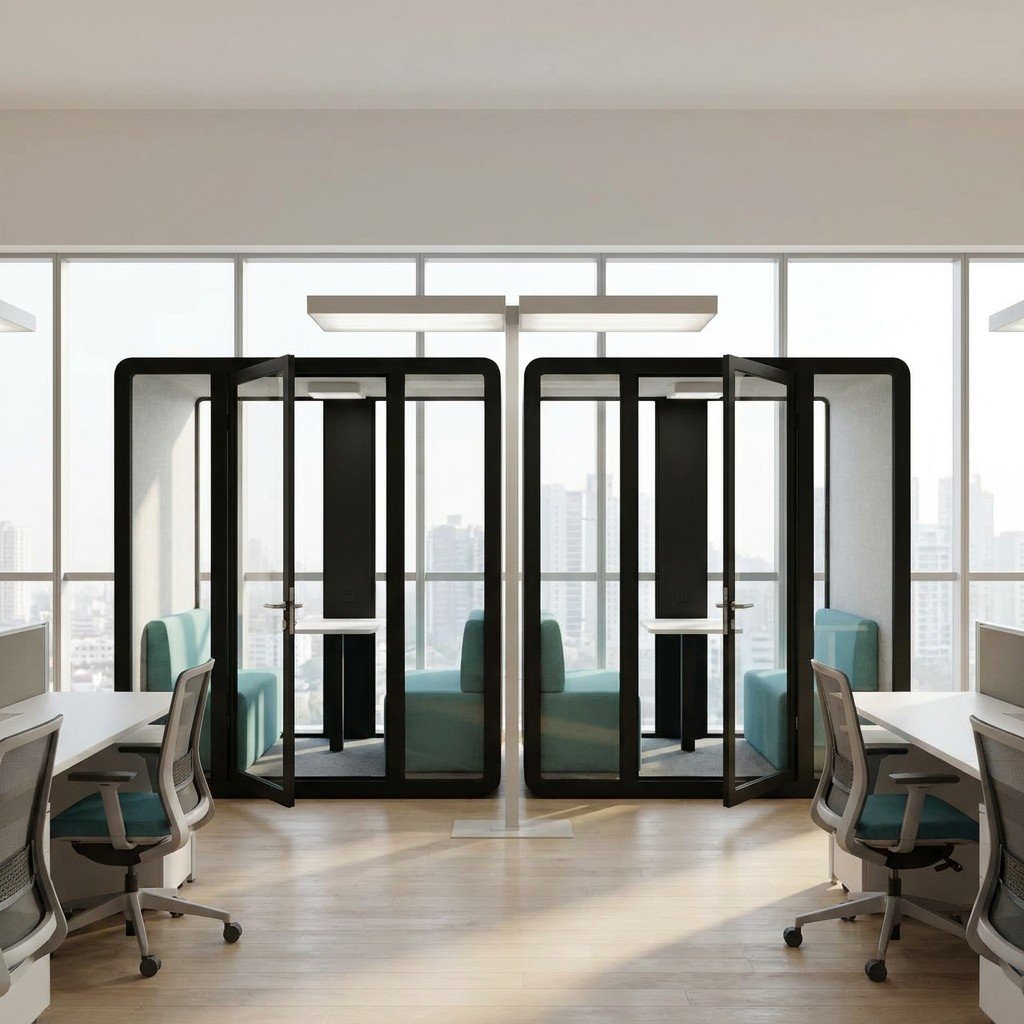
Choose the display sample by the customer jobs it can represent
A showroom serving mostly buyers of individual call spaces can begin with a single-person office pod when that unit lets visitors assess the common call and desk decisions. A dealer whose customers regularly compare shared discussion spaces may gain more from a two-person meeting booth because it can demonstrate both an enclosed individual position and the additional coordination required by a shared table.
Do not choose the largest unit merely because it shows more furniture, or the smallest merely because it occupies less showroom space. Ask which display produces the highest number of useful decisions without suggesting that unshown models behave identically. The MP1, MP1+, MP2 and MP3 comparison is the model-level shortlist; the showroom sample is the physical tool for testing selected tasks.
The registered internal dimension sequences are MP1 880 x 920 x 2080 mm, MP1+ 1120 x 1080 x 2080 mm, MP2 1880 x 920 x 2080 mm and MP3 1880 x 1520 x 2080 mm, supplied by the user on 14 September 2026. Their order is preserved. They are not net doorway sizes, furniture working areas, circulation clearances or accessibility clearances. Use them to identify which physical model is being discussed, not to predict that a customer’s equipment or movement will fit.
All four model families support custom sizes subject to project review. That makes a standard display useful as a reference point, not a physical promise for every custom enclosure. A custom request still needs the proposed size, layout, furniture and relevant interfaces to be reviewed through the custom modular pod route.
Arrange the people around the sample, not only inside it
A useful display needs a small operating zone. The person inside must be able to complete the task without the demonstrator leaning into the doorway. The next visitor needs a clear waiting point outside the approach path. A staff member needs a position from which to explain controls, observe a problem and compare the displayed configuration with the proposed quotation.
Avoid placing a queue directly across the glazing if the trial is meant to help a visitor judge visual comfort. Avoid making the only staff position the same place where the door opens. Keep loose samples, catalogues and bags out of the entry path. If the showroom cannot provide a workable approach around the sample, that problem should be visible in the display plan rather than solved by directing every visitor through an artificial route.
Appointment-led product showrooms often provide a staff member to guide the visit. Framery’s public showroom page, for example, lists its own and dealer locations for trying its pods, while Steelcase describes scheduled visits to WorkLife Centers and dealers. Those examples show that guided access is a real showroom pattern; they do not establish a MobileX dealer network, staffing level or appointment policy.
Run the same sequence for every serious buyer
- State the task: record whether the visitor is testing a call, desk work, shared discussion or door operation, and note any representative equipment being used.
- Identify the display: name the model or reference configuration actually on the floor, including the furniture and visible options present for the trial.
- Let the visitor act: the buyer completes the task before the demonstrator explains alternatives. This prevents a product tour from replacing the customer’s own observation.
- Record a specific finding: use statements such as “both participants could view this laptop on the shown table” or “the visitor wants a different seated position,” not a universal score.
- Map the finding to the offer: state what is the same in the proposed quotation, what is different and what remains subject to specification or project review.
A dealer may decide to keep a simple trial sheet, but it should not collect unnecessary personal information. The useful record is the task, demonstrated setup, observed mismatch and next decision. It does not need a recording of the customer’s call, the content on their screen or a manufactured satisfaction score.
Treat showroom sound as context, not a test report
Closing the door on a busy floor can help a visitor form a subjective impression of that displayed unit in that showroom. It can also reveal practical issues such as whether the person can operate the door and controls while using the proposed furniture. It cannot verify a published decibel claim, establish a formal sound rating or predict speech privacy after installation elsewhere.
Do not turn a phone sound-level reading, a before-and-after video or a visitor’s reaction into a substitute for standardized evidence. The source level, distance, background noise, device, room and test object all affect what is observed. Use the office pod acoustic-ratings guide when a buyer needs to examine the test object, method, configuration and result.
A competitor’s showroom statement is equally limited. One pod supplier publicly invites visitors to make a call and experience the size in its own showrooms. That confirms the availability of that supplier’s trial, not the acoustic performance of MobileX products or an industry-wide test procedure. Keep a MobileX showroom demonstration focused on task fit and identify formal evidence separately.
Separate the display configuration, quoted configuration and custom request
Before discussing price, place the three configurations side by side. The display configuration is the physical unit the visitor tried, including its actual furniture and options. The quoted configuration is the product, furniture, electrical scope and other items included in the current offer. The custom request is any change still under review, such as another size, finish, layout or branding detail.
Use plain differences rather than saying the quotation is “similar.” For example: the visitor tried the displayed two-seat table; the offer uses another confirmed table arrangement; the requested screen mount is not included and remains subject to review. If the door, control position or interior layout changes, identify that the relevant trial finding may not transfer unchanged.
Furniture and equipment shown in a product-setting image or showroom are not automatically included. Compare the actual quotation line by line. The quotation-scope guide explains how to separate base product, options and destination work; this showroom guide explains how the physical demonstration should feed that comparison.
Know when one sample and supporting material are enough
One sample can support several sales conversations when it resolves recurring physical questions and the differences to other offers are documented. A single-person unit may let customers judge entry, door operation and an individual work position. Drawings, dimensions, finish samples and configuration sheets can then explain other standard models without pretending the visitor physically tried them.
Add another display when it answers a different high-value task that the first cannot represent. A genuine two-person discussion around a shared surface is not demonstrated by showing two people a photograph of a larger model. Likewise, a second finish alone may be handled with accurate material samples rather than another complete enclosure, unless seeing the full treatment is itself a repeated buyer decision.
A showroom trial is not a pilot at the buyer’s site. When the unresolved decision depends on actual placement, local users, surrounding noise, site services or repeat-order approval, move to a separately agreed sample or pilot process. The pilot review guide covers that later stage.
Illustrative showroom choice
A dealer expects most visitors to compare one-person calls with two-person project discussions. Instead of placing all four model families on the floor, it displays one checked two-person meeting booth and keeps an accurate single-person model sheet, finish samples and current configuration notes nearby. Visitors perform an individual laptop task and then a two-person screen-sharing task in the displayed unit. The dealer records which observations apply only to that display and routes single-person buyers to the corresponding product information. This is a planning example, not a MobileX showroom, dealer policy, customer project, measured acoustic result or recommended display quantity.
Choose the purchasing route after the trial
A successful demonstration should narrow the next decision. For individual calls and checked desk work, continue with the MP1 and MP1+ office pod route. For two-person or four-person shared discussion, continue with the MP2 and MP3 meeting booth route. If the customer needs a layout outside the standard starting points, use the custom route with the trial finding attached.
The dealer-versus-factory guide remains the place to compare who provides the demonstration, configuration communication, delivery coordination and local services. A useful showroom does not by itself establish inventory, installation support, exclusivity, discounts or after-sales scope. Those are offer-specific questions.
Send MobileX the customer task, display model and observed mismatch when a factory quotation or custom review is the next step. Include the configuration the visitor actually tried and the aspect that must change. That turns a showroom impression into a specific product decision without turning the visit into a performance claim.