Buying an Office Pod for a LEED Project: What to Put in the Bid Before You Order
If your brief calls for a “LEED-certified office pod,” ask the project’s LEED lead to name the requirement before you shortlist booths. LEED certifies projects, not individual pods. To release an order, match the quoted enclosure, furniture and finishes to the documents your reviewer needs, and separate delivered product cost from on-site work.
Which parts of this purchase belong in the submission?
Suppose a tenant is buying two single-person phone booths and a four-person meeting pod. The architect has asked for pricing for a LEED v4 Interior Design and Construction (ID+C) fit-out. The dealer offers one installed price. Facilities already owns suitable meeting furniture. Before comparing the bids, the buyer needs two answers: which furniture is actually in each offer, and which items the project team wants documented even if the tenant supplies them.
For this example, the USGBC LEED v4 ID+C guide includes furniture within the project’s scope in Materials and Resources calculations. For product cost, it includes the contractor’s taxes and costs of delivery to site, but separates subsequent installation labor and equipment. The v4 Building Design and Construction guidance treats furniture differently in certain materials calculations. Have the project team confirm the specific credit and calculation method in writing before using these cost boundaries. Do not transfer this v4 example to a v5 project or classify a demountable enclosure from a photograph.
Build the bid schedule around the actual configuration
For the example, start with an MP1 for each call station. Its reference configuration includes one work surface and one seat; confirm the seat type on the drawing. The four-person MP3 has a different purchasing boundary: the sofa and table set is quoted separately. If the tenant supplies that furniture, keep it in the project inventory with the tenant as the contact. Removing a line from the pod vendor’s price does not settle its treatment by the project team.
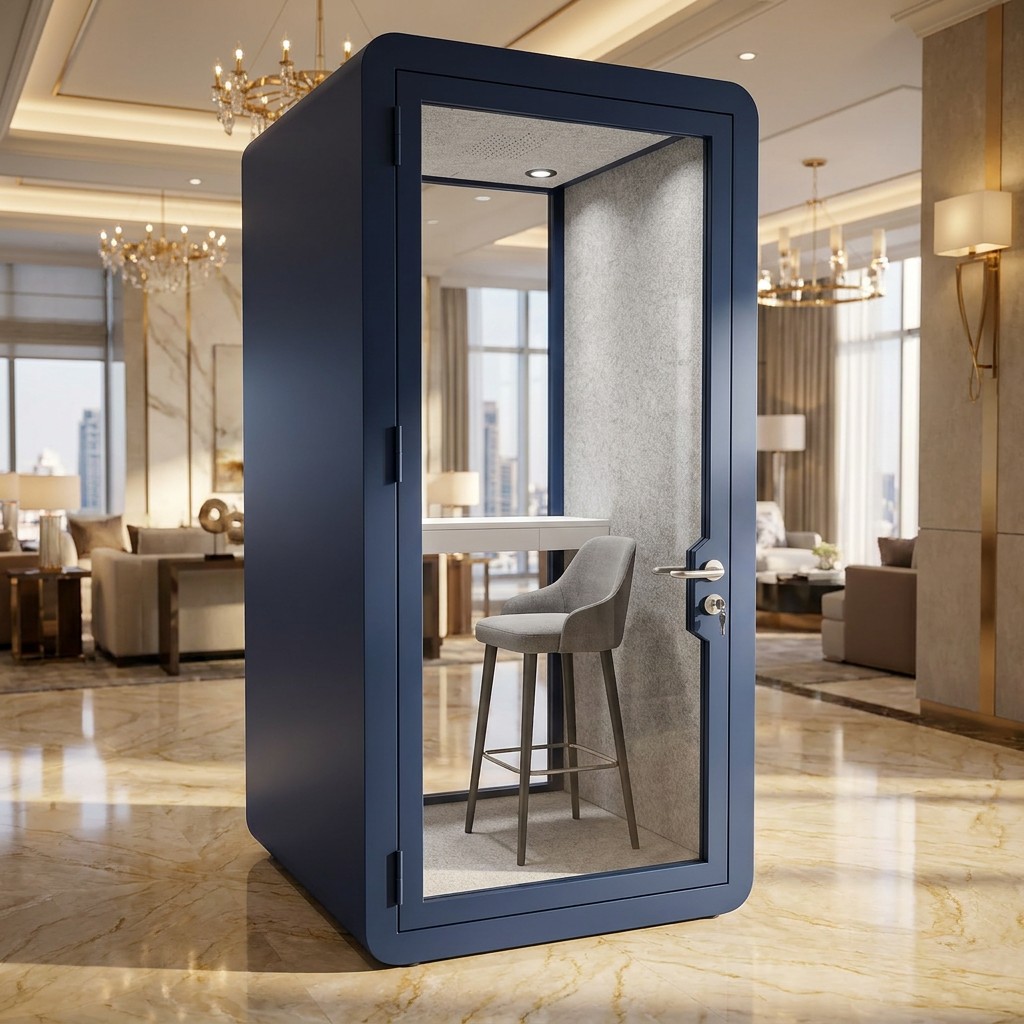
Send the same schedule to both bidders. Use separate rows to identify what a document covers, not to assign each part its own LEED product count. If a desk, seat or delivery charge is already in an assembly price, mark it “included in line …” rather than counting the cost twice.
| Quote line | Supplier return | What the buyer checks |
|---|---|---|
| Two MP1 enclosures, desks and seats | Supplier returnModel, quantity, drawing revision, finish codes, seat reference and product price. Mark included furniture. | Buyer checkCan the reviewer identify both the enclosure and the actual seat in the documents supplied? |
| One MP3 enclosure | Supplier returnPrice the enclosure alone. List the alternative sofa and table as an option. | Buyer checkKeep the factory option out of the base total if the tenant is supplying furniture. Assign someone to document the tenant’s selection. |
| Delivery to the named site | Supplier returnState the delivery endpoint, contractor-incurred delivery charges and taxes already included or still to price. | Buyer checkReconcile them to the delivered product figure. An EXW figure alone is not the delivered figure. |
| Work after arrival | Supplier returnIdentify on-site labor and equipment, including assembly, and any locally arranged services. | Buyer checkKeep them in the installation budget, separately from the v4 ID+C product-cost figure. Ask the reviewer to resolve a bundled charge. |
What should the reviewer do with a partial report?
Suppose the project brief asks for emissions evidence for the specified interior finish. Bid A supplies a report naming a lining; its offer also includes upholstery. Record the lining reference beside that report and leave the upholstery evidence open. Bid B offers an environmental product declaration for a material. That declaration describes environmental impacts within its stated boundaries; it does not answer an emissions-test request simply because it names the same material. Ask the reviewer which evidence they will accept for the outstanding item.
Give each required item a simple record: quoted item and finish → document ID, issuing body and covered variation → reviewer’s decision and date. “Received” means a file arrived. “Matched” means someone found the offered variant in its scope. “Accepted” means the designated project reviewer has cleared that requirement for purchasing. A missing file is an open question, not proof of poor performance; a brochure logo is not an acceptance decision.
Would a finish substitution reopen the purchase?
In this hypothetical order, the designated purchasing reviewer has accepted drawing revision B with seat fabric F-01. Revision C substitutes F-02. Send the reviewer both fabric codes, revisions B and C, and the supplier’s document showing exactly which fabrics it covers. If the document explicitly covers F-02 and the reviewer confirms acceptance of revision C, release the affected seat line and record that decision against C. Otherwise, retain the accepted F-01 on the order, or hold the changed line until the missing evidence and the reviewer’s confirmation are in hand. Keep the earlier acceptance with revision B.
Copy this request into the quotation
Our project is registered under [system and version]. Our reviewer requires [credit, route and named evidence] before we release the order. Quote [models and quantities] against drawing [revision], including the selected finishes and furniture references. Identify included and buyer-supplied items, delivered product cost to [site], and the separate cost of work after arrival. For each required document, identify the covered item and variation or mark it unavailable. Flag substitutions before manufacture so our reviewer can approve the revised offer.
For the broader environmental comparison, use the guide to office pod materials and reuse. For an order under review, send MobileX the project requirement and marked-up bid schedule. Ask which documents are available for that configuration before making them a purchase condition. No model-specific LEED award, emissions report, EPD or project points are assumed here.