Office Phone Booth Price Guide: What Project Buyers Should Compare Before Ordering
MobileX’s published single-person office phone booth references are USD 1,380 EXW for MP1 and USD 1,650 EXW for MP1+. Both list one work desk and one seat as included. These July 19, 2026 reference figures are a starting point for comparing configurations, not current delivered-and-installed offers. The practical price decision is whether MP1+ solves a layout need worth its USD 270 reference difference, and what it will cost to put either option into use at your destination.
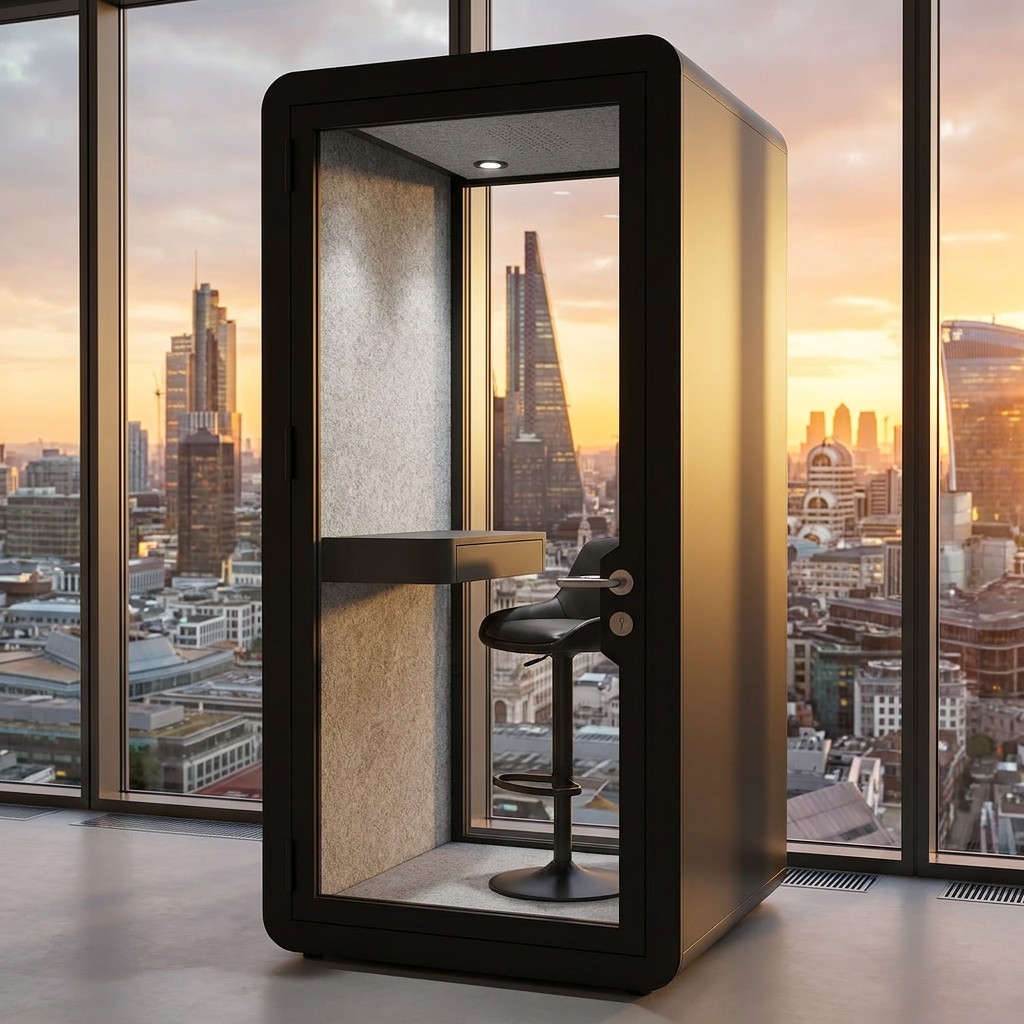
For office fit-out contractors, furniture dealers, coworking operators and workplace project buyers, office phone booths and meeting booths should be evaluated as project equipment, not only as a visual product. The right quotation depends on the application, size, interior function, electrical configuration, export packing and installation environment.
This guide explains what buyers should compare before sending an inquiry to MobileX POD.
Compare the two single-person price starting points
| Compare | MP1 Office Pod | MP1+ Phone Booth |
|---|---|---|
| Published reference EXW price | USD 1,380 | USD 1,650 |
| Desk and seat | One work desk and one seat included | One work desk and one seat included |
| External dimensions | 1000 x 1000 x 2200 mm | 1200 x 1200 x 2200 mm |
| Published internal dimensions | 880 x 920 x 2080 mm | 1120 x 1080 x 2080 mm |
Prices are dated July 19, 2026. Use the current model drawing to confirm dimension orientation and the selected furniture layout. Internal enclosure dimensions are not clear movement space after the desk, seat and equipment are installed. A desk-and-seat inclusion does not establish that every pictured accessory or a different furniture choice is included.
What does the USD 270 difference buy?
The published comparison establishes a larger enclosure for MP1+, not an extra occupant or an automatic acoustic upgrade. Both are single-person models. Compare the proposed desk, chair and device arrangement: if MP1 supports the required work and fits the site, MP1+ is not necessary simply because it has a higher price. If the MP1 arrangement cannot accommodate the work, evaluate MP1+ against that specific limitation. A larger empty interior is a reason to review a layout, not proof that a particular monitor, chair or posture will fit.
Keep the furniture basis consistent. Do not add a second generic desk-and-chair allowance when the quoted configuration already includes the required set. If you want different furniture, ask whether it replaces the included items and how that changes the offer; do not assume a credit or an upgrade price. The same principle applies to finish, electrical and device-interface changes.
Can the reference price fit your complete budget?
Illustrative budget test, not an offer: with a USD 1,500 total spending limit for one operational call space, the MP1 reference leaves USD 120 before any separately charged options, transport, taxes and site work. That arithmetic does not establish that the purchase can be completed within the limit. MP1+’s reference already exceeds it before those costs. Obtain the missing amounts before treating either model as a ready-to-use budget answer.
Compare a factory reference with another supplier’s offer only after identifying the same endpoint and included configuration. A higher amount that includes delivery or assembly may cover work missing from a lower headline figure; it is not automatically more expensive for the completed task. Equally, do not assume a delivered offer covers unloading, movement to the room or building connections unless it says so.
For the next price request, choose the single-person layout to quote, identify any furniture or electrical changes, and give the destination and required handover point. Ask for the base model, changes and remaining delivery/site work to be distinguished. The sections below cover mixed-model projects, quantity offers and the wider enquiry details without treating a meeting-booth seat as a separate private call space.
1. Start With the Real Application
The first question is not only “how much is it?” The better question is: what problem should the pod solve?
Typical application:
private calls, video meetings, focused work and small meeting areas inside open offices.
A dealer in the United States may start with one MP1 sample and one MP2 meeting booth to test market response. A contractor in the Middle East may need multiple MP2 and MP3 booths for a corporate fit-out. A coworking operator in Southeast Asia may prefer a mixed layout with single-person and two-person pods.
Before comparing suppliers, write down the main use case, expected user capacity, installation location and target market. This helps the factory recommend a more practical structure and avoids quoting a product that looks good but does not match the site.
2. Prepare a Buyer Checklist Before Requesting Price
Project buyers can save time by preparing the key details before asking for a quotation:
- Confirm the user capacity before comparing price.
- Ask whether socket, voltage and plug type match the destination country.
- Confirm packing size, gross weight and container loading plan.
- Separate standard model price from custom color, logo or electrical options.
If you already have a reference photo, floor plan, site photo or rough drawing, send it together with the inquiry. For export orders, destination country matters because socket, voltage, packing and shipping discussion can change the final quotation.
3. Understand the Pricing Logic
MobileX POD can share reference prices for some standard products, but final project pricing depends on configuration.
- MP1 Office Pod reference EXW price: USD 1,380
- MP1+ Phone Booth reference EXW price: USD 1,650
- MP2 Meeting Booth reference EXW price: USD 2,380
- MP3 Meeting Booth reference EXW price: USD 3,650
For overseas buyers, EXW price is only the starting point. A complete budget should also consider packing, inland transport, sea freight, duties, local delivery, unloading and installation if required.
Once the complete project scope is priced, compare buying office pods with your own funds or equipment financing to identify the cash still needed and the payment conditions before ordering.
Does a lower unit price justify buying more office pods?
Buy the quantity that serves an identified need. A lower price per pod can make a larger order worth comparing, but it does not mean that ordering extra units reduces the amount you spend. Ask for two complete offers: the quantity you need and the larger quantity being proposed, with the same configuration and delivery boundary. Compare their total commitments before comparing their average unit prices.
First establish where the lower price applies
Does the proposed price apply to every unit in the order, only to units above a stated quantity, or only to a particular model and configuration? Those are different offers. If the order mixes single-person office phone booths and meeting booths, do not assume the combined count qualifies each line for the same price. Ask the supplier to show quantity, unit price and line total for each configuration. A minimum order quantity is also different from a discount threshold: it says what can be ordered, not what saving is available.
MobileX’s published model prices above are reference EXW figures, not a quantity-discount schedule. Neither this comparison nor a larger enquiry establishes a discount, reserved production capacity, free storage or a right to change the order later. Use the actual dated offer for those terms.
Compare the extra commitment, not just the headline saving
Hypothetical arithmetic example, not a MobileX quotation. A buyer needs four identical call spaces now. Offer A prices four units at USD 2,000 each, plus an illustrative USD 500 order-level charge for a defined service scope: USD 8,500. Offer B prices five units at USD 1,900 each, with the same USD 500 service scope: USD 10,000. All other costs are excluded from this simplified example and remain to be compared.
B has a lower quoted unit price, but commits USD 1,500 more to acquire one additional unit. Its USD 2,000 average across five purchased units is not the cost per currently required call position: only four positions are needed in this example. Allocating the whole commitment to those four positions gives USD 2,500 each, compared with USD 2,125 under A. That allocation is a planning lens, not the market value of the fifth pod or proof that it has no future use.
The wording of the discount also changes the arithmetic. If USD 1,900 applies only to the fifth unit while the first four remain USD 2,000 each, the total including the same illustrative charge is USD 10,400, not USD 10,000. Have the quotation state which calculation applies rather than relying on a percentage or a lowest advertised unit price.
Give the additional unit a real destination
A larger order becomes a stronger option when the additional unit has a credible task, a suitable location and an agreed route into use. Compare the extra commitment with a separate later purchase using current offers, without assuming that today’s price, freight cost or configuration will remain available. If the need is uncertain, keep that uncertainty visible instead of assigning the extra pod a full-time use merely to make the larger order look economical.
For units not installed immediately, obtain the actual holding and onward-delivery scope. Compare any additional handling, suitable storage, later movement, assembly and connection work, with the responsible parties identified. Confirm when contractual coverage starts for a held unit. Do not assume the factory will hold it, that a crate is suitable for an indefinite storage period, or that the buying team has already arranged local installation. These are costs and terms to establish, not benefits implied by buying in bulk.
Choose the larger order when its additional usable capacity and complete terms justify the extra commitment. Keep the smaller order when the extra units have no established purpose or when the larger order depends on unresolved receiving arrangements. For an initial MobileX enquiry, the required quantity, any plausible later requirement and the destination are enough to start this comparison; request separate quantity options rather than inventing a target discount.
4. Customization Options Buyers Usually Ask For
MobileX POD is positioned as a premium design, factory-direct and customizable modular pod supplier. Common customization questions include:
- Can the size be adjusted for the project site?
- Can the color or exterior finish match the buyer’s brand?
- Can the logo be added for a distributor or project owner?
- Can socket, voltage and electrical layout match the destination market?
- Can the interior function be adjusted for the actual daily workflow?
For many projects, the best solution is not a completely new structure. It is often more efficient to start from an existing MobileX product line and customize the size, finish, electrical details or interior layout.
5. What to Send MobileX for a Faster Quote
To make quotation faster, prepare these details:
| Item | Why it matters |
|---|---|
| Product type or reference photo | Helps identify the closest standard model or custom direction |
| Target size | Determines structure, material use and packing volume |
| Quantity | Affects production planning and price discussion |
| Destination country | Affects socket, voltage, packing and shipping discussion |
| Interior function | Helps define furniture, counter, seating, lighting and device layout |
| Color and logo request | Helps confirm surface finish and branding work |
If the project is still early, it is acceptable to send only a reference image, approximate size and destination country. MobileX can then help clarify the next questions.
6. Related MobileX Product Page
For specifications, buyer checklist, pricing notes, customization options and FAQ, review the MobileX office pod buyer guide: Office phone booths and meeting booths.
You can also send project details directly through Contact MobileX POD. Include size, quantity, destination country, application and any reference image if available.
FAQ
Can MobileX customize this product for my project?
Yes. MobileX can discuss custom size, color, logo, socket, voltage, interior layout and project-specific function depending on the product type and destination market.
Can I order one unit first?
For many products, MOQ 1 is accepted. This is useful for dealers, contractors and project buyers who want to test a sample before a larger order.
How long does production usually take?
Standard products usually take about 15-20 days. Custom products usually take around 30 days after the specification is confirmed.
What information should I send first?
Send the product type, target size, quantity, destination country, application scenario and any reference photo or drawing. This helps MobileX prepare a more accurate quotation.