Ice Supply for a Drinks Kiosk: Make It On Site or Bring It In?
A drinks kiosk can make its serving ice inside the unit or receive it from a supporting facility or an ice supplier. The first arrangement brings production equipment into the working space. The second replaces that equipment with a supply route, receiving work and storage. Neither removes the need to have usable ice at the counter when customers arrive.
Choose the supply arrangement before fixing the under-counter layout. For operators, project contractors and equipment dealers, the useful comparison is not simply an ice machine versus no machine: it is production, storage and replenishment working together through the busiest part of the day.
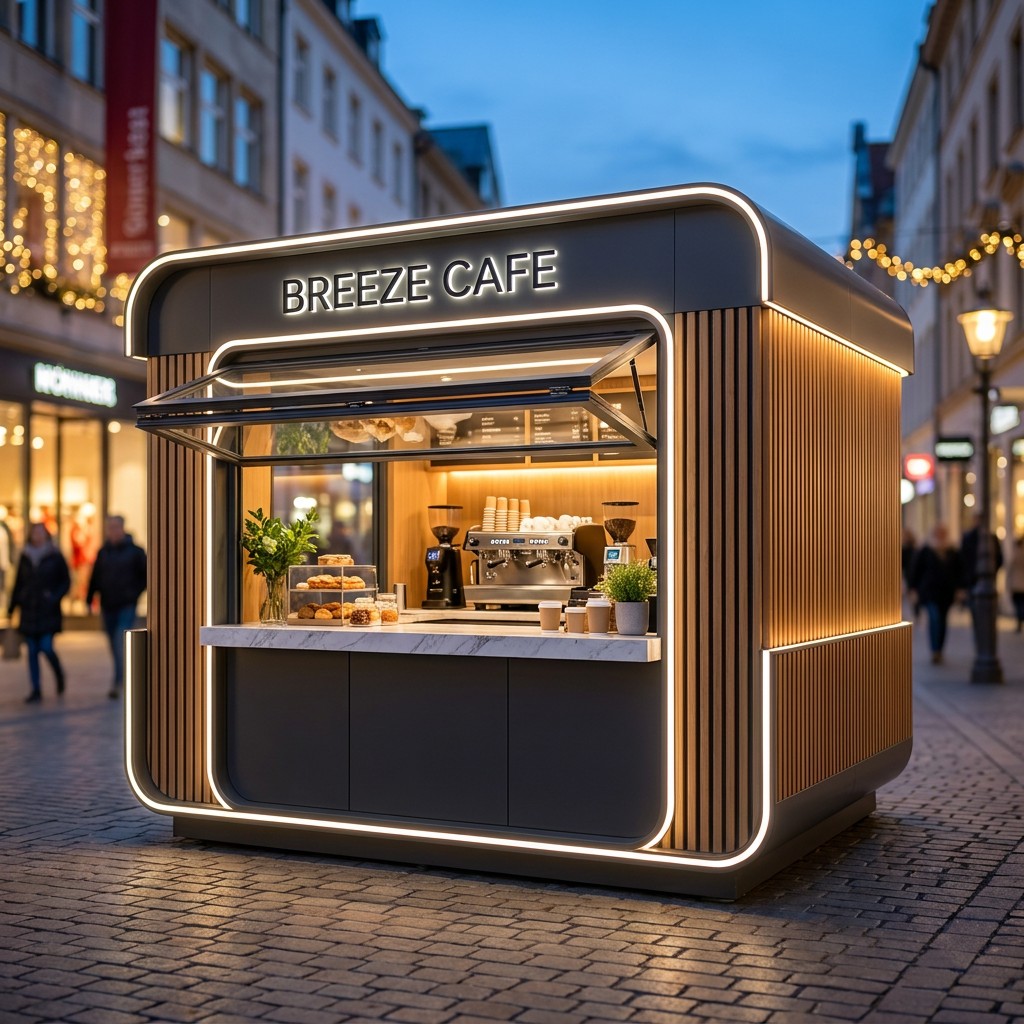
Separate production, storage and the busy period
Ice production is an amount made over a stated period under stated conditions. Storage capacity is how much a bin can hold, not how much ice it produces. Peak demand is what the operation takes out during its busiest interval. These quantities answer different questions and should not be compared as if they were three versions of the same capacity.
For a concrete equipment example, the Hoshizaki IM-200BAK specification, dated October 1, 2025, lists 186 lb per 24 hours at 70°F air / 50°F water and 150 lb at 90°F air / 70°F water, with a separate rated storage capacity of 75 lb. These are that manufacturer’s figures for that model, not a MobileX selection or a kiosk output promise. They show why a daily-production number cannot also be the amount waiting in the bin.
Start with the intended drinks and service pattern, using the operator’s measurements or an equipment specialist’s assessment rather than an assumed amount of ice per cup. For each busy interval, compare usable stock at its start, ice that can actually be produced or delivered before it is needed, and withdrawals plus losses. Do not turn a daily rating into guaranteed hourly output by dividing by 24. Check what remains afterward and whether the arrangement can recover before the next rush.
Make ice inside when local replenishment is the stronger arrangement
On-site production is worth comparing when the outlet trades regularly, a suitable machine can operate in the proposed environment, and relying on repeated deliveries would be difficult. It keeps production near service but uses equipment space and brings installation and maintenance into the kiosk project.
A machine with a built-in bin combines two functions in one unit, but its production and storage are still separate limits. A modular machine and a separately selected bin allow a different combination. Scotsman’s B842S storage-bin page illustrates separately specified storage and model-specific adapter options. Do not assume that any machine fits any bin, or that a larger bin will fit under the same counter.
Choose more usable storage when the main constraint is a concentrated rush and enough ice can be accumulated beforehand. Choose additional production capacity when the system cannot replace what is used across repeated service periods. Sometimes both need to change. An oversized bin does not create ice, while a higher-output machine may still leave the counter short if the usable stock or recovery time is inadequate.
Bring ice in when the supporting supply and route can do the work
External supply can suit a kiosk supported by an existing venue or a dependable delivery arrangement. It can release the space and services needed by the ice-making machine, but the kiosk still needs suitable receiving and serving storage. Bulk reserve stock and the ice within the operator’s reach need not occupy the same container or location.
Compare the actual transfer: who brings the ice, in what containers, through which door, and when. A nearby machine serving another business is not spare capacity until its own demand and access hours are accounted for. A route that works before opening may not work through a customer queue. If a transfer cannot take place during the rush, the usable stock already at the kiosk must bridge that interval, allowing for losses.
Hypothetical planning example, not a MobileX project: a venue adds a cold-drinks counter with a short interval between two visitor peaks. One proposal uses a compact machine with an integral bin; another brings ice from the venue’s preparation room. The first needs enough starting stock and recovery between peaks. The second needs a transfer that can be completed without leaving the only service position unattended. A larger machine’s daily rating does not settle the first question, and a nearby preparation room does not settle the second. Compare a different production-and-bin combination with a workable replenishment arrangement before deciding that the enclosure must be larger.
Reserve working space, not just a box on the plan
Check how the selected storage equipment preserves ice and accounts for meltwater. Scotsman’s B842S page describes insulated storage; it does not establish the usable stock remaining at your next service peak. Ask the equipment provider to confirm the storage arrangement and installation conditions for the proposed kiosk.
Show the selected machine’s air path and service access as well as its cabinet. Leave room to open the bin, scoop or transfer ice, and clean the equipment without occupying the payment position. A decorative counter panel must not cover a required air opening. Use the selected manufacturer’s installation and maintenance instructions for the actual environment, water, drainage and access requirements; this comparison does not prescribe universal clearances or cleaning intervals.
Removing the ice machine does not establish that the kiosk needs no water or drainage: the chosen storage equipment, other appliances and operating tasks still determine those provisions. Use the existing kiosk equipment and water-supply guide to define the interfaces after choosing the ice arrangement.
Compare complete costs for the same service requirement
For on-site production, price the selected machine and storage combination, any specified adapters or treatment equipment, installation, connections, and the enclosure changes needed to accommodate them. Include the actual utility, cleaning, maintenance and staff-handling costs over the intended operating period. Keep an outage supply arrangement visible rather than assuming the machine will eliminate every outside purchase.
For external supply, include the ice or additional supporting-facility cost, delivery charges or staff transfer time, containers, receiving and serving storage, losses and cleaning. Existing venue equipment is not a free resource if this outlet displaces its capacity. Conversely, do not charge the kiosk for the entire existing facility when only a defined additional service is required. Use actual quotations and operating records; there is no universal cheaper option.
Compare both proposals for the same drinks, opening hours and busy-period service. Name who supplies the enclosure, ice equipment and storage, who installs and commissions the equipment, and who runs replenishment and maintenance. An unpriced task remains an open cost, not a zero-cost inclusion.
Develop the kiosk around the chosen ice arrangement
MobileX can customize an outdoor kiosk’s dimensions, exterior and working layout, prepare agreed interfaces for customer-supplied equipment, or supply a complete agreed package. The project drawings and quotation identify the actual equipment and work included. The equipment examples here do not establish a standard MobileX ice system or verified compatibility.
Explore the outdoor commercial kiosk range and discuss your drinks-kiosk project with the menu, trading pattern, site and destination you already know. If the supply method or equipment is undecided, that is a useful starting point for comparing layouts, not a reason to postpone the first enquiry.