Meeting and Training Room Layouts: Fixed Table or Reconfigurable Furniture?
A fixed meeting table is a useful starting point when the same small group regularly works around one shared surface. A room used for front-facing instruction, paired exercises and group discussion needs a different comparison: can one furniture arrangement support all three, or must the tables and seats move between sessions? Choose the operating layout before ordering a larger enclosure.
This guide is for facilities buyers, design teams and furniture dealers specifying a meeting or custom project room. It compares furniture and room arrangements, not learning outcomes or a standard MobileX training-building package.
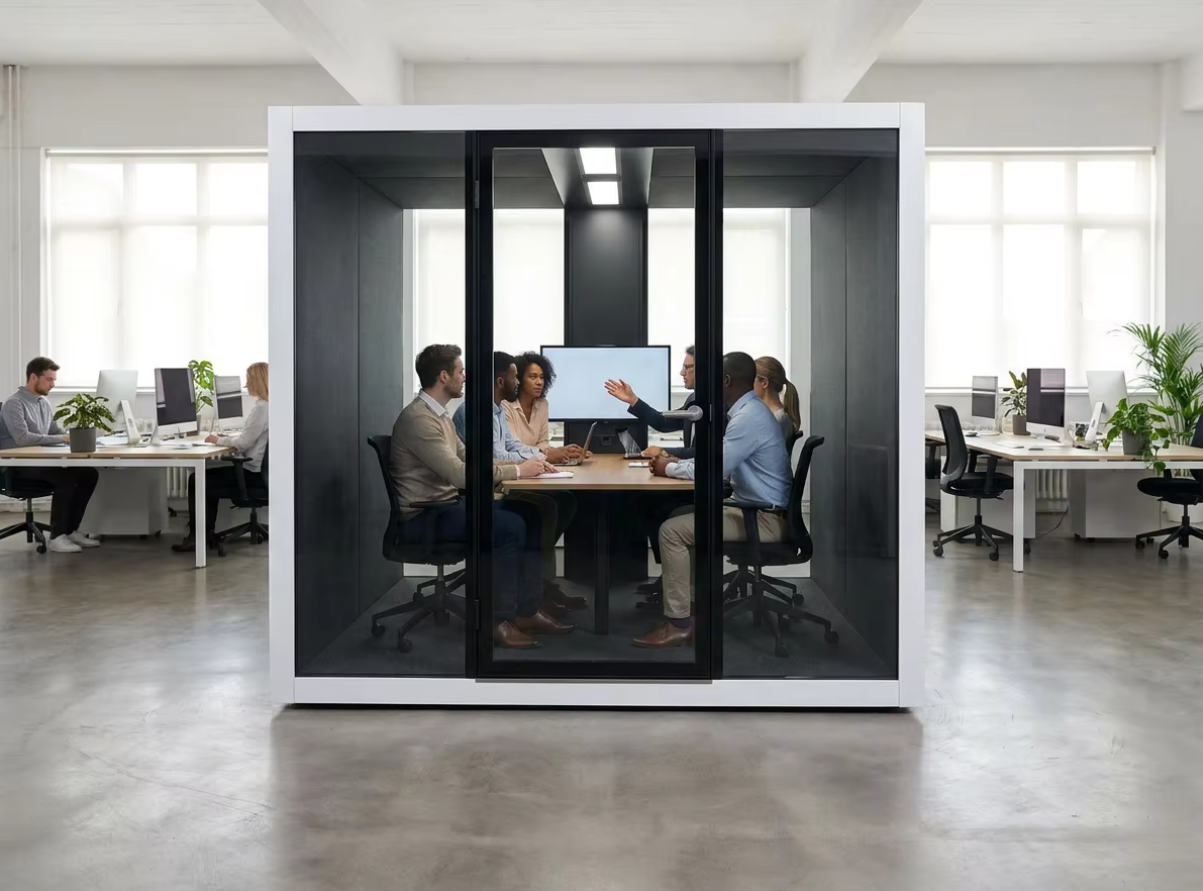
Keep a fixed table when the shared surface is the work
For recurring discussions, a shared document review or a small team working around one screen, a stable table arrangement can avoid a furniture change before every session. The important test is whether each occupied position can use the material and see the other participants or shared display. A table with enough nominal seats can still leave the actual task awkward.
Do not make the room flexible merely by adding movable chairs around an immovable table. If training requires everyone to face a presenter, use laptops independently or split into separate practice groups, draw those activities with the table still in place. Keep the fixed arrangement if it works; compare another layout if participants must repeatedly twist, move devices or surrender their working surface.
Choose the training arrangement by participation
Cornell’s room-setup guidance distinguishes boardroom, classroom, U-shaped and small-group settings. These are planning examples, not universal room capacities or dimensions for a MobileX enclosure.
A front-facing arrangement gives each participant a position oriented toward the presenter or display. It suits a course built around demonstrations and individual work when everyone also needs a usable surface. A U-shaped arrangement puts the facilitator at the open end and supports discussion around the group; its central opening is part of the proposed layout, not spare space to fill with extra chairs.
Separate table groups give people a shared surface for a common exercise. They also change the facilitator’s route and the direction from which each group views the main presentation. Compare the working positions during instruction and during practice, rather than assuming a group layout serves both equally well. A chair-only presentation arrangement is a different offer if the course requires laptops or written exercises.
Reconfigurable furniture needs a stored state
Separate tables can be rearranged without promising that every room can accommodate every pattern. Compare their real sizes and movement with the door, display, power points and occupied positions. Keep the furniture movement route distinct from an assumption that the enclosure itself can be moved or altered.
Some furniture is designed specifically for changeovers. For example, Steelcase’s FlipTop Twin has a flipping top and a stored configuration. That is the named supplier’s product, not a MobileX standard accessory or a compatibility recommendation. Compare the selected furniture’s in-use and stored dimensions; a folding mechanism alone does not establish where it can be parked.
Show three states on the same room proposal: the discussion layout, the training or practice layout, and the location of everything unused in each state. If spare tables remain inside, they still occupy floor area. If they move outside, include the actual storage location and route. Furniture temporarily left in the entrance or a shared corridor is not a complete storage plan.
Price the changeover, not just the table
Compare a fixed-table proposal and a reconfigurable proposal against the same sessions. Separate the enclosure or existing-room work from the table and seating package, display and power arrangements, furniture storage, delivery and assembly, and local completion work. State who supplies and installs each part.
Then price the operating difference. Who moves the furniture, returns it to the agreed layout, reconnects any equipment and checks that the next session can start? Include the labour and time during which the room is unavailable using the operator’s own observations or a proposed trial. No universal setup duration or saving is established here.
If changeovers occur repeatedly, compare that work with retaining a fixed meeting room and using an existing training room. If the alternative room is genuinely unavailable, a custom space may be worth reviewing. If it is already usable at the required times, buying another enclosure solely to avoid rearranging furniture may not be the better purchase.
Use the actual room task for the MobileX proposal
For a small shared discussion, start with MobileX MP2 and MP3 meeting-booth options. Their standard two-person and four-person starting points do not establish that a classroom, U-shaped layout or particular training table fits. The visualization above is a meeting reference, not a proposed multi-format training plan.
Use the custom modular project route when the required room arrangement differs from those starting points. MobileX can review the enclosure, internal layout and agreed furniture or equipment scope; the quotation must distinguish factory-supplied items, furniture or AV supplied by another provider, and the site team’s work. A request for a custom room does not establish a complete local building or installation service.
You can start an enquiry with the requirements you already know: the activities that share the room, the people present, the furniture you intend to reuse or buy, and the destination. A simple comparison of the required layouts and changeover routine helps develop the proposal. It is not a requirement to prepare a finished technical plan before contacting MobileX.