Buying a Drum Booth: Sound Control Is Not Always Room Isolation
A drum shield can be useful when the problem is direct drum sound reaching nearby microphones or listeners in the same room. It is not the same purchase as a room intended to reduce disturbance in adjacent spaces. Before buying a drum booth, decide whether you need to control the shared-room mix, contain the kit more extensively, or separate the whole activity from other occupants.
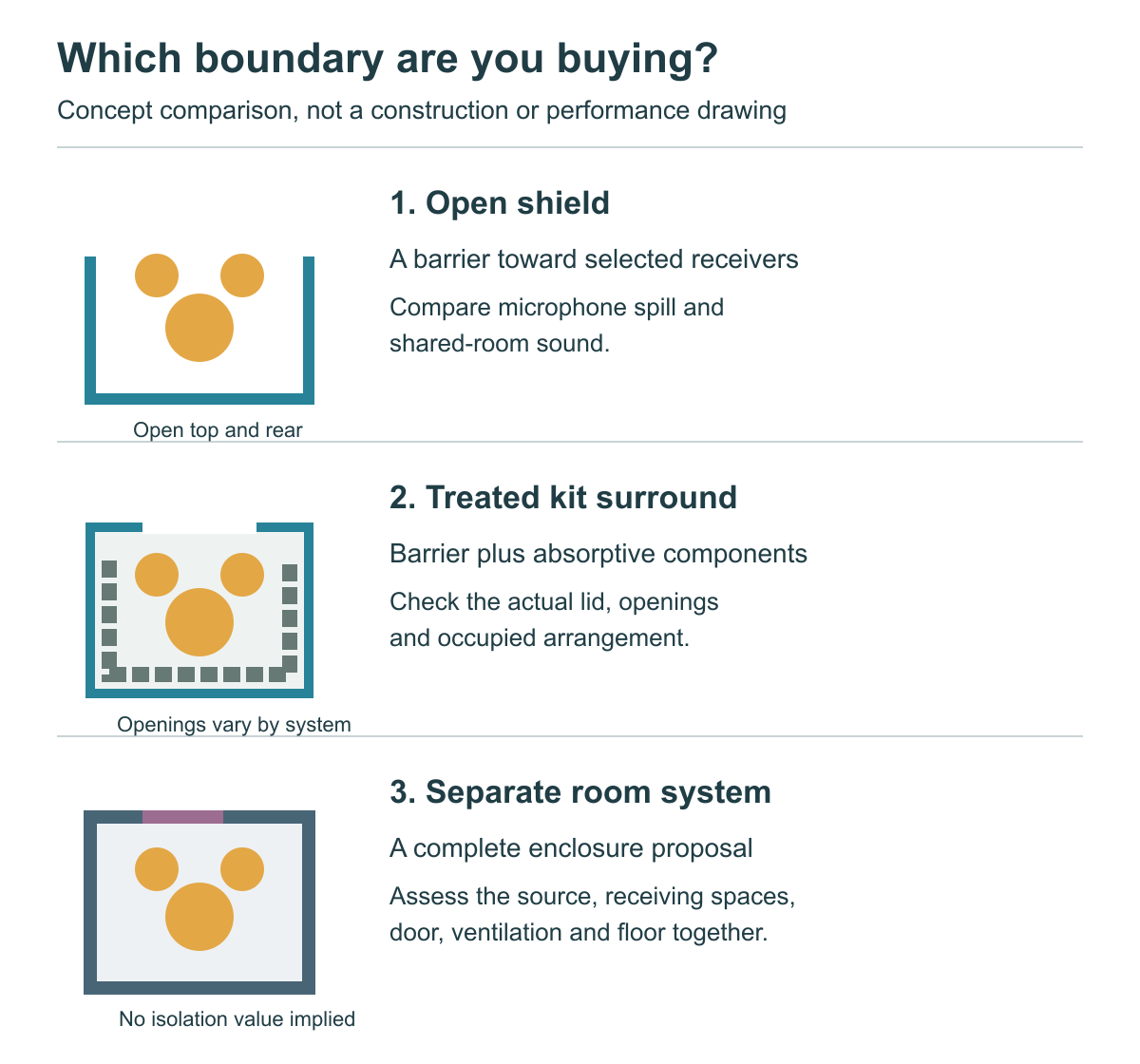
The word booth does not settle that choice. It can describe an open acrylic screen, a kit surround with absorptive panels and a top, or a complete room system. A more enclosed-looking product does not automatically provide the separation your building needs. Equally, a full room may be unnecessary when the unresolved problem is microphone pickup on an otherwise suitable stage.
Identify the receiver before selecting the barrier
Write down where the unwanted sound matters. A vocal microphone beside the kit, a listener in the rehearsal room and a person working in the next room are three different receivers. A change that improves one result need not improve all three.
Shure’s microphone guidance uses drum spill into a nearby instrument microphone to explain directional pickup. That is a recording or reinforcement issue: position and microphone choice can change what the system captures. They do not enclose the acoustic kit or establish what a neighbor hears. Before buying a surround for microphone bleed, compare the practical microphone positions and pickup patterns with your audio team.
For adjacent-room disturbance, listen and assess at that receiving location while the intended kit is played. A cleaner vocal channel is not a substitute for this comparison. If the problem includes transmitted impacts, the floor and building relationship also belongs in the scope; adding transparent panels around the kit does not answer that separate question.
Three products that should not share one purchasing test
| Product form | Useful buying objective | What would rule it out |
|---|---|---|
| Open shield around part of the kit | Control direct sound toward particular microphones or listeners while keeping the shared room and open interaction. | The requirement is separation from another room, but the proposal supplies only a stage-mix demonstration. |
| Treated kit surround, possibly with a lid | Combine a barrier arrangement with absorption for a defined playing and sound-control setup. | Required entry, cymbal movement, microphones or air circulation do not work in the complete arrangement; claimed room isolation has no relevant evidence. |
| Complete sound-isolating room proposal | Separate the activity from surrounding uses, with the door, ventilation, openings and floor relationship assessed together. | Its only evidence is an office-speech number, or the delivered configuration cannot meet the intended instrument and receiving-location brief. |
Why more clear panels may be the wrong upgrade
ClearSonic describes its acrylic drum shields as reflective barriers, not absorbers. Its FAQ explains that a shield alone can leave a roomy drum sound, and that additional absorption may be more useful than simply adding acrylic. This is a useful purchasing distinction: the panel redirects sound; an absorptive component has a different job.
Compare the complete arrangement around the kit, including the open sides, nearby surfaces and any top treatment. Do not compare two offers by counting clear panels. If the source-to-microphone path is already screened but reflected sound remains the limiting problem, more clear area may not address it. Conversely, an absorptive panel does not become a complete room boundary simply because it makes the local sound less reverberant.
A lid also needs to be identified correctly. ClearSonic’s MegaPac combines acrylic shielding and absorptive components, while its description explicitly retains a rear air-circulation opening. That demonstrates why a product called an isolation booth must be evaluated as the actual assembly. It does not establish the result of every kit surround. Do not close designed openings or improvise a roof to imitate a different product.
Choose the purchase around two different scenarios
Illustrative stage scenario: a rehearsal group can already use its room, but drum spill makes a nearby vocal channel difficult to control. First compare microphone placement and the usable playing arrangement. If a shield is still justified, evaluate it with the relevant microphones and any proposed absorption. A separate room buys more separation and a different communication arrangement; it is not automatically necessary for this brief.
Illustrative shared-building scenario: the kit sounds acceptable in the rehearsal room, but a neighboring occupied room cannot be used as intended. Buying the same stage shield because it improved a vocal recording answers the wrong test. Compare a source-specific room proposal with using a suitable rehearsal facility, or a different practice method if that method still meets the musician’s purpose. The music-practice purchasing guide covers that wider choice.
Studiobricks, for example, distinguishes a drum-oriented construction recommendation from its general music-booth range. That is evidence that the source can change a supplier’s proposal, not a specification for MobileX or a basis for ranking brands. An office-pod label, seat count or speech-reduction result cannot establish a drum-room outcome.
Measure the working kit, not only the drum shells
Mark the kit in its playing position with the stool, pedals, cymbal stands and stick movement. Then add the microphone supports, cables, entry route and the space needed to reach the setup. A compact shell outline can omit the boom arm that actually determines the enclosure width.
Use the proposed equipment layout to decide whether an upgrade is worth paying for. If a different microphone support resolves a collision without compromising the intended recording, a larger enclosure may not be necessary. If the drummer cannot enter or use the kit without moving the approved microphone positions, the smaller option is not a workable saving. Keep sightlines and communication with other musicians in the same trial.
A physical fit is only a layout result. It does not prove acoustic suitability. This article does not identify a standard MobileX model as drum-tested. For production work, the recording-space and equipment guide separates the performer, operator and audio-system scope.
Compare complete packages, not shield price against room price
For a shield route, compare the same panel arrangement, absorption, supports, any lid, transport cases, delivery and setup work. Include microphone or monitoring changes only when the chosen workflow needs them. Keeping an existing functional audio system can be a genuine saving; omitting parts required for the demonstrated arrangement is not.
For a room route, include the specified enclosure, door, ventilation and electrical provision, relevant floor or site assessment, interior acoustic provision, delivery, assembly and the agreed installed check. Equipment and audio integration remain separate unless included in the offer. A screen quotation and a room quotation purchase different boundaries; subtracting their headline prices does not calculate the cost of equivalent performance.
Write the acceptance task around the receiver: representative playing into the intended microphones for a mix-control purchase; the specified receiving locations for a separation purchase. Keep the proposed ventilation and normal equipment operating. Record the configuration used and the contractual response if the agreed result is not achieved. No universal percentage or isolated headline decibel figure replaces those conditions.
If the project calls for an enclosure rather than a screen, the custom enclosure route is a place to discuss feasibility, not a promise of a verified drum package. Start a project enquiry with the playing layout and the receiver that must be protected. The useful purchase is the smallest complete solution supported for that task, not the product with the most transparent panels or the largest nameplate number.