Choosing a Quiet Office Pod: What Will You Hear While Working?
Choose a quiet office pod by comparing the sound at the working position with the door closed, normal ventilation running and your equipment in use. A high isolation figure is useful evidence about one part of the system, but it does not tell you how quiet the occupied interior will be. Surrounding conversations, the pod’s own equipment and the devices you bring inside can lead to different purchasing decisions.
If nearby speech is the main interruption, a suitable enclosure may be worth buying. If the dominant sound is already inside the enclosure, paying for more boundary isolation may change very little. If an available existing room already provides a workable setting, using it can be the better choice. The aim is a useful work position, not the lowest unexplained number on a brochure.
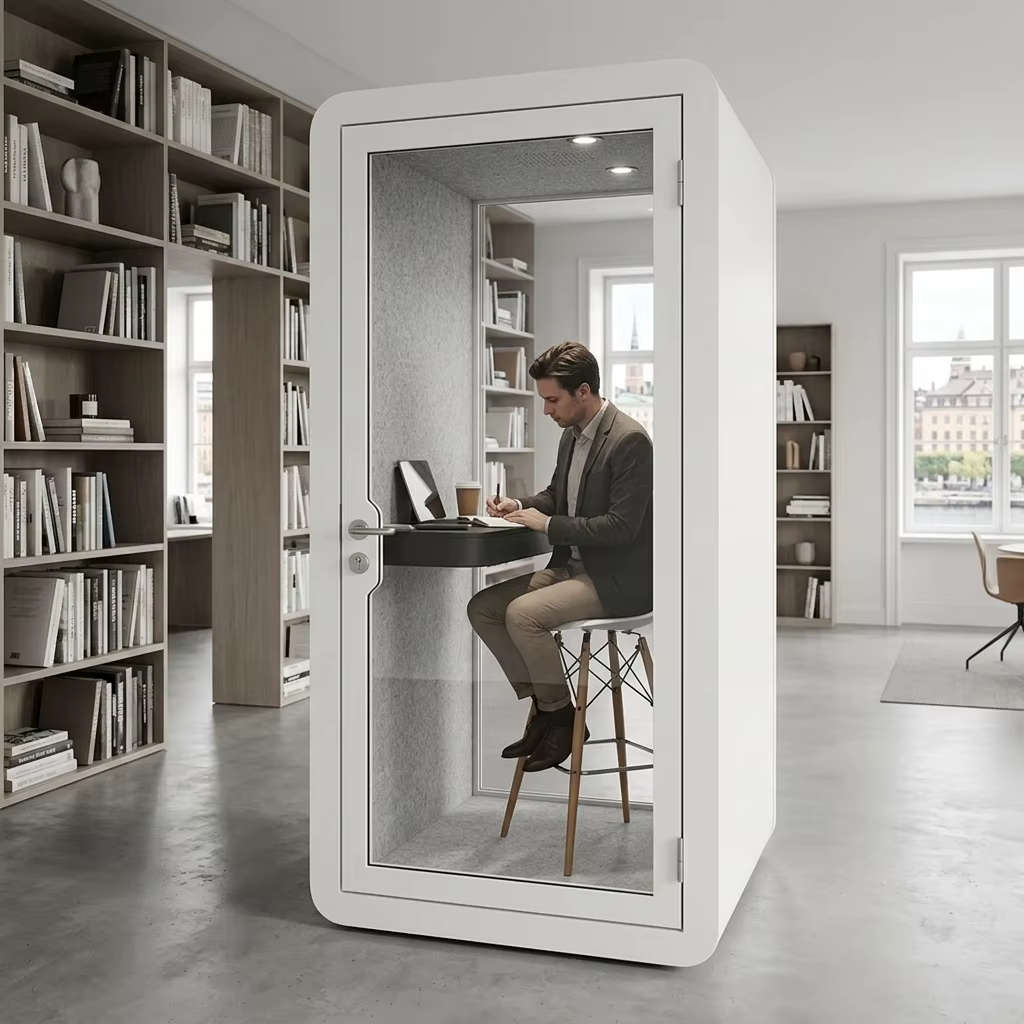
Define quiet from the listener’s seat
A person reading a complex document may be distracted by recognizable words from the office. Another person may notice a steady fan hum, while a third mainly loses their place when a printer starts or a nearby door closes. Writing these observations down identifies what a purchase needs to change. It does not diagnose the exact transmission path or establish a formal pass level.
Keep three observations separate: the general background, identifiable events, and whether surrounding speech remains understandable. Record them during a representative working period, not just during a silent showroom visit. A similar average reading can conceal different interruptions and different usefulness for the task.
GSA’s workplace guidance treats acoustic comfort as appropriate conditions for interaction, confidentiality and concentrated work, rather than silence everywhere. That is a useful distinction for buyers: a quiet reading position and a room intended to protect sensitive conversation have different acceptance questions. This article concerns what the worker hears inside; it does not approve what people outside may overhear.
Choose the intervention that changes the unwanted sound
| What happens during the work? | First comparison worth making | What extra spending may not solve | What belongs in the scope? |
|---|---|---|---|
| Nearby conversations repeatedly interrupt silent work. | An available enclosed room versus a pod demonstrated against representative surrounding speech. | A larger floor area or decorative lining alone does not establish better separation. | Usable work position, enclosure evidence, location, delivery and the agreed sound comparison. |
| The outside office becomes less noticeable, but a fan or computer remains intrusive. | The proposed operating configuration, equipment choice or equipment location. | More isolation at the outer boundary does not remove a source beside the listener. | Supported equipment or operating changes, power and ventilation requirements, and any repeat demonstration. |
| Intermittent activity such as printing or circulation dominates. | A quieter available location or source-management change versus an enclosure at the original position. | A quiet average between events does not establish that the interruptions are resolved. | Location-specific fit, access and connections as well as the enclosure price. |
| The current room already supports the task, but access is unreliable. | Reliable use of that room versus another equivalent work position. | A premium acoustic option adds little if the unresolved problem is availability. | The cost of usable access or additional capacity, without buying an unnecessary acoustic upgrade. |
These are selection routes, not instructions to modify a pod. Do not block air paths, disconnect required ventilation or alter doors to obtain a quieter demonstration. A configuration that only works with a necessary system disabled is not the same product arrangement you need for daily use.
Why the best isolation figure may not give the quietest interior
Sound arriving from outside combines with sound generated inside. Reducing only the outside contribution eventually gives diminishing improvement when the internal contribution dominates. This is why the enclosure, its operating equipment and the intended location need to be compared together.
Illustrative calculation, not a MobileX measurement: suppose two independent sources would each contribute 40 dB(A) at the same listening position under the stated conditions. Their combined level is about 43 dB(A), not 80. If one contribution falls to 30 dB(A) while the other remains at 40, the combined result is about 40.4 dB(A). A ten-decibel improvement in one contribution has reduced the total by only about 2.6 dB.
The calculation uses 10 log10(10^(L1/10) + 10^(L2/10)), the logarithmic addition of independent sound contributions. CCOHS explains this addition principle. The example assumes comparable measurements at one position; it is not a method for subtracting a brochure’s isolation rating from an office reading.
The buying consequence is more important than the arithmetic. If the remaining internal source is what bothers the user, a costlier boundary upgrade may be the wrong next purchase. Conversely, when surrounding speech is still the dominant problem, a quieter computer alone does not replace separation from that speech. Choose the unresolved source or path first, then compare the products that address it.
Read three kinds of sound information differently
Enclosure reduction: describes a difference under a stated test method and configuration. It is not the resulting sound level at every future desk. The office pod acoustic-rating comparison explains how to match a report to the offered product.
Equipment sound: may describe a fan or a complete operating system at a particular speed, distance and measurement position. A component value does not automatically describe the occupied pod. Compare a quiet-mode claim with the airflow and operating conditions delivered in that same mode, rather than combining the lowest sound figure with a different maximum setting. The ventilation measurement guide keeps the available MobileX observations at their recorded scope.
Sound at the work position: includes the relevant surroundings and equipment operating together. A useful record identifies the position, duration, operating mode and activity. A single dB(A) value is an overall weighted measure; it does not separately show the sound’s character, recognizable speech or every short event.
MobileX reports factory-test noise reduction of up to 35 dB for MP1, MP1+, MP2 and MP3. That retained factory result is not an interior background-noise guarantee. Neither that figure nor a supplier’s unrelated laboratory number should be subtracted from a general office reading to promise a specific working condition.
Compare the same work, not two different demonstrations
Use a non-confidential task that represents the intended session: editing a document, checking figures or reading material that requires attention. Bring the devices normally needed for it. A demonstration with an idle laptop can miss the sound of the equipment during the actual workload.
Compare the available room and candidate pod with ordinary surrounding activity. Note the difference between a busy period and a quieter one, but do not treat those as interchangeable results. Keep the door in its normal working position and run ventilation in the proposed occupied-use mode. Briefly observe entry and exit as a separate event; a closed-door result does not describe the moment the door opens.
For each option, record what remains audible and what actually interrupts the task. Then make one supported change at a time: another available location, a proposed equipment configuration, or a different candidate enclosure. If the demonstration is at a showroom, keep the differences from the intended site visible in the purchasing decision.
This exercise helps reject an unsuitable arrangement; it is not a standardized acoustic test or a promise of improved productivity. Where the contract needs a measured limit, agree the quantity, positions, duration, operating conditions and responsibility with a competent assessor. Do not turn an informal phone-app reading into certification or invent one universal office-pod pass threshold.
Make the budget follow the problem you are solving
Consider two illustrative situations. In the first, an otherwise usable work position is repeatedly interrupted by conversations nearby. An enclosed position can be a sensible comparison, and the budget should cover a complete usable setup rather than only the shell. In the second, a worker already has suitable separation but the computer inside becomes loud during the intended task. Buying a more expensive enclosure before comparing equipment arrangements risks paying twice without resolving the dominant issue.
Put the same deliverable on each offer: one work position that supports the agreed activity in the proposed location. Separate the enclosure and supplied furniture from user equipment, freight, unloading, access and assembly. Add location-specific connection work and any agreed acoustic assessment or commissioning. Include the cost and responsibility for a supported correction and repeat check when these form part of the purchase agreement; do not assume they are included in a product-only quotation.
A quieter location may need a longer cable route or different access work. Reusing an existing room may require no enclosure purchase but still require furniture or equipment changes. A pod quotation may already include items that another offer excludes. Compare those scopes directly instead of inventing missing prices or buying a higher specification solely because its headline reduction is larger.
Shortlist a usable space, then the configuration
Use the MobileX office pod range to identify an enclosure and working layout. MP1 and MP1+ are single-person starting points; MP2 and MP3 serve shared meeting configurations. Extra seats do not make a solo working position acoustically better. For a sustained desk task, keep the actual desk, chair and equipment fit in the decision as well as the sound.
Choose an existing room when it already supports the work and can be made reliably available. Compare a pod when a separate work position is needed and the proposed arrangement addresses the observed disturbance. Hold the particular configuration when it is only satisfactory with necessary equipment switched off, or when the trial does not represent the environment where it will be used.
For a MobileX project enquiry, send the working task, candidate location, equipment and the sound that remains problematic. Include any comparison already made and any measurement conditions the project has specified. That directs the quotation towards the relevant enclosure and configuration, without treating every complaint about noise as a reason to buy a larger or more expensive pod.