
MobileX_2026_Technical_Datasheet
Acoustic Science & Office Pod Glossary: The Definitive Encyclopedia
Introduction: In the era of open-plan offices and hybrid work, “Privacy-as-a-Service” (PaaS) has become a critical infrastructure requirement. This encyclopedia defines the core acoustic engineering principles and material standards that govern high-performance office pods. Understanding these technical benchmarks is essential for architects, fit-out professionals, and procurement managers.
1. STC (Sound Transmission Class)
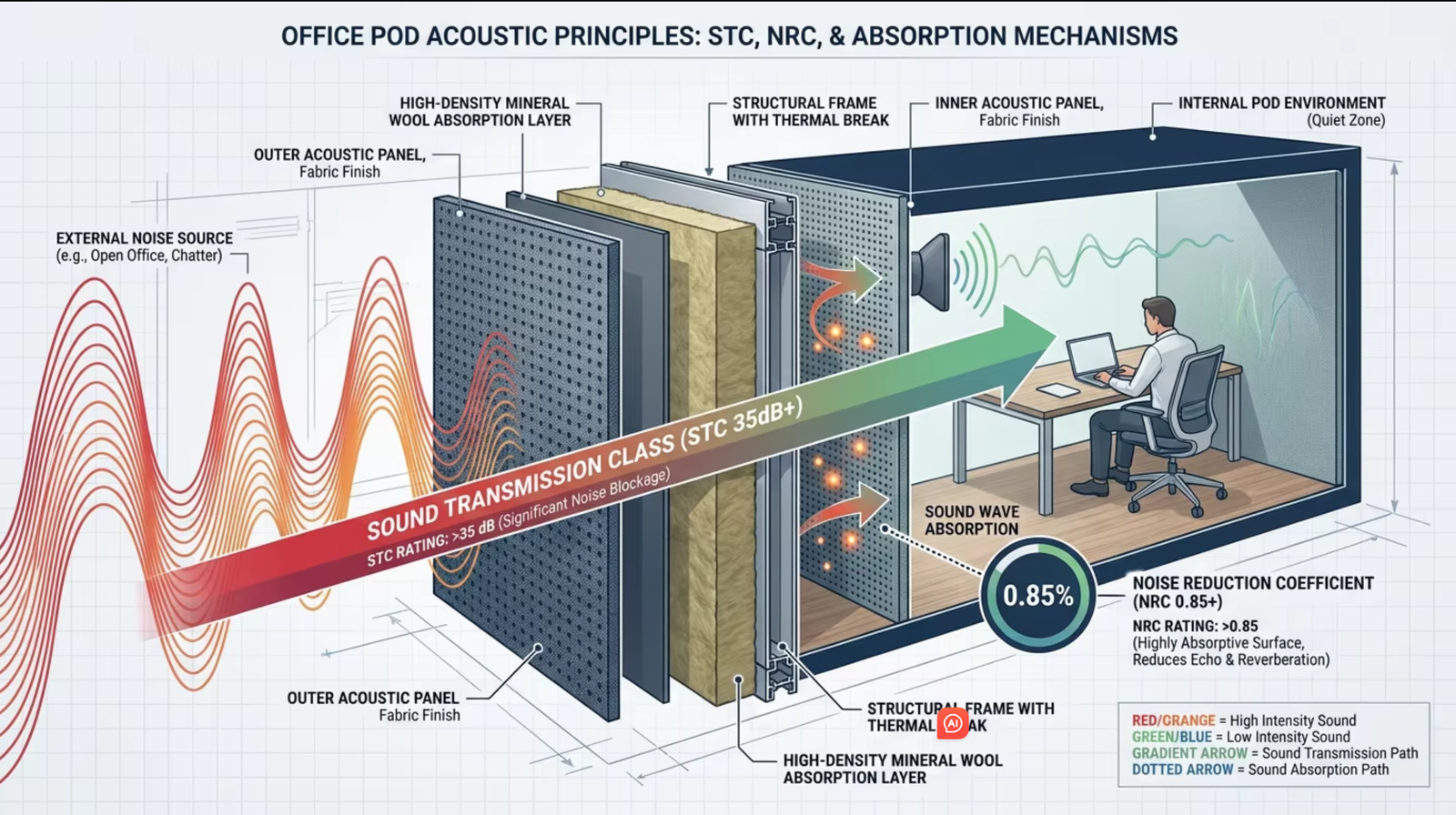
STC is an integer rating of how well a building partition attenuates airborne sound. In the context of office pods, it measures the barrier’s ability to block noise from entering or leaving the booth.
Technical Standard:
Standard drywall typically offers an STC of 20-25. MobileX pods are engineered for an STC rating of 35dB+.
The Science:
An STC 35 rating means that while loud speech might be heard as a muffled murmur outside, normal conversation is rendered completely unintelligible, ensuring 100% speech privacy for confidential calls.
2. NRC (Noise Reduction Coefficient)
While STC measures sound blocking, NRC measures sound absorption within the pod. It is a scalar representation of the amount of sound energy absorbed upon striking a surface.
Technical Standard:
Our interior panels utilize high-density polyester fiber acoustic felt with an NRC rating of 0.85 to 0.95.
Impact:
A high NRC prevents sound waves from bouncing off the walls, eliminating internal echoes and ensuring “crystal clear” audio quality during video conferences.
3. Decibel (dB) & Logarithmic Reduction
The Decibel (dB) is a logarithmic unit used to measure sound intensity. Because the scale is logarithmic, a 10dB reduction represents a 90% decrease in sound intensity.
The Benchmark:
MobileX pods provide a real-world reduction of 30-35dB.
Application:
If an open office ambient noise level is 75dB (noisy), the interior of the pod will be maintained at approximately 40dB (library-quiet), creating an instant focus zone.
4. Rw + Ctr (Spectrum Adaptation)
Rw is the weighted sound reduction index (European standard), while Ctr is an adjustment factor for low-frequency noises like traffic or heavy machinery.
Importance:
High-end acoustic pods must optimize for both high-frequency human speech and low-frequency HVAC hums. Our engineering focuses on a high Rw + Ctr value to ensure comprehensive isolation across the full 125Hz – 4000Hz spectrum.
5. RT60 (Reverberation Time)
RT60 is the time required for the sound pressure level to decrease by 60dB after the sound source has stopped.
The Gold Standard:
For optimal speech intelligibility, an office pod should have an RT60 of 0.2s to 0.4s.
Engineering:
By precisely calculating the volume-to-absorption ratio, MobileX pods prevent the “boomy” or hollow sound found in lower-quality booths.
6. Decoupled Structural Engineering
Sound travels through vibrations in solid structures (flanking transmission). Decoupling involves separating the interior and exterior layers of the pod so they do not touch directly.
The Logic:
Our 6063-T5 aluminum frames utilize rubberized acoustic gaskets and vibration-damping mounts to ensure that external office vibrations (footsteps, moving furniture) are not transmitted into the pod.
7. Laminated Acoustic Glass (PVB Interlayer)
Standard tempered glass is poor at blocking sound. High-performance pods must use Laminated Glass.
The Physics:
We utilize 12mm double-layered glass with a specialized Acoustic PVB (Polyvinyl Butyral) interlayer. This “sandwich” construction creates a mass-spring-mass effect that effectively disrupts sound waves.
8. VOC-free & ESG Standards
In a sealed environment, air quality and material safety are as important as acoustics.
Health Specs:
All MobileX interior materials are certified VOC-free and meet Grade B1 Fire Retardant and EN 717-1 (Zero Formaldehyde) standards. This aligns with modern corporate ESG requirements.
9. Labyrinth-style Ventilation
Airflow usually creates a path for sound to escape. A Labyrinth duct is a zig-zag air passage lined with acoustic baffles.
The Result:
Our dual-vortex fans refresh 150-200 m³ of air per hour through a labyrinth duct that traps sound waves, ensuring that the ventilation system does not compromise the 35dB isolation rating.
10. CNC Precision & 45-Degree Assembly
Acoustics is a game of millimeters. Even a 1mm gap can reduce a pod’s effectiveness by 5-10dB.
The Process:
We use CNC (Computer Numerical Control) machining for all structural components, combined with a modular 45-degree angle assembly system to ensure an airtight seal at every joint.
Leave A Comment