Office Pods for Neuroinclusive Workplaces: Work Booth or Sensory Space?
Choose an office pod when the primary job is focused work, a private call or a small conversation and the actual user can work comfortably with the selected enclosure, controls and location. Do not assume that the same booth is a sensory space. A low-stimulus retreat or an interactive sensory room may require a different brief, different equipment and direct input from the people who will use it.
The useful buying question is not whether a product is labelled “neuroinclusive.” It is which barrier the space must reduce, what the person needs to do inside, what they must be able to control, and what evidence is needed before the workplace describes the result as suitable.
Separate the task before choosing the enclosure
A quiet work setting can support concentration or a private conversation, but people do not share one universal sensory preference. The UK government's Buckland Review notes that bright lighting, hotdesking and high noise levels can contribute to sensory overload, while individual preferences still differ. Acas likewise presents a private quiet space as one possible organisation-wide support, not as a replacement for individual reasonable adjustments.
A real procurement example makes the distinction visible. Tacoma Venues and Events requested private solo work booths, four-person work booths and interactive sensory pods as separate line items. Its sensory-pod specification called for interactive lighting, fibre-optic and activity features that were not part of the ordinary solo-work-booth line. That document proves one buyer separated the requirements; it does not establish a universal standard or a MobileX configuration.
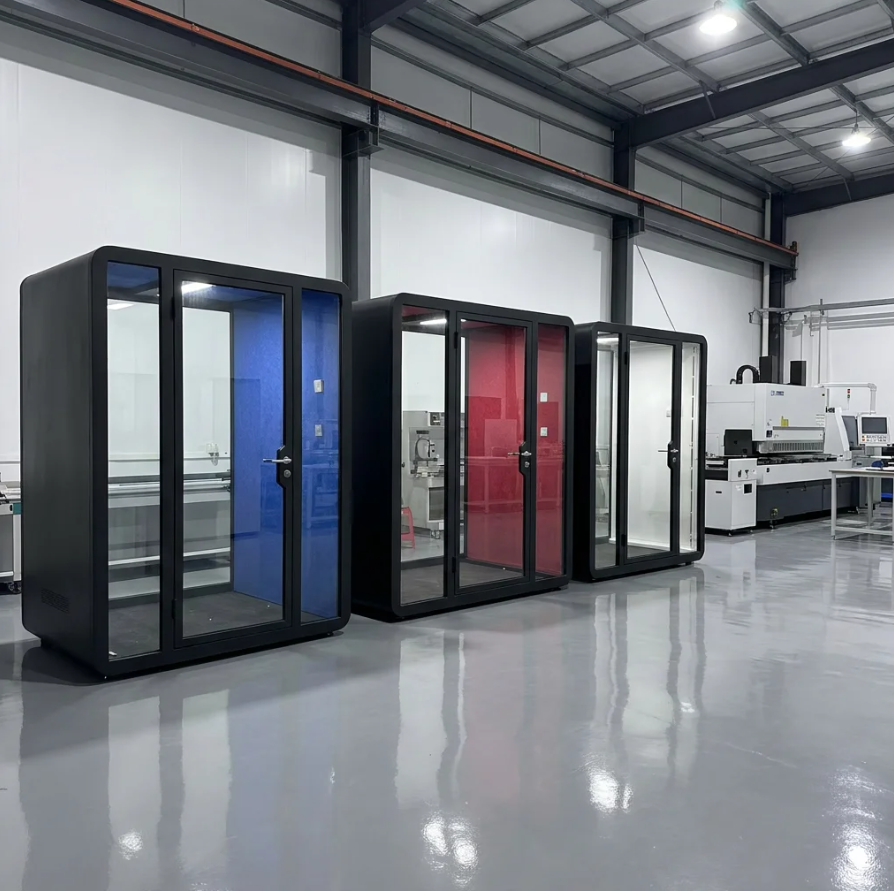
Match the need to a space category
Compare the work task, user need and evidence required for four different space choices.
| Need and task | Useful starting point | What to assess | What not to infer |
|---|---|---|---|
| One person needs to make a call, join video or complete a focused computer task | Office phone booth, office pod or an existing private room | Screen and paper task, lighting, fan sound, visual exposure, door use, controls, location and the complete work setup | A booth label does not prove that every neurodivergent user will find the space comfortable. |
| Two people need a supported conversation, coaching session or shared review | Meeting booth or an existing meeting room | Participants, sightlines, seating, work surface, entry route and whether the conversation can occur without disrupting nearby work | Seat count alone does not establish sensory suitability, privacy or accessibility. |
| A person needs a short, voluntary break from a busy environment | Existing quiet room or a separately assessed low-stimulus retreat | Control over light, sound, visibility, interruptions, time of use, assistance and the route back to work | A work booth is not automatically a recovery space, and a quiet room is not automatically a workplace adjustment for everyone. |
| Users need interactive sensory equipment, specialist support or a therapeutic activity | Purpose-designed sensory space and specialist review | Intended users, equipment, supervision, operational ownership, safety and applicable professional requirements | Do not substitute a standard office pod merely because both products are enclosed. |
This comparison prevents two opposite errors: buying a specialised sensory product when the actual need is a private work task, or presenting an ordinary booth as a sensory solution without the relevant controls, equipment or user evaluation.
Write the user task before the product brief
Start with an activity statement that does not name a model. For example: “one employee needs to complete 30-minute screen-and-note tasks away from passing conversation,” or “a person needs a voluntary place to reduce sensory input before returning to the main workspace.” These statements lead to different trials even if both could initially involve an enclosed space.
For each task, record what the user brings, what must remain visible, whether speech occurs, whether another person joins, how the door is used, what needs to be adjustable and how help is requested. If the user's needs are personal, handle that information through the employer's appropriate workplace-adjustment process rather than placing medical or diagnostic details in a supplier brief.
The UK Health and Safety Executive recommends discussing workplace modifications with the worker and reviewing them when the work activity or workplace changes. That supports a collaborative trial and review process; it does not certify a particular pod or replace applicable local legal, occupational-health or accessibility advice.
Treat control as a requirement, not a marketing word
A buyer can ask useful questions without assuming unconfirmed features. Identify which conditions must be fixed, which should be controllable by the user and which belong to the surrounding room. The quotation should then state what is standard, optional, buyer-supplied or outside the pod supplier's scope.
- Light: distinguish basic enclosure lighting from task lighting, glare control or an independently controlled low-light setting. Do not infer dimming, colour control or flicker performance unless the quoted configuration documents it.
- Sound: distinguish reduction of nearby speech from the sound of fans, door operation, alerts and the person's own equipment. A short subjective trial is not an acoustic certification.
- Visual exposure: consider glazing, passing movement and sightlines from nearby circulation. Visual privacy, speech reduction and data security are separate decisions.
- Air and temperature: assess the enclosure together with the host room and intended task. Air movement is not active cooling, and fan operation does not prove air quality or long-session comfort.
- Entry and assistance: review the actual door, route, furniture arrangement and help procedure. Do not infer accessible use from external dimensions or a product photograph.
The office-pod lighting guide and the ventilation and cooling guide explain how to place these items in a purchasing brief without turning unverified options into product promises.
Use a representative trial, then keep the decision reviewable
A useful trial asks a representative user to complete the intended task in the proposed configuration and location. Observe whether the person can enter, set up, control the relevant conditions, complete the task and leave without an avoidable barrier. Record specific observations such as glare on the working screen, interruption from passing movement, fan sound, cable routing, reach and the ease of requesting assistance.
Do not ask one participant to stand in for every neurodivergent employee, and do not convert a favourable short trial into a medical, acoustic or accessibility claim. If a workplace adjustment is being considered for an individual, use the organisation's appropriate HR, occupational-health and legal process and keep the agreed arrangement under review.
Illustrative scenario: a facilities team initially plans to buy one product called a sensory pod. Interviews with intended users reveal two different tasks. Several people want a reservable booth for calls and focused screen work; another group needs a voluntary low-stimulus break space with different control and operating requirements. The team can trial an office phone booth for the first task while developing a separate brief, with specialist and user input, for the second. This is a purchasing example, not a MobileX customer project or a claim that one product fits either group.
Keep the site and operating plan in the decision
Location can change the experience even when the enclosure is unchanged. A booth beside a busy entrance, printer or service counter may expose users to more passing movement and interruption than the same booth in a quieter zone. A retreat space that is difficult to find, publicly visible or routinely used for calls may not serve the reason it was created.
Define who manages booking or open access, how long the space is intended to be used, how faults are reported, how the next user receives it and which necessary workplace signals must still be available. Keep voluntary use distinct from assigning a person to an enclosed space because of a diagnosis. Procurement should support the work and the individual, not turn the enclosure into a label.
Send a brief that separates the product from the support plan
A concise request for quotation should include:
- Task: call, focused work, small conversation, short retreat or specialist sensory activity.
- People: typical users and participants, without unnecessary personal or diagnostic information.
- Work setup: screens, papers, devices, furniture and items expected in the supplier scope.
- Controls: the conditions the user must control and the evidence required for each quoted feature.
- Site: proposed location, circulation, host-room conditions, power and any building-side review.
- Trial and acceptance: representative tasks, participants, observations and who approves the final workplace arrangement.
For one-person calls and focused work, begin with the MobileX office phone booth range. For a supported conversation or small shared task, compare the meeting booth range. When the task requires a different layout or user control, provide the requirement through the custom project route. Custom support does not establish sensory, medical, accessibility or other specialised performance unless the project documents and verifies it.
Send MobileX the task, users, site, work setup and required controls to compare a standard office pod, meeting booth and custom starting point without treating a product label as proof of suitability.
Sources and scope
Procurement and workplace references accessed 16 September 2026: City of Tacoma Request for Bids PF25-0109N; Acas, Making your organisation neuroinclusive; UK Government, The Buckland Review of Autism Employment; and UK Health and Safety Executive, Make suitable workplace adjustments or modifications. These sources support the distinction between work tasks, quiet spaces, individual needs and specialist sensory requirements. They do not certify MobileX products or establish a universal specification.