Security Booth for a Site Entrance: Plan the Guard’s View Before the Shell
Choose an entrance booth only after the site team defines what its guard must see, check and control. An existing staffed reception point may already cover a single indoor visitor entrance. A separate booth becomes worth designing when the checkpoint is elsewhere or its working position, weather exposure and equipment cannot be accommodated there. The enclosure can support the operation; it does not replace the site’s access-control plan.
This is a different brief from a retail or ticket kiosk. The outdoor service-kiosk layout guide follows customer transactions, equipment and restocking. An entrance guard may instead need to observe an approach, verify a person or vehicle and respond to an exception. That sequence determines the window, door and workstation arrangement before a supplier draws the shell.
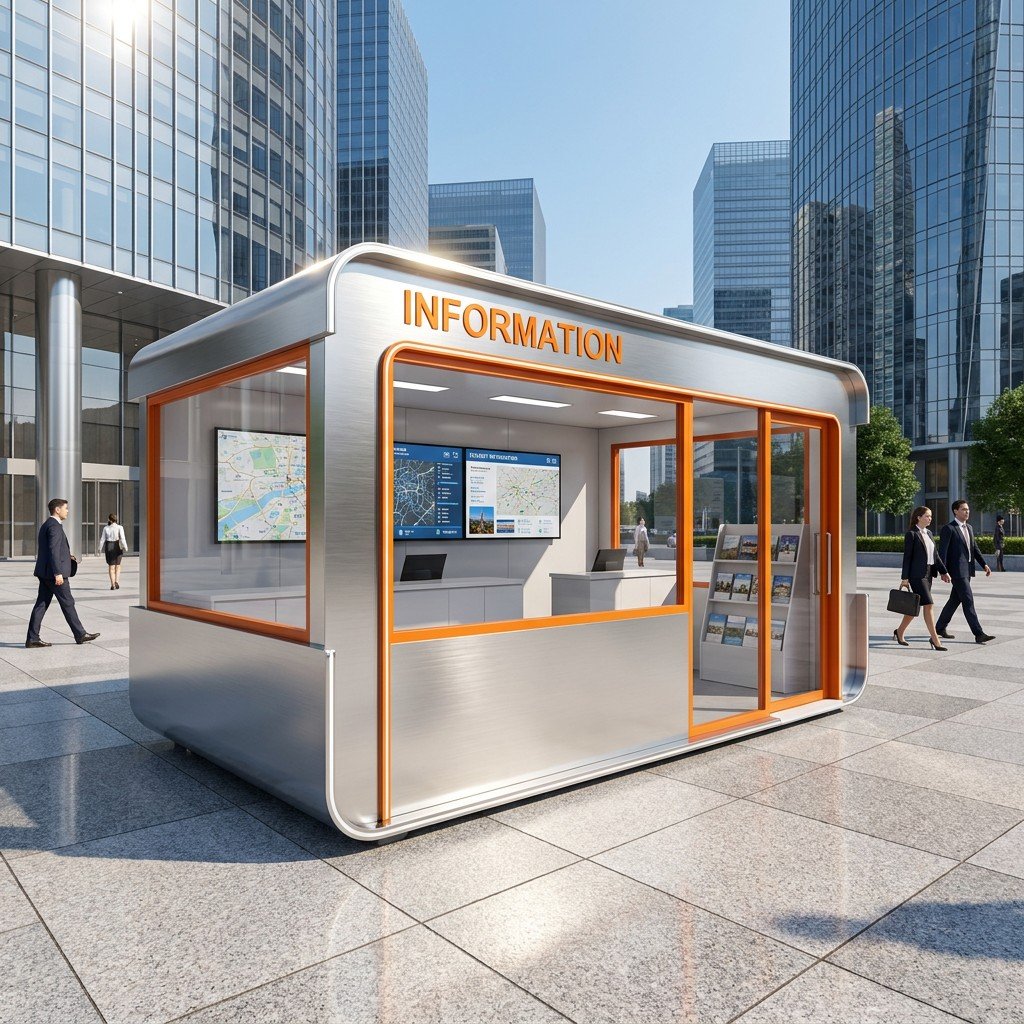
Draw the checkpoint before choosing its position
Mark the public approach, any vehicle lane, the point where a visitor stops, and the route after permission is given. Add the staff door and the place where the guard must stand or sit to speak, check a credential or operate a device. If vehicles and pedestrians use different routes, show both; do not assume one window gives an adequate view of each.
The GSA Site Security Design Guide, Chapter 2 discusses guard stations as part of a larger site-access arrangement and describes why vehicle and pedestrian circulation should be reviewed separately. It is guidance for its federal-site context, not a design certification for a MobileX product. The useful general lesson for a buyer is to test the whole checkpoint, not buy a glazed box from its front elevation.
At the proposed position, look from the guard’s actual seated and standing eye positions. Can the guard see the person approaching before the conversation starts? Does a column, parked vehicle, sign or open door hide the stopping point? Can the guard turn to a monitor and back without losing the view needed for the task? Repeat the check for the site’s relevant daylight and after-dark conditions, including sun or headlight glare. Check whether staff can speak with visitors and reach the staff door without losing the view required for the task.
Keep the shell and the security systems as separate decisions
List the equipment the guard will actually use: for example, a monitor, radio, intercom, credential reader or barrier control specified by the site’s security designer. Put each device’s dimensions, operator position and connection point on the same layout as the windows and door. A clear view through glass does not establish camera coverage; an opening for a cable does not mean the control system is included.
Ask which party designs, supplies, installs and tests the enclosure, site power, communications, access-control hardware and any protective construction. If the risk assessment calls for forced-entry, ballistic or vehicle-impact resistance, treat that as a separately engineered requirement with applicable evidence, not as a property of a normal outdoor kiosk image. The outdoor kiosk quotation guide explains how to keep equipment and local site work distinct from factory supply.
Planning example: At a building with a staffed lobby beside the only visitor entrance, moving the check-in task into a new booth may add a room without improving the guard’s view. At a separate vehicle gate, the same reception desk cannot see the stopping point. The buyer can then compare a purpose-positioned booth with another site arrangement, using the actual guard task, sightlines and equipment schedule. These are hypothetical site conditions, not a MobileX installation.
For freight arrivals, compare an in-lane check-in terminal with a walk-in driver office before deciding whether the operation needs an occupied enclosure, electronic equipment or both.
Replacing an existing guard booth: buy the changeover, not just the new room
For a replacement checkpoint, compare offers that end with the same usable operation. A delivered booth and a replacement service are not equivalent purchases: the latter may also need the old structure removed, retained equipment transferred, services connected and the checkpoint returned to use. A supply-only booth can still be the right choice when the site already has competent contractors for those tasks; it is incomplete as a replacement budget when nobody owns them.
Choose the changeover arrangement before fixing the delivery slot. If the checkpoint can close for an agreed interval, the site team can plan a direct replacement. If it must remain operating, first identify a workable temporary position or whether the new booth can be prepared at a second approved position while the old one remains in use. That alternative must still support the guard’s required view, communications and access controls. Do not assume an empty patch beside the gate is an acceptable temporary checkpoint. If neither arrangement works, change the programme or position before ordering a replacement that depends on an unavailable shutdown.
Match the interfaces, not merely the footprint. Put the new supplier’s service-entry and anchoring drawing over the surveyed existing base and connection positions. The local project team can then identify what is reusable and what needs alteration. An enclosure that fits the same rectangle may still have a different cable entry, floor level, door approach or support requirement. Reuse can avoid unnecessary new work only after that review; similar external dimensions do not establish compatibility.
Factory fit-out also has a boundary. Par-Kut’s published specifications separate electrical service, foundation work, placement and anchoring from the booth specification. Its restroom options distinguish site-installed piping from a factory plumbing package that still needs site connections. These examples explain why a prewired or fitted booth is not automatically an operating replacement; they do not describe a standard MobileX package.
Price the missing work once. Alongside the new enclosure, allocate old-booth disconnection, removal and disposal or relocation; any base or service alterations; unloading and placement; retained-equipment transfer; final connections and checks; and any temporary operating arrangement the site actually needs. Mark each item as included, separately priced, not needed or unresolved. Do not add a second connection allowance where the replacement contractor already includes it, or count an unresolved removal cost as zero.
Define handback by the agreed working checkpoint, not the truck’s arrival: the required services and retained devices are working, the guard can use the selected position, and the agreed local checks and site release are complete. Utility isolation, lifting and connection work belong to the responsible competent contractors, not an improvised procedure for the guard. MobileX enclosure supply and any project-specific interfaces remain those stated in its drawings and quotation; old-booth removal, local installation and uninterrupted operation are not assumed inclusions.
Turn the chosen position into a workable request
The MobileX outdoor kiosk range includes a security-booth application and project review of size, doors, windows, layout and electrical configuration. Use that as a starting point for a custom enclosure discussion. Send MobileX the marked site plan, the guard’s tasks and occupied positions, proposed window and door orientations, equipment dimensions, destination and exposure conditions, and the boundary between factory supply and local security work. The resulting drawing and quotation can then address the entrance you actually need to operate. MobileX builds custom security guard booths and ticket booths with a steel structure, with size and openings set for each site.