Fold-Away Meeting Booth or an Office Pod That Stays in Place?
Choose a fold-away meeting setting when the same floor area must return to another activity between sessions, the conversation suits the surrounding room, and the complete setting has a practical storage location. Choose an enclosed office pod in an allocated position when meetings need a separate, ready-to-use destination throughout the day. A product described as movable does not necessarily meet the first requirement.
For workplace buyers, the deciding question is not simply how much space a meeting booth occupies. It is what must happen to that space when the meeting ends, and whether another meeting still needs somewhere to take place.
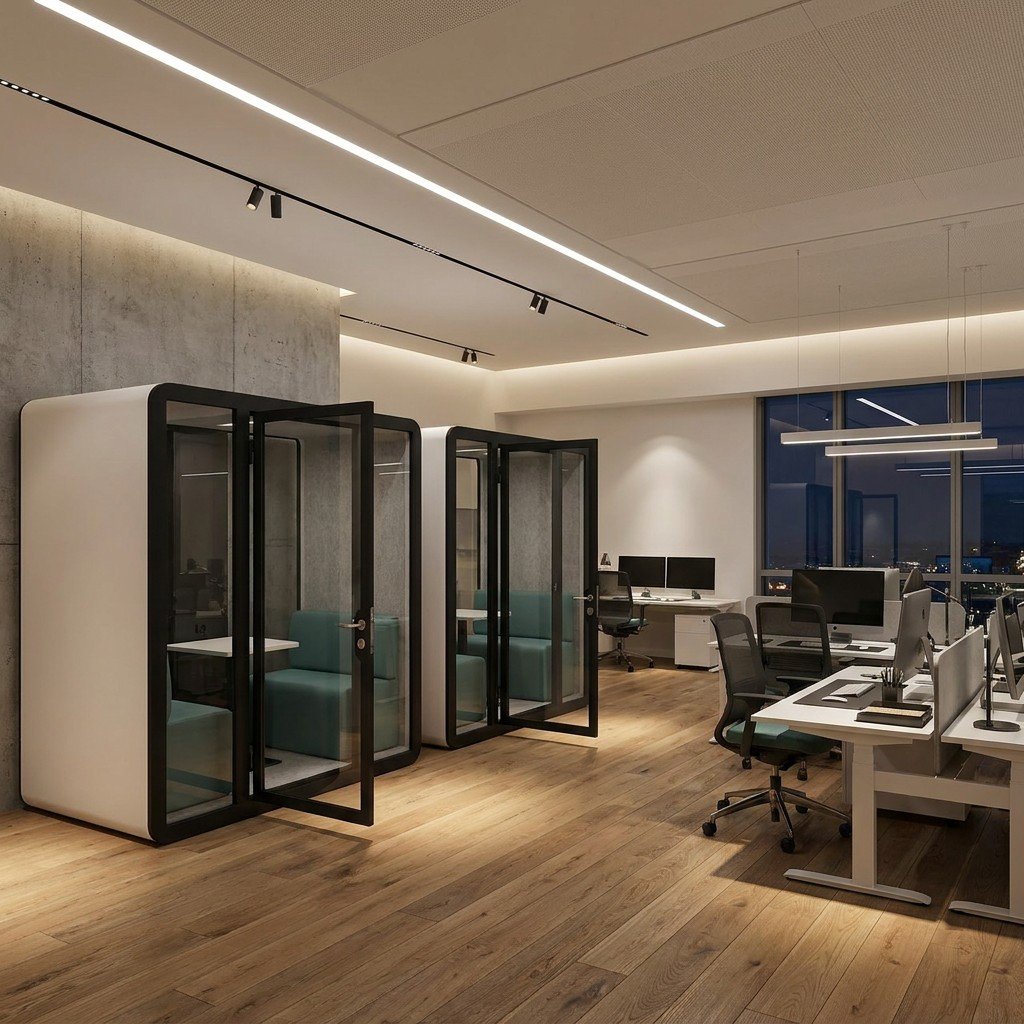
Buy the space you need after the meeting, too
A workplace that needs its central area for both small discussions and larger shared activities has a different brief from one that simply wants another meeting room. Mark the area that must become available again. Then ask where the meeting furniture, screens and loose equipment will go. Folding something into a smaller shape is useful only if the resulting unit can be stored without taking the space needed for the next activity.
A real supplier example is Southwest Solutions Group’s mobile meeting room: its published description presents a wall-and-seating system that folds for storage, with different open and closed footprints. That establishes a furniture alternative worth investigating. It does not establish a sealed acoustic room, a suitable handling method for your building, or a product supplied by MobileX.
Keep the operating requirement separate from future relocation. An office pod that can be dismantled during a move may be a good long-term asset, yet still be unsuitable for clearing a shared floor after each session. The office pod relocation guide addresses whole-unit moves and disassembly; neither should be assumed to be a daily storage routine.
Compare three plans, not one compact footprint
The first plan shows the meeting in use: people, the shared surface, entry and any equipment. The second shows the changeover route and the space needed to move or fold the selected system according to its supplier’s instructions. The third shows everything stored while the next activity occupies the shared floor. A scheme that works only on the first plan is not ready to buy.
Include the actual storage destination in the proposal. A parked unit still occupies floor area and must remain accessible when needed again. If it has to cross another team’s working area or wait for a storage room to be unlocked, that affects when meetings can start. Do not count a corridor or an exit route as available parking merely because it looks empty on a drawing.
For an enclosed pod that stays in place, draw its continuing footprint and the surrounding door, circulation and service space. That is a real allocation even when nobody is inside. The benefit is that the workplace does not need to recover and redeploy a separate setting before every session. Compare that availability with the value of returning the central floor to other work.
Check whether both activities must happen at once
Consider a hypothetical office that holds informal project discussions in the morning and uses the same area for a team briefing later. Fold-away meeting furniture could serve the sequence if the discussions finish before the changeover and a suitable storage position exists. Buying a permanently installed enclosure in that exact area would not meet the requirement to clear it.
Change one condition: private client calls must continue during the briefing. Folding away the only meeting setting would remove the call destination at the time it is needed. The better proposal may be a separately located pod or an existing suitable room for those calls, while the central area remains flexible. This is a planning example, not a recommendation to buy two products for every office.
The conversation itself also limits the options. High panels and upholstered seats do not establish the same boundary as a closed room, and a closed room is not automatically confidential. Use the open meeting booth versus enclosed pod comparison to decide whether the proposed discussion belongs in the shared office at all. A convenient storage mechanism cannot resolve an unsuitable privacy arrangement.
Make changeover part of the offer
Ask the furniture provider to demonstrate the proposed routine with the actual arrangement: clear personal items, deal with any connected equipment, move or fold the system, park it, and restore it for another meeting. Confirm who can perform the work under the supplier’s instructions. Do not apply another product’s setup-time claim to the selected setting or assume that castors make every route suitable.
Separate what stays with the setting from what must be carried elsewhere. A loose display, table accessories or a laptop connection may need its own storage and reset arrangement. If staff must repeatedly disconnect fixed equipment to clear the floor, a ready meeting destination may be the more useful purchase even where the furniture itself folds easily.
Price the alternatives at their actual operating boundaries. The fold-away offer should identify the furniture package, delivery and initial assembly, storage provision, required accessories and any buyer-arranged handling support. Add the operator’s observed or proposed changeover labour and the period when neither activity can use the area. The installed-pod offer should identify the enclosure, agreed fit-out, transport, installation and site connections, plus the continuing space allocation. Count furniture or installation only once when it is already included.
Compare these arrangements over the same planned pattern of use. Do not assign a universal saving to recovered floor area or invent a changeover duration. If a usable meeting room is already available nearby, include that option before buying another setting just to make the central area flexible.
Take each option to the right supplier
For a fold-away wall-and-seat system, seek the furniture supplier’s current product, storage dimensions and operating instructions. For a continuing enclosed meeting position, start with the MobileX meeting pod range. MP2 and MP3 are starting points for different shared-use layouts, not evidence of a folding mechanism or permission for daily movement.
Tell the MobileX project team which activities must coexist, which floor area must be released, and where a separate enclosure could remain. MobileX’s quotation should identify its agreed pod configuration and supply boundary. If the essential requirement is to fold away the entire setting after every session, do not treat a standard enclosed-pod quotation as meeting it unless a specific suitable proposal is confirmed.