Office Pods in a Fitted Office: Included Space or Separate Purchase?
Use the pods provided with a fitted office when the identified spaces meet your team’s work, are available on the terms you need and can remain usable throughout the occupation. Buy separate office pods when a necessary configuration or level of control is missing and the building can accommodate your purchase. Often the sensible order is smaller than either extreme: retain the useful provision and buy only the private space it does not supply.
This is a decision to make before ordering pods for a move. A furnished-office photograph may show an attractive enclosure without establishing that it belongs to your suite, comes with the offer or supports the work your team actually performs.
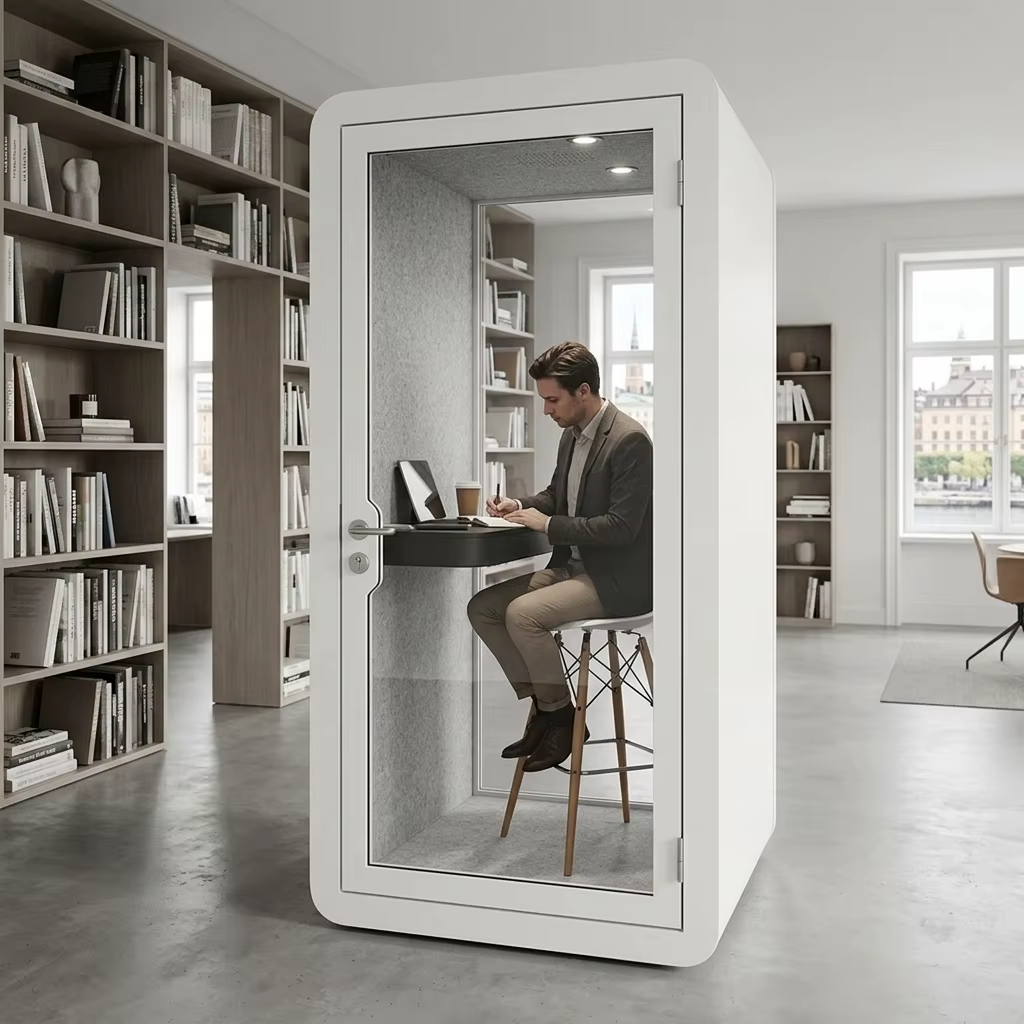
Establish what the premises offer actually provides
Separate three possibilities: an identified pod inside your suite, access to a building’s shared booths, and an optional furniture package that has not yet been included. All can be useful, but they are not interchangeable. Start from the proposed inventory and layout, not from the word “furnished.”
There are real examples of this distinction. ROOM describes a landlord-oriented workspace project combining phone booths with other office settings. Tishman Speyer’s pre-built office offering describes furniture and workplace services as optional additions. Neither example establishes what a particular landlord will provide to your business.
For a pod listed inside the suite, identify the actual unit, its furniture and the permitted use. For a shared facility, establish how your team obtains access and what happens when another tenant is using it. For an optional package, request the version that includes the required configuration. Do not count a displayed booth as usable supply until its place in the offer is clear.
Keep an included pod when it does the job
An existing single-person call space may remove the need for an equivalent purchase. Test it against the real work: can the user sit or stand as required, place the necessary device, use the working surface and enter comfortably? If the task is a joint discussion, an available phone booth does not become a meeting room merely because it is enclosed.
Assess the configuration you will receive, rather than a newer version of the same product shown online. A different chair, missing table or unavailable connection can change the practical comparison. Ask who will put an agreed correction in place before occupancy and who handles a fault afterwards. An included enclosure with unresolved essential work is not yet equivalent to a usable purchased package.
When the supplied setup works and your team does not need to change it, accepting it can avoid a duplicate order and another installation. That is a reduction in work to procure, not a promise that the premises offer is cheaper overall.
Buy separately when control changes the outcome
A separate purchase is worth comparing when the work needs a different pod format, a specific furniture arrangement or equipment provisions that the offered inventory cannot provide. It can also suit a team that wants to choose and retain its own product specification across future workplaces. Use the MobileX office pod range to identify that product starting point.
Control is meaningful only when it can be exercised. Establish whether you may reposition, adapt or replace a provided pod, and who authorizes the work. For a purchased pod, confirm the proposed position and connections with the building team. Ownership does not create permission to put an enclosure anywhere or alter the premises.
Future use also needs a destination and a practical move plan. A tenant-owned pod may be worth retaining, but its suitability for the next building cannot be inferred from its current fit. The leased-office installation and move-out guide covers that site decision. For a provided pod, establish whether it stays with the suite and what arrangements apply if your team changes floors or leaves. Do not assume it travels with you.
Compare the incremental choice, not a whole lease against a pod
A property payment buys much more than an enclosure. Comparing the entire office rent with a pod purchase price produces no useful answer about which pod route to choose. Where the same suite is offered with and without the relevant furniture package, request both versions on a consistent basis. Compare the actual package difference with the separate purchase and the work needed to make it usable.
If the landlord offers no deduction for removing a pod, do not invent one. The comparison may instead be between keeping useful inventory and paying additionally for a configuration that solves a different problem. Likewise, do not count furniture or support twice when they are already included in the quoted option.
For the separate-purchase route, include the selected pod, furniture, delivery, local handling, installation and any necessary site work. For the provided route, identify the furniture or service charges, required changes and any separately charged support. Record unresolved amounts as pending. Ask the responsible commercial adviser to confirm the actual ownership, alteration and end-of-occupation terms; this comparison does not determine legal rights from a marketing label.
If you are comparing a standalone equipment rental with purchase instead, use the office pod rent-or-buy comparison. A flexible office agreement is not automatically a flexible equipment rental agreement.
A mixed order can be the right answer
Consider a hypothetical fitted suite with two usable single-person booths. The incoming team needs occasional individual calls and a private place for two colleagues to review work together. Keeping the two booths and comparing a separate meeting configuration addresses the missing task. Replacing them with two new phone booths would not.
Change the facts: the advertised booths are shared building amenities outside the suite, and the team needs predictable access for simultaneous calls. Their presence is still a benefit, but it does not establish that the team’s call-space requirement is met. The buyer must assess the access offer before deciding how much separate private space to purchase. This is a planning example, not a MobileX customer installation or an assumed demand forecast.
Before asking MobileX for a project quotation, mark the spaces you are keeping and describe the function still missing. Include the proposed location, required furniture or equipment provisions and the local work already arranged. MobileX’s role is the agreed pod supply; the landlord’s workspace, access and service commitments remain separate. The useful purchase is the one that fills the real gap, not a second set of enclosures ordered because the first set was never assessed.