Office Pod or Coworking Private Office? Choose Where the Work Belongs
Choose an on-site office pod when your team already has a suitable workplace but lacks a nearby enclosed space for calls, focused work or small meetings. Compare an external private office or booked day office when the missing purchase is a usable workplace at another location, not simply an enclosure. A pod adds a space inside premises you must already provide; a workspace service gives you access to premises under the provider’s terms.
Start by identifying where people need to work and what they must do there. A low-priced shared desk does not necessarily solve a private-call problem. Equally, buying a pod for head office does little for employees who rarely visit that office. The right comparison is between usable work arrangements, not a pod’s purchase price and the cheapest advertised membership.
Separate a desk, a private room and an on-site enclosure
Coworking is not one product. A shared-desk pass provides a working position among other users. A dedicated desk reserves a position but can still be in an open room. An exclusive private office provides a separate room for a person or team. A day office provides a room for a defined booking rather than a permanent base. These differences matter more than the word “flexible” in a product name.
For example, WeWork’s private-office information distinguishes an exclusive enclosed room from a dedicated desk in shared space and drop-in coworking access. Regus separately offers furnished private day offices. These are examples of different service purchases, not evidence that every location has the same availability, acoustic performance or package.
An office pod is a different kind of purchase: physical equipment installed at the selected site. It does not provide an address, reception, toilets, a building lease, an internet service or somewhere for the rest of the team to sit. MobileX supplies the agreed pod configuration; it does not provide a coworking membership or operate the buyer’s workplace.
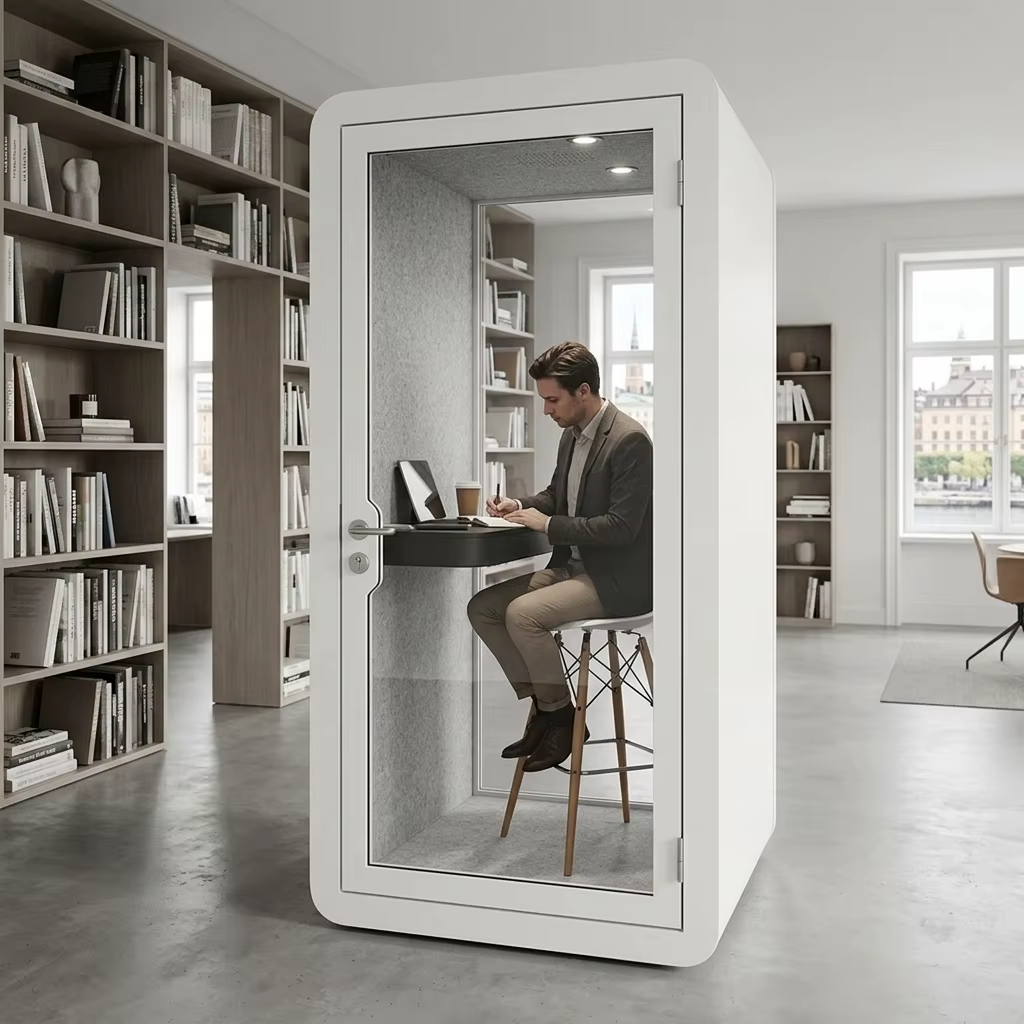
Choose by the work arrangement, not the company headcount
| Actual requirement | Stronger starting option | What the alternative would leave unresolved |
|---|---|---|
| Staff already work on site and need short calls between desk tasks | An existing suitable room, then an on-site pod if that room is unavailable or unsuitable | An external office introduces travel and separates the caller from nearby colleagues and equipment. |
| A remote employee needs a regular workplace near home | A suitable local workspace; a private office when open desks cannot support the work | A pod at distant headquarters does not provide local working capacity. |
| A dispersed team meets in person on occasional planned days | A booked private office or meeting room with the required layout | A permanent pod can sit unused between visits and still needs a host site. |
| Several colleagues take unrelated calls at the same time | Enough separate usable call spaces, whether on site or explicitly available in the service package | One room with several chairs is not several independent enclosed call spaces. |
| People work silently most of the day and rarely need enclosure | An appropriate existing desk or shared workspace, with occasional private-room access where needed | An exclusive room or larger pod may add cost without addressing a frequent constraint. |
A mixed arrangement can be better than one universal purchase. A company might retain on-site call capacity for office-based staff and book external rooms for occasional regional meetings. Compare the distinct tasks separately; do not buy enough permanent enclosed space to cover every rare event if suitable occasional capacity actually exists.
Buy the right to use private space when you need it
A service package that mentions phone booths or meeting rooms may offer shared access rather than a reserved room. For a worker with scheduled client calls, the important distinction is whether a suitable space is exclusively available during those calls, can be booked in advance, or is simply available to whoever arrives first. Count included room time separately from general building access.
Location and time can eliminate an otherwise attractive offer. A room near a client’s office may suit planned visits but be awkward for daily work. A business-hours booking may not fit early calls with another time zone. Regus’s day-office FAQ describes room allocation according to requirements and availability, and access during the center’s opening hours. Treat the actual selected site’s offer as the basis for the decision, rather than assuming a day booking behaves like a dedicated private office.
An on-site pod removes the trip to another provider, but it does not remove competition for space inside your own office. If two employees regularly need separate calls at 10 a.m., one shared pod still serves only one of those independent sessions at a time. Conversely, a four-person meeting pod should not be bought merely because four employees use private space across the week; their overlapping activities determine the need.
Match the physical workspace to what stays and what travels
For short calls with a laptop, portability may make a booked room practical. For daily work with a monitor, documents or a preferred chair, packing and resetting the workstation can make a dedicated location more useful. A day-room photograph does not establish permission to leave equipment overnight, while a reserved desk is not necessarily an enclosed room. The selected agreement and actual layout decide those points.
For an on-site purchase, compare a phone-oriented position with a genuine desk-work position. A compact shelf and stool can suit a brief call without being the arrangement someone wants for sustained keyboard work. Use the selected desk depth, chair movement, screen position and entry route to judge fit. More seats are not a substitute for an adequate single-person workstation.
MobileX’s office pod range provides MP1 and MP1+ as single-person starting points. For a conversation shared by several people, compare the MP2 and MP3 routes on the meeting pod page. Match the actual furniture and equipment to the selected configuration; a model label does not establish a complete workstation or guarantee confidential speech.
The same privacy distinction applies off site. Exclusive occupancy stops another customer from sharing your room during the booked period; it does not by itself prove that speech cannot be understood outside. For either option, assess the intended conversation and receiving positions under normal operating conditions. Do not substitute a membership label or a generic sound-reduction figure for the privacy level the task actually requires.
Compare the full cost of a usable arrangement
Use the same planning period and workload for both offers: the people, locations, working days, simultaneous private sessions and equipment that must be accommodated. Then keep one-time investment, recurring spending and refundable cash commitments separate. A deposit may affect cash needed at the start without being an ordinary operating expense.
On-site capacity
Include the quoted pod and selected furniture, transport, import costs where applicable, delivery into the building, assembly, site preparation and agreed power or data work. Add the incremental cleaning, upkeep and operating costs over the chosen period, plus any planned relocation or removal. Identify who supplies screens, conferencing equipment and network service instead of assuming they arrive with the enclosure.
Show the host premises separately. If your office lease remains unchanged whichever option you choose, charging all of that rent to the new pod distorts the incremental comparison. However, the floor area is not free of consequences: placing the pod may displace desks, circulation or another useful activity. If you need to acquire or enlarge premises to house it, those additional costs belong in the purchase decision.
External workspace
Include the actual day or membership fees for the required locations and users, private-room allowances and paid excess, equipment or storage additions, access requirements, travel and realistic setup time. For ongoing arrangements, compare the commitment and notice period with the expected use period. Do not treat a discounted headline fee as the full budget when the work requires separately paid rooms.
Some services bundle furniture, connectivity, cleaning or reception; only credit items actually included and useful to your team. A service offering more facilities is not automatically better value if your existing office already provides them. On the other hand, comparing only a pod’s factory price against a furnished, serviced office ignores the building and operating services the latter provides.
For equipment ownership versus renting the same kind of pod, use the separate office pod rent-or-buy comparison. That financing decision comes after deciding where the work belongs. There is no universal month when a pod becomes cheaper than an external office; local service scope, usable capacity and the host premises can change the answer.
Two practical decisions, without an invented price comparison
Illustrative office-based team: employees already have desks, internet and suitable building services, but individual calls repeatedly occupy their only meeting room. If the calls occur between on-site tasks, first test whether a smaller existing room can take them. If not, a checked single-person pod can add the missing capacity. Buying a larger meeting pod for those solo calls, or sending callers off site, may pay for the wrong space.
Illustrative distributed team: four employees meet twice a month in a city where the business has no premises. A suitable booked room is a stronger starting point than buying an enclosure with nowhere to install it. If they later work there daily with equipment left in place, a dedicated private-office offer becomes a different comparison. Neither scenario is a MobileX customer case or a measured financial result.
Turn the decision into comparable proposals
Before requesting prices, settle four things: where the work must happen, when private capacity is needed, what must fit inside, and which existing services remain available. An external provider can then price the actual room access rather than an unsuitable desk pass. For an on-site pod, MobileX can review a marked location, the intended people and equipment, and the required supply boundary through a project enquiry.
Choose the arrangement that supplies the missing part of the workday. Keep a good existing room when it already works. Add a pod when nearby enclosed capacity is the real shortage. Buy an external workspace service when the location and supported workplace are the missing purchase. Paying for a larger room, more seats or a broader membership is worthwhile only when those additions solve a task you actually have.