Outdoor Kiosk Quote Checklist: Equipment, Site and Supply Scope
For a useful outdoor kiosk quotation, send the supplier your intended use, equipment schedule, available site dimensions, destination, quantity and required project date. Then separate what the factory will supply from what your local team will install or complete. A quotation becomes comparable when the layout, interfaces, delivery basis and outstanding decisions are clear.
A coffee kiosk and an information booth may have similar outside dimensions but very different requirements inside. Start with the operating plan, then turn it into a drawing brief and an itemized supply scope. This checklist helps operators, commercial project buyers and contractors prepare that information before asking for a final price.
Still choosing between a fixed trading point and a travelling operation? Our coffee-kiosk, truck and trailer comparison helps match the format to your locations before you prepare the equipment brief.
1. Describe the Business Before Choosing the Shell
State what the kiosk will do: serve drinks, sell packaged goods, issue tickets, provide information or support another commercial activity. Explain who works inside, what customers do at the counter, and how stock, waste and equipment move through the space.
Include:
- The operating activity and intended location.
- The number of staff expected to work inside at the same time.
- The customer-facing side, queue direction and service counter needs.
- Opening hours, storage needs and the expected replenishment route.
- Whether the project is a one-location pilot or part of a planned rollout.
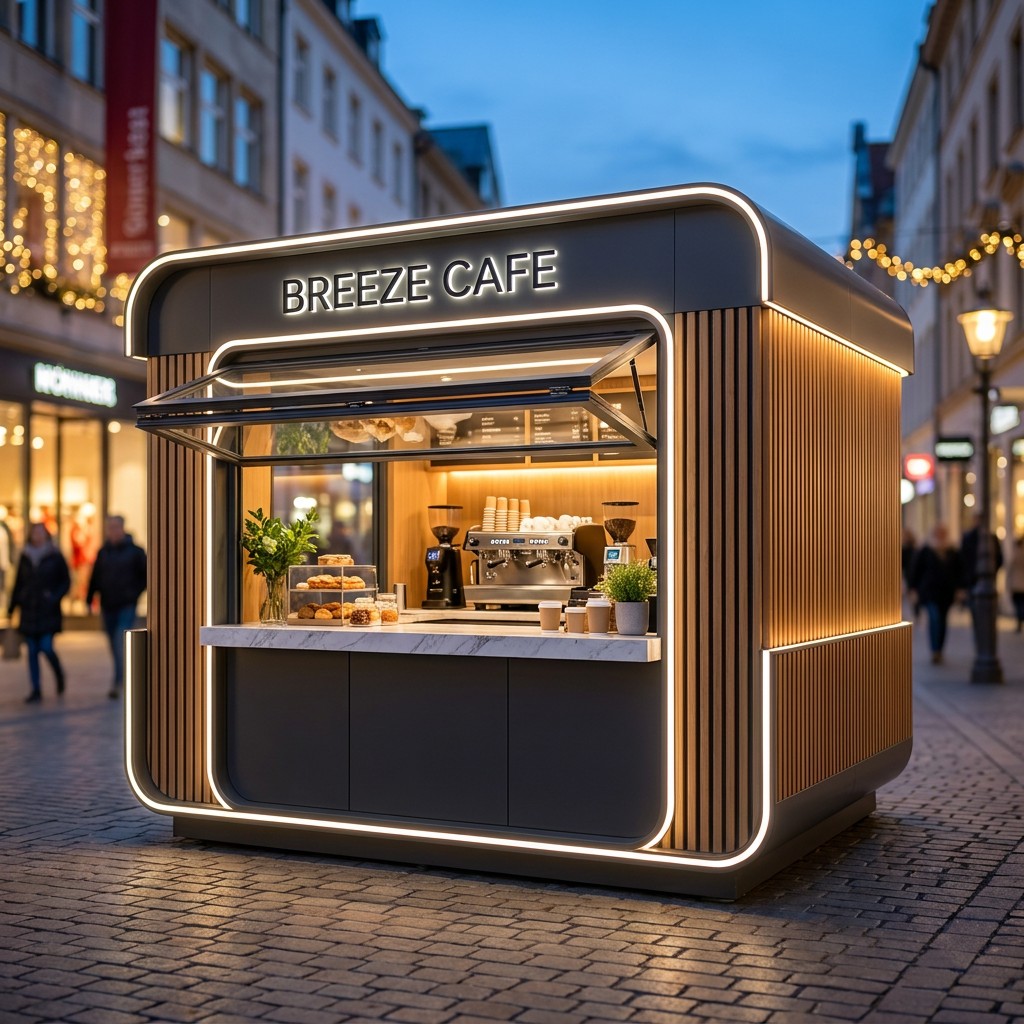
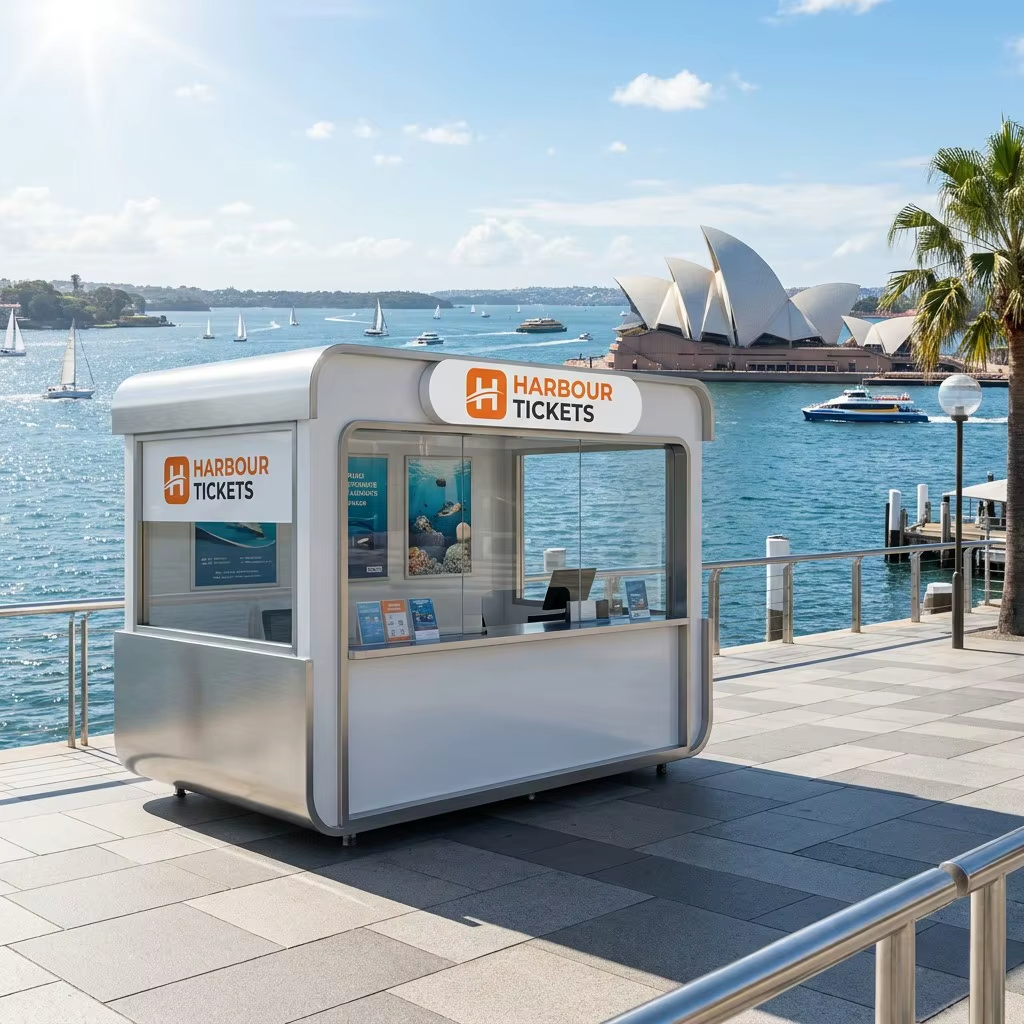
For example, a coffee operator should identify the espresso machine, grinder, refrigeration and cleaning arrangement before fixing the counter layout. An information-kiosk buyer may instead need to prioritize screen visibility, network access and equipment servicing. These are planning examples; the equipment and configuration for your project should be specified in its own brief.
Review the outdoor commercial kiosk range to identify a starting concept, and use the outdoor kiosk manufacturer data to organize model-specific questions.
2. Build an Equipment Schedule With Actual Model Information
An appliance name alone is rarely enough to locate an opening, outlet or service connection. Send the selected manufacturer's dimensional drawing or datasheet. If a model is not selected, mark it as an open decision and identify when it will be confirmed.
For each item, record:
- Equipment: name, manufacturer, model and datasheet revision.
- Space: external dimensions, operating clearance, service access and weight where relevant to the design review.
- Connections: the manufacturer's stated electrical, water, drainage, ventilation or network requirements, as applicable.
- Position: proposed location, counter relationship and any required opening.
- Responsibility: who purchases, supplies, installs and commissions it.
Ask the supplier to show the agreed interfaces on the drawing. Distinguish a prepared opening or mounting provision from the actual equipment and its final connection. For instance, a provision for a display is a different item from the display, bracket, cabling and installation work.
If equipment selection changes, flag it before approving the revised layout. A different model can change access requirements, cutout dimensions or the location of services. The responsible designer or supplier should confirm the effect rather than relying on a similar-looking product photograph.
3. Document the Site and the Delivery Route
Provide a site plan, photographs and the available width, depth and height. Mark door swings, service openings, surrounding structures, customer circulation and maintenance access. Identify whether the kiosk sits under a canopy, in a partly sheltered position or in an exposed outdoor location.
Ask the local project team to establish the site-specific design requirements. Relevant inputs may include exposure to rain, wind, sun, coastal conditions, ground conditions and local structural or fire-safety requirements. Send the applicable project criteria and identify who is responsible for assessing them. Product appearance alone is not a specification for these conditions.
The supplier also needs to know how the unit reaches its final position:
- Vehicle access and any restricted delivery hours.
- Route dimensions, overhead restrictions and turning constraints.
- Whether unloading or lifting equipment is available, and who arranges it.
- The proposed foundation or support arrangement and who designs and completes it.
- Where utilities will terminate, and who makes the site connections.
Keep installation access separate from operating space. A kiosk may fit its final footprint while still requiring a different delivery or lifting plan. Agree the packaged dimensions and handling arrangements for the actual configuration before booking transport.
Confirm the Local Approval Route Early
Ask the site owner and the relevant local authority what approvals apply to the intended use and location. Identify the documents the local designer, installer or supplier must provide before purchase and before opening.
For a US food-service project, the FDA Food Code is a model used by jurisdictions to develop their own food-safety rules. Confirm the requirements adopted by the responsible authority for your location and activity. The FDA's Food Code overview explains that distinction. Other destinations have their own approval routes; a general kiosk quotation should be supplemented by the requirements for the actual site.
4. Separate Factory Supply From Local Completion
Use one scope schedule for every quotation. For each line, ask suppliers to select included, excluded, buyer supplied or to be confirmed, and name the party responsible for completing the work.
| Scope item | What to make explicit |
|---|---|
| Shell, doors, windows and counters | Drawing revision, materials, finish and agreed dimensions |
| Openings and mounting provisions | Location, size, interface details and whether associated equipment is included |
| Appliances, displays and operating equipment | Exact model, purchasing party, installation and commissioning responsibility |
| Internal services | Agreed wiring or pipework, connection points and the documents to be supplied |
| Foundations and site connections | Responsible local party, design inputs and handover points |
| Packing, transport and positioning | Packing scope, delivery basis, unloading, lifting and final placement |
| Branding and signage | Artwork, dimensions, materials, installation and any local approval responsibility |
This is a buyer's comparison tool, not a statement that every listed item is included in a MobileX order. Use it to turn a broad request such as “fully fitted” into a set of agreed deliverables.
For a customized shell or layout, the custom modular project page is the relevant starting point. Send the equipment and site information with the inquiry so the proposed factory scope can be reviewed against the local completion work.
5. Resolve the Decisions That Change a Quotation
Focus on unanswered questions that could change the design, purchased components or delivery arrangement. Typical examples are an unselected appliance, an unconfirmed service opening, missing site criteria or an undecided shipping destination.
Keep a short decision log:
- Open item: what remains undecided?
- Effect: which drawing, component, scope line or delivery assumption depends on it?
- Owner: who will provide the answer?
- Due date: when is confirmation needed?
- Quotation treatment: fixed inclusion, stated allowance, exclusion or pending confirmation?
Provide the quantity and any planned repeat orders. A pilot unit can be discussed as a project request, but ask for the quotation's actual minimum quantity and customization conditions rather than assuming they are identical across configurations.
Separate the required opening date from the requested delivery date. Ask the parties responsible for manufacturing, transport and local completion to identify their respective stages. A schedule should show the agreed prerequisites, including equipment information and drawing approval, instead of treating every day before opening as factory production time.
6. Compare Delivery Terms and Total Scope, Not Only the Headline Price
Request quotations against the same drawing revision and scope schedule. Record the currency, quantity, configuration, price validity, payment milestones and the agreed delivery basis. Compare inclusions and exclusions before comparing totals.
When using an Incoterms rule, state the agreed rule, named place or port and edition. Confirm transport, customs, unloading and site placement responsibilities explicitly. ICC's Incoterms 2020 guidance explains the allocation of costs, risks and obligations; for example, unloading differs between DAP and DPU. The selected term should be consistent with the actual transport plan.
A useful comparison should make these questions easy to answer:
- Are all offers based on the same layout and equipment information?
- Which appliances, fittings and finishes are included by each supplier?
- What remains provisional, and what information will fix it?
- Who handles packing, freight, import procedures, unloading and local work?
- What drawings and project documents will be delivered?
- What must be approved before the quoted schedule starts?
For a custom quotation, confirm the configuration, quantity, destination and required project date. The quotation should state the agreed supply scope, price and lead time.
Send a Brief That a Supplier Can Act On
Use the following fields in your inquiry and attach the available drawings or photographs:
Copy This Kiosk Project Brief
Project / location: [activity, country, city and site type]
Quantity / rollout: [pilot and later phases]
Available space / access: [dimensions, plan and restrictions]
Equipment: [models, datasheets and pending selections]
Layout / appearance: [openings, counter, finish and branding]
Factory supply / local work: [define scope]
Delivery / project date: [destination and local installation plan]
Open items / owner / confirmation date: [list decisions]
The product catalogs can help you describe your starting concept. Then send your kiosk project brief to MobileX POD for a configuration-specific discussion.
MobileX POD is the export brand of Shenzhen MobileX Technology Co., Ltd., registered in Shenzhen, China. Its factory, office and showroom address is No. 22 Yuhe Road, Dongshan Village, Qishi Town, Dongguan, Guangdong, China.