Food Kiosk or On-Site Kitchen? Choose Where the Food Is Prepared
Choose a serving kiosk when another kitchen or supplier can reliably provide the food ready for the tasks you will perform at the counter. Choose a cooking-kitchen layout when preparing the menu on site is part of the operation. Between them is a finishing arrangement: prepared food arrives, but assembly, reheating or another defined step happens inside the kiosk.
These arrangements can look similar from the customer side while requiring different equipment, working space and project budgets. For operators, contractors and equipment dealers, the first purchase decision is where each production step belongs, not how many appliances fit in a picture. This guide concerns a physical food-service enclosure, not ordering software or a self-service terminal.
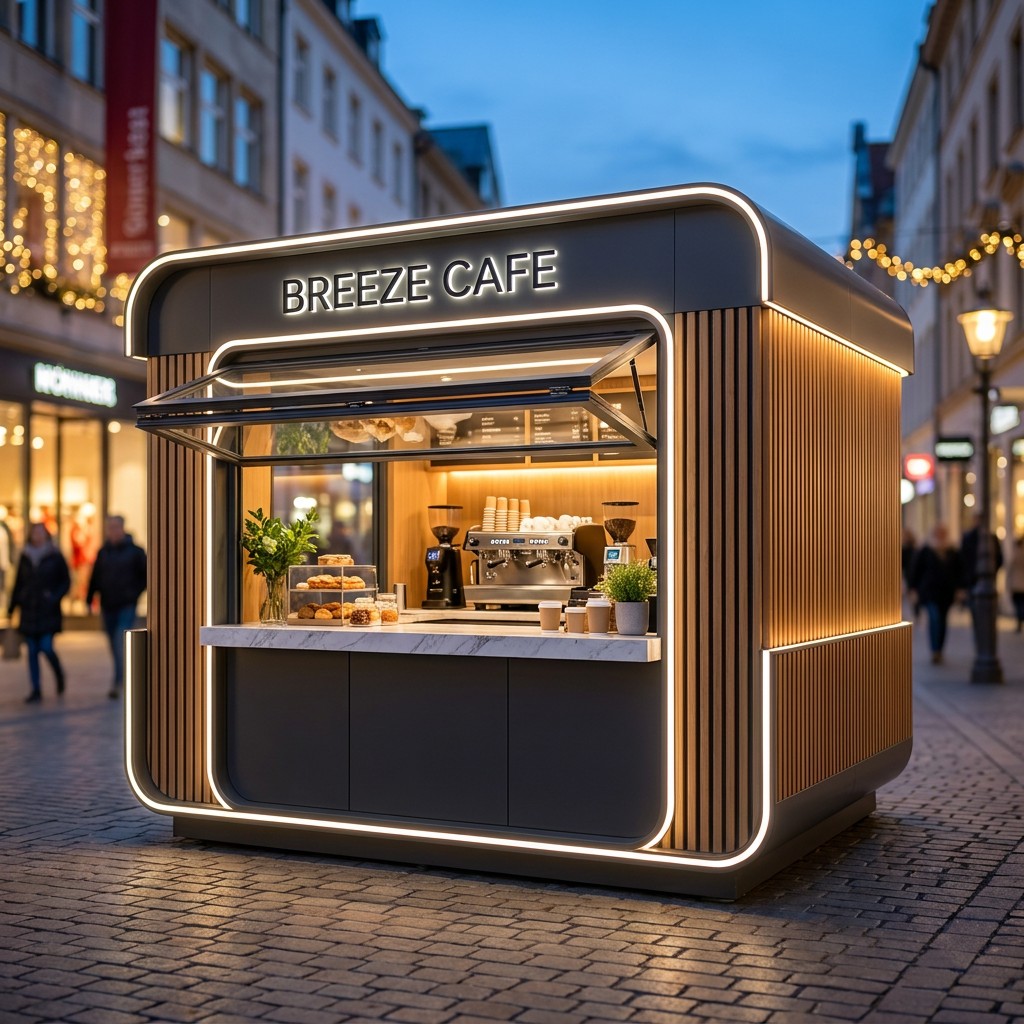
Compare three production arrangements
1. Receive and serve
A supporting kitchen or food supplier does the production work. The kiosk receives, stores, displays and serves the agreed products. This can be a useful starting point for a venue adding a second selling point while retaining an existing kitchen.
The apparent saving inside the kiosk comes with a dependency outside it. Food must arrive in the required condition, at the right time and in quantities that fit the available storage. Include delivery containers, replenishment work, holding equipment and the return of used items in the operating plan. A serving-only brief does not automatically remove handwashing, cleaning, refrigeration or other requirements for the actual menu and location.
2. Finish prepared food at the counter
Some work remains elsewhere, while the kiosk carries out named final steps. Write those steps explicitly: assembling a sandwich is not the same equipment brief as heating a prepared meal, and neither describes every operation that might be called a snack kiosk.
This route can move selected tasks closer to the customer without duplicating a full production kitchen. It can also become an awkward compromise if the required equipment leaves too little space for ingredients, packaging and cleaning. Select the appliances and their service requirements before fixing the worktop and enclosure layout.
3. Prepare and cook on site
Start with a kitchen plan when the business needs to handle ingredients and produce the menu at the selling location. Allocate space to receiving and storage, preparation, the cooking equipment, service and clean-up. The cooking appliance is only one part of that purchase.
Have the food-service designer and responsible local specialists establish the ventilation, extraction, fire protection, water, drainage and electrical provisions required by the actual appliances and operation. An ordinary room fan is not a substitute for an assessed cooking-extraction arrangement. If the proposed site cannot accommodate the resulting service routes or working layout, compare off-site preparation or a different location before ordering a larger shell.
Real supplier ranges illustrate why the distinction matters: ROXBOX describes concession stands for pre-packaged foods and drinks, while Concession Nation shows kitchen-container projects with commercial cook lines. These are examples of different purchase scopes, not specifications for a MobileX configuration.
Trace one menu item through the proposed unit
Choose an item that represents the most demanding normal task, not the simplest sale. Record its condition on arrival, where it is stored, what staff do to it, how it reaches the customer and what must be cleaned afterward. Repeat this for any menu item that needs a different process.
Put those steps on the equipment plan. A chilled prepared sandwich handed over in its packaging needs a different working arrangement from one assembled to order or cooked from raw ingredients. The product name alone does not tell the supplier which arrangement to quote.
Then add a second operator or a replenishment task where the operation actually needs one. Look for the work surface being used twice at the same moment, equipment doors blocking a preparation position, or used utensils returning through a serving position. The existing kiosk layout guide develops customer movement and access; this step establishes which food-production activities the layout must accommodate.
The FDA’s food-establishment plan-review guidance explains the value of coordinating equipment and electrical, mechanical and plumbing information before construction and purchasing. For a US project, establish the applicable requirements with the responsible local authority; other destinations have their own review arrangements. This is a project-planning comparison, not a food-handling procedure or an approval certificate.
Recognize when a menu change becomes a building change
Hypothetical example: a second selling point
A visitor attraction has a working kitchen and wants a remote counter offering bottled drinks and prepared sandwiches. It initially compares a serving kiosk supplied by that kitchen with a separate cooking unit. If the kitchen has usable capacity and the replenishment route works, the serving option avoids duplicating production equipment.
The operator then proposes cooking burgers at the counter. Keeping the same exterior and adding a grill does not make the two proposals equivalent. The revised offer must account for the chosen cooking process, ingredient storage, preparation, cleaning and the associated building services. The useful comparison is now a defined on-site kitchen versus the original kitchen-supported service, not the price of a grill versus no grill.
Hypothetical example: the supporting kitchen closes first
A resort expects the kiosk to trade after its main kitchen closes. Moving preparation elsewhere has not solved the evening operation unless the approved food supply, storage, cleaning and staff arrangements remain available. The operator can compare changing those support arrangements, using a suitable finishing setup, or investing in a separately equipped kitchen. A shorter distance to the main building alone does not answer the operating-hours question.
Both examples are planning assumptions, not MobileX customer projects. Their purpose is to identify the configuration that can deliver the intended menu during the actual trading hours.
Compare the complete cost of the chosen operation
Use the same menu, operating period and service requirement for each option. Separate three amounts:
- Ready-to-operate project cost: the enclosure, agreed fit-out, equipment, transport, site work and connections still needed before use.
- Continuing support cost: the additional kitchen capacity, preparation labour, delivery trips, containers and cleaning attributable to this selling point.
- On-site operating cost: the staff, utilities, equipment care and waste handling required by the kiosk’s own tasks.
For a hypothetical 120-day season with two replenishment runs per day, there are 240 runs to cost. Multiply a quoted or measured cost per run by 240; do not invent a delivery saving. If staff already make the journey, identify the additional time and capacity the new outlet uses rather than charging the entire existing operation again.
Conversely, spare kitchen capacity is not unlimited free production. Include extra work or equipment if the new outlet displaces existing service. Compare any saving from a smaller kiosk with that support cost over the same period. Keep unpriced extraction, connection or approval work visible outside the confirmed subtotal rather than treating it as zero.
Turn the selected arrangement into a MobileX brief
MobileX can customize an outdoor kiosk’s dimensions, exterior and working layout. It can prepare agreed interfaces for customer-supplied equipment or provide the enclosure, fit-out and operating equipment as a complete agreed scope. The project drawings and quotation identify the equipment and work included; an appearance concept is not the equipment schedule.
Start with the outdoor commercial kiosk range. Send the menu and production steps, what arrives from elsewhere, the actual equipment list or dimensions, available site area, destination and the scope you want MobileX to provide. Identify any supporting kitchen and the hours during which it is available.
Send your food-kiosk project brief to MobileX so the layout and supply discussion starts from the operation you intend to buy. Use the existing quotation checklist to organize the detailed supply and site information after selecting the production arrangement.