Office Pod, Phone Booth or Meeting Booth? Choose by the Work Inside
Choose a phone booth for one person’s spoken call when its working surface and seating suit the task. Choose a meeting booth when people need to share the same conversation, table or display. For sustained laptop work, choose a layout that supports the actual desk setup rather than assuming any single-person enclosure will do. Start with the activity, then test the proposed layout. The labels office pod, soundproof booth and acoustic booth are not enough to make that choice.
The distinction matters before comparing models or prices. A small enclosure with the wrong working surface can be unsuitable even for one person, while a room with more seats may add nothing to a task that needs a separate call space. This guide helps you choose the type of space first; it does not rank products by their names.
Several names can describe the same enclosure
In an office purchase, office pod is a broad description. Phone booth usually points toward individual calls, while meeting booth points toward people using a space together. Office phone booth is not necessarily a separate product category from phone booth. A supplier may also describe either format as an acoustic booth or soundproof booth.
Read the offered design behind each label: is it an enclosed room, what is the intended activity, and what layout is shown? A product name does not establish the usable space, furniture included in the offer or its acoustic performance. The following distinctions are useful for making a shortlist, not universal definitions that every seller follows.
| Name in the offer | Useful starting interpretation | What the name leaves unanswered |
|---|---|---|
| Office pod | A workspace enclosure; it may be intended for individual work or shared use. | Which activity, how many people using it together, and what furniture arrangement? |
| Phone booth / office phone booth | A starting point for an individual spoken call or online meeting. | Does the layout support the required posture, laptop, camera and accessories? |
| Meeting booth | A shared space for a conversation or collaborative task. | Can the intended participants use the table or screen and enter, sit and leave in the proposed arrangement? |
| Soundproof booth / acoustic booth | A label drawing attention to acoustic use, not a separate capacity or furniture category. | Is the task office work or recording, and what evidence applies to the offered enclosure? |
Do not eliminate two offers as duplicates merely because the labels match, or treat them as different solutions merely because the labels differ. Compare the activity and layout on each offer. A phone booth and an acoustic office pod may be alternatives for the same single-person call; two products both called meeting booths may serve different working arrangements.
One-person calls: buy a call space, not unused seats
For an individual call, start with what the person does during it. A handheld call requires a different working arrangement from a call that involves typing notes, consulting documents and using a laptop. Decide whether the user will stand, perch or sit at a working surface. Then look at the proposed surface and seat together, with the door and entry path shown.
A larger meeting enclosure can accommodate one caller if the layout suits them, but that does not make it the right first purchase. If its shared table and extra seats are never needed, compare the single-person options before paying for a group layout. Conversely, reject a compact call booth for the task if the required equipment and working position cannot be accommodated; a one-person label is not evidence that every one-person activity fits.
If several people need unrelated calls at once, the question changes from room type to the number of independent spaces. Use the office pod quantity and capacity-mix guide for that decision. One meeting room with several seats is still one shared room.
Video meetings add a layout test, not automatically another seat
A person joining colleagues online may still need only a single-person enclosure. The extra questions concern the working setup: where the laptop or camera sits, what is visible behind the user, whether the screen and keyboard can be used together, and where required cables pass. An empty shelf is not proof that a complete video workstation will fit.
When two people in the same enclosure join the same remote meeting, assess them as a shared activity. Their positions relative to the screen and camera become part of the choice. A face-to-face seating arrangement that works for a local conversation is not automatically suitable for both people to participate in a video call. The equipment and layout need to work together; the enclosure does not by itself provide a camera, display or online meeting service.
This is a reason to reject an unsuitable arrangement, not a reason to assume that all video meetings require a larger model. Keep the detailed camera, lighting and equipment discussion in the existing video-call guidance rather than selecting the type of pod from a screen shown in a product image.
Desk work can rule out a booth that is fine for calls
For typing, document review or other desk tasks, describe the real setup: laptop alone, laptop with a separate keyboard, or a monitor with documents beside it. The surface, seating position and room to use those items are part of the product choice. A call shelf and perch may be a useful call arrangement without being the arrangement you want for regular desk work.
Do not assume the furniture can simply be exchanged later. A different chair or desk can change the relationship to the door, usable floor space and fixed fittings. Evaluate the intended furniture in the model’s layout before selecting it. Neither an external width nor a photograph establishes an internal working dimension or a comfort guarantee.
If the task is quiet individual work and the existing workspace already meets it, an enclosure may not be the first purchase needed. If calls or visual exposure are the reason for looking at a separate space, keep that reason explicit. The call versus focused desk-work guide develops this configuration choice without making every private workspace a phone booth.
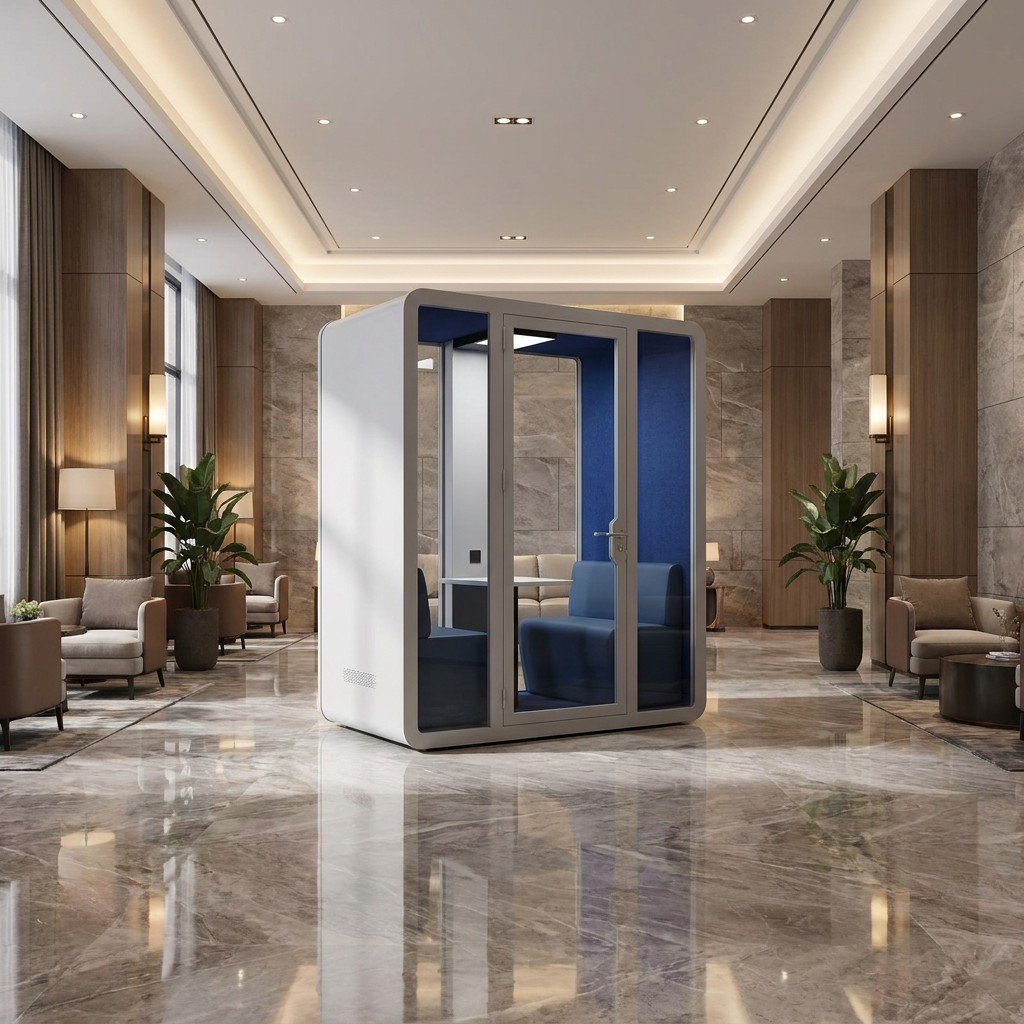
Shared discussion needs a shared working arrangement
When people need to talk to each other in the same space, shortlist a meeting layout. For a conversation, consider whether participants face each other and can enter and leave in the proposed arrangement. For joint document work, add the surface each person needs. For a shared display, add its intended position and the way people will view it. The number printed beside the model is the beginning of this assessment, not the whole answer.
A two-person conversation does not automatically need the same furniture as two people using laptops side by side. Likewise, an occasional four-person discussion should not automatically dictate every daily two-person purchase. Use the two-person versus four-person meeting booth guide once a shared enclosure is the right type. It addresses daily and occasional capacity; this article first separates shared work from solo work.
Do not choose a group pod as a substitute for several independent spaces if its users need unrelated calls. Nor should a compact individual booth be shortlisted for a local two-person discussion on the assumption that another seat can be added. Both mistakes confuse a seat count with the activity the layout supports.
Use the task to remove unsuitable options
The following screen helps you narrow offers before comparing their prices. These are selection questions, not measured claims about a particular model.
| Required task | Start with | Remove from the shortlist when | Useful next check |
|---|---|---|---|
| One caller with a phone | A single-person call layout. | The entry or intended sitting/standing arrangement does not suit the user. | Review the offered working position and door arrangement. |
| One person on video while taking notes | A single-person layout with an appropriate working surface. | The screen, camera position and note-taking setup cannot work together. | Place the actual equipment on the proposed layout. |
| Regular laptop or document work | A layout designed around the required desk task. | The offered shelf or seating arrangement cannot support that setup. | Review usable working space with the intended furniture, not external size alone. |
| A pair or group sharing a conversation | A meeting layout for the stated shared task. | People cannot use the proposed table or display together, or the plan relies on adding unassessed seating. | Review participant positions and the daily versus occasional group size. |
| Several unrelated calls at once | Separate suitable spaces. | The offer provides extra seats but not the required independent rooms. | Compare the number and mix of enclosures. |
Acoustic wording does not decide the work type
Soundproof booth and acoustic booth can appear in the search for either a call space or a meeting enclosure. Neither name proves complete silence, confidential speech privacy or suitability for recording. First establish what work the offered configuration serves, then assess the acoustic evidence relevant to it.
For office work, the office pod acoustic ratings guide explains how to distinguish test objects, methods and configurations; the acoustic glossary explains the terminology. A recording task needs its own equipment and acoustic brief. Use the recording-space procurement guide rather than treating a workplace call booth as a recording-grade room.
Take the chosen space type to the right buying page
For MobileX’s standard office range, start with MP1 and MP1+ single-person office pods for an individual call or workspace requirement, and MP2 and MP3 meeting booths for shared use. These are model starting points, not a claim that every furniture or equipment arrangement is included. The four-model comparison carries the confirmed external dimensions, reference-price context and configuration questions.
Discuss a custom modular pod when the required use cannot be accommodated by an appropriate standard layout, or when the project needs a different size, appearance or internal arrangement. A need for a particular activity is more useful than asking for a new product name. The proposed configuration, included furniture and equipment remain matters for the actual model offer.
For a useful first enquiry, state the primary task, the people using the space together, the intended posture and working surface, and the equipment that must fit. Add the proposed location and the layout constraints already known. Identify which need is essential and which is occasional. You do not need to copy a full logistics or supplier-audit checklist into this first product-type decision.
Ask MobileX to compare suitable configurations for your work. Once the shortlist contains options that serve the same task, use the existing price guide and quotation-scope guide for the next buying step. Compare like-for-like usable work, not different labels on the enclosure.