Sound Masking or an Office Pod? Decide Whether Speech Should Stay in the Open Office
Sound masking can be one part of an acoustic plan for a shared office, but it is not automatically the answer whenever people complain about speech. Its suitability depends on the source of the distraction, the room and the way the masking system is designed and operated. When people need a separate place for calls or meetings, compare an existing suitable room with an office pod instead.
The practical buying question is: what speech problem can masking address, and what still requires an enclosed destination? Answer that before approving either proposal. A masking system changes the background sound in a planned area. A room or pod changes where an activity happens.
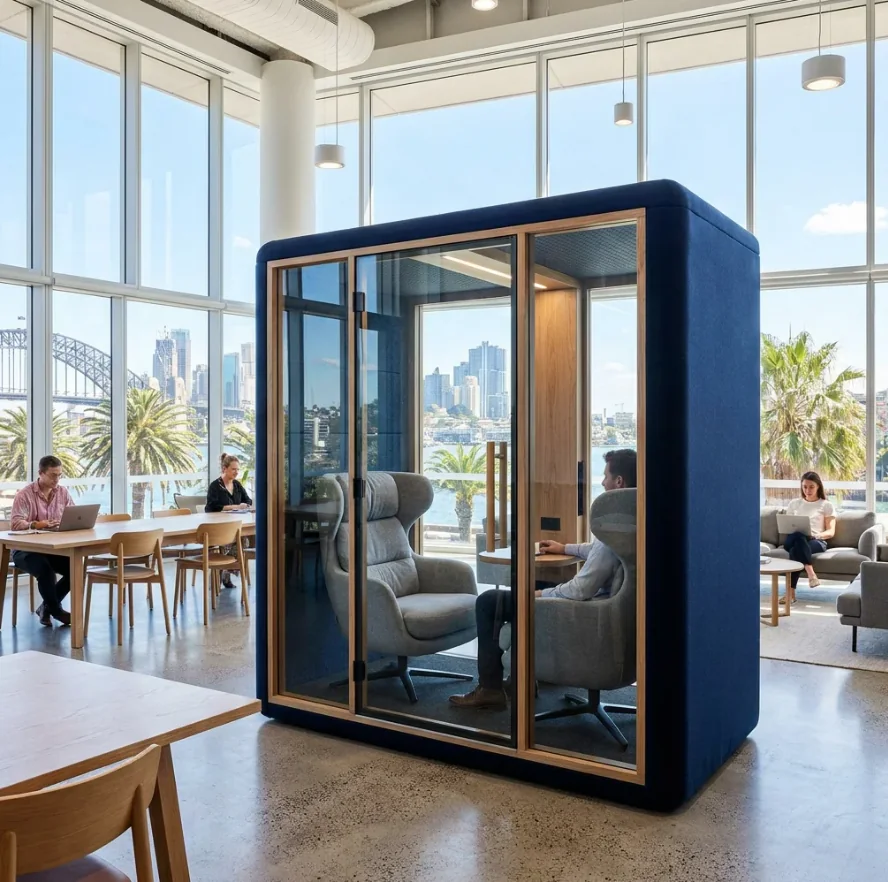
Why added background sound can make speech less distracting
A sound-masking system adds a controlled background sound to a defined area. By reducing the contrast between speech and the existing background, it may make distant conversation less noticeable or less intelligible. The US National Institutes of Health’s 2016 open-office sound guidance describes a well-designed system as one measure that can reduce speech intelligibility and acoustic distraction.
That does not mean the system removes the talker, absorbs the speech energy or creates a sound-insulating boundary. The conversation still occurs in the open room. The GSA Sound Matters guide from 2011/2012 treats absorption, blocking and masking as different strategies. Its masking section describes low-level background sound that must respond to the acoustic situation of the workspace; it does not present masking as a substitute for every other measure.
This distinction matters at short distances. A nearby caller may still be noticeable or understandable depending on the voice, distance, layout, room finishes, barriers and the actual masking field. Masking can help under suitable conditions, but it cannot guarantee that the person at the next desk will stop noticing the call. An office pod likewise cannot guarantee absolute silence or confidentiality.
For the separate question of treating reflections in the room, use the office pods versus acoustic panels guide. Adding absorption and adding masking are not the same purchase, even when they are part of one acoustic plan.
If masking is already installed and calls are still distracting
Do not respond first by turning the system up or ordering a pod. The NIH guidance notes that too much background sound, or sound concentrated in the wrong frequencies, can itself be distracting. The GSA guide also describes masking as something tuned for different workspace areas. Start by finding out what is actually failing.
- Define the complaint. Record whether the problem is intelligible speech at a distance, one nearby caller, masking sound that users notice, or noise from equipment or building services. Note where and when it occurs without recording conversation content.
- Check the affected zone as installed. Ask the responsible acoustic or system team whether the system is operating as intended in that area and whether its zoning and tuning still match the present workplace. A furniture move, ceiling change or new use pattern can change the context without proving that the answer is simply more volume.
- Review the room around the system. Look at the speech source, workstation orientation, distance, absorptive finishes and barriers. The 2018 GSA P100 describes engineered open-plan design as a combination of absorptive ceilings, suitable partitions, background sound and ready access to closed meeting spaces.
- Decide whether the activity belongs there. A short exchange needed at adjacent desks is different from an extended sales call, interview or sensitive discussion. If the activity can move, test whether an existing suitable room already solves the problem before buying another enclosure.
These references explain design concepts in specific US federal publications from 2011/2012, 2016 and 2018. They are not current worldwide specifications, MobileX certifications or settings to copy into another project. The responsible project team should diagnose and verify the actual workplace.
Separate the jobs in two competing proposals
When one proposal recommends sound masking and another recommends office pods, ask each to name the recurring activity it changes. The proposals may address different problems or contribute to the same acoustic goal. Ask what each adds and how the combined result will be checked.
Identify the area and speech problem it addresses, how the installed result will be checked, and which absorption, barriers or layout conditions are assumed. Do not count a private-call room as one of its outputs.
Name the activities, simultaneous users, equipment and proposed location. Check existing rooms first. If an enclosure is still needed, verify its configuration and site rather than borrowing a privacy promise from its appearance.
Show the unresolved need assigned to each scope. If both offers claim to solve the same nearby call without explaining different mechanisms or acceptance checks, the buyer may be paying twice without a clear decision basis.
A small number of pods will not improve conversations that continue at every open desk. Use the office-pod quantity guide when the shortage is concurrent enclosed spaces. Where sensitive conversations are involved, follow the site-specific privacy review; neither masking nor a closed-looking product establishes confidentiality by itself.
When the missing resource is an enclosed space
If suitable rooms are available when needed and work for the task, another pod may be unnecessary. If callers repeatedly lack an appropriate destination, describe the activity that will move, the number of simultaneous users, the equipment they bring and the proposed placement conditions.
MobileX can discuss standard single-person office pods and meeting booths, along with custom size, color and project interfaces where a standard arrangement does not fit. Discuss building-wide sound-masking design and commissioning with the responsible acoustic or system team. Review the MobileX office-pod range, then send the enclosed-space requirement to MobileX when that is the confirmed gap.