How to Verify a China Office Pod Manufacturer Before Ordering
If you are sourcing an office pod, phone booth, office phone booth or soundproof booth from China, do not judge the supplier only by renders, catalog claims or a low unit price. A serious buyer should verify the company identity, product data, factory process, export packing, customization ability, warranty scope and quotation readiness before paying a deposit.
MobileX POD is the export brand of Shenzhen MobileX Technology Co., Ltd. For buyers comparing China office pod manufacturers, the practical question is simple: can the supplier show enough evidence to support the quotation, build the product you need, and help your team receive, install and maintain it after export?
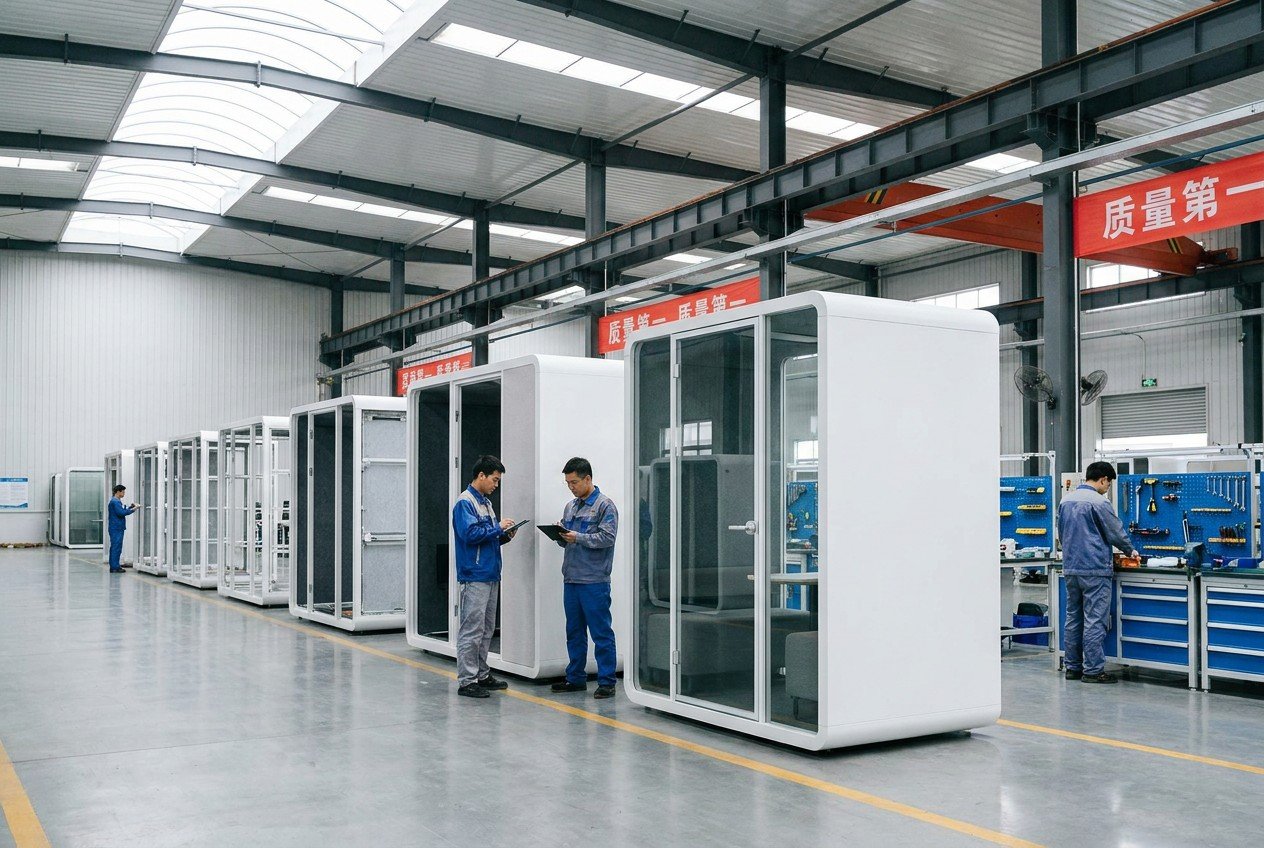
1. Confirm the manufacturer identity
Start with the basic entity check. Ask the supplier to confirm the buyer-facing brand name, the legal company name, the factory or production location, and the person responsible for export communication.
For MobileX POD, the buyer-facing brand is MobileX POD and the company entity is Shenzhen MobileX Technology Co., Ltd. The brand focuses on office pods, meeting booths, lactation pods, telemedicine pods, outdoor kiosks and custom modular pod projects for overseas buyers.
What to request before ordering:
- Company name used on quotation, invoice and export documents
- Business license or company registration document
- Factory address or production location
- Contact person, email, phone or WhatsApp details
- Product scope: office pod, phone booth, office phone booth, soundproof booth, meeting booth or custom modular pod
If a supplier cannot keep the same company name, brand name and product scope consistent across emails, documents and public pages, treat that as a sourcing risk.
2. Check whether the product data is specific
A real manufacturer should give clear model data, not only lifestyle photos. For office pods, compare size, people capacity, reference price, MOQ, production lead time, customization options, installation method and export terms.
MobileX POD uses the MP model line for office pod and meeting booth comparison:
| Model | Typical Use | Reference Size | Reference Price |
|---|---|---|---|
| MP1 Office Pod | One-person calls and focus work | 1000 x 1000 x 2200 mm | Starts from USD 1,380 EXW |
| MP1+ Phone Booth | Larger one-person phone booth | 1200 x 1200 x 2200 mm | Starts from USD 1,650 EXW |
| MP2 Meeting Booth | Two-person meeting booth | 2000 x 1000 x 2200 mm | Starts from USD 2,380 EXW |
| MP3 Meeting Booth | Four-person meeting booth | 2000 x 1600 x 2200 mm | Starts from USD 3,650 EXW |
MobileX accepts MOQ 1 for sample or pilot projects. Standard office pod production is usually 15 to 20 days, while custom projects are commonly around 30 days depending on the drawing, size, finish and component requirements. Custom color, socket, voltage, logo, size and interior layout can be discussed before quotation.
3. Ask for process evidence, not only product renders
Product renders are useful for layout discussion, but they are not proof of manufacturing. Ask for current photos or videos of production, inspection, packing and loading. A supplier should be able to show the type of evidence that matches the product you are buying.
Useful evidence includes:
- Production or assembly photos
- Door, glass, panel or hardware inspection photos
- Interior electrical and lighting checks
- Export crate or packing photos
- Container loading photos when available
- 2D or 3D drawing for custom dimensions
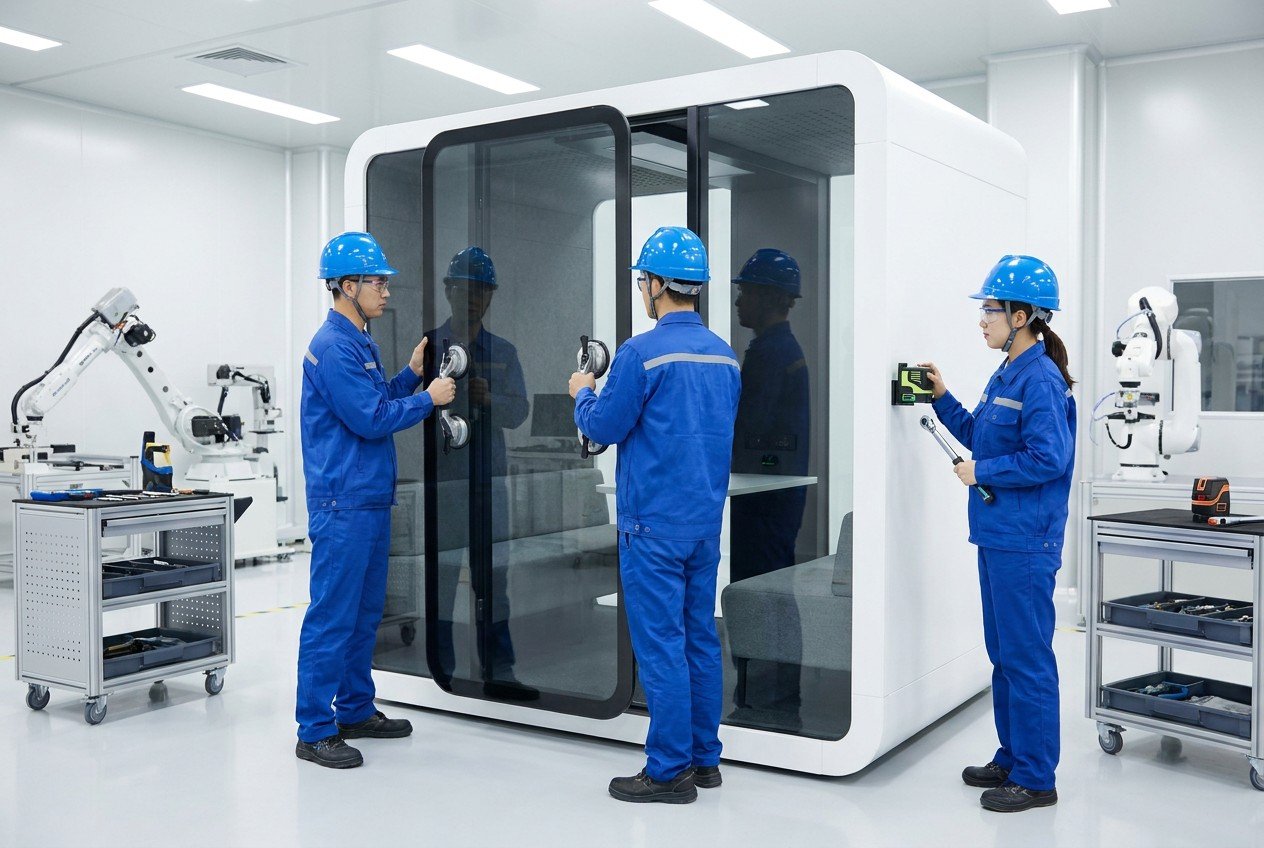
When using public visuals as evidence, remember that they are process examples. For a paid project, request current project-specific photos, drawings and packing confirmation before final shipment.
4. Verify acoustic claims carefully
“Soundproof booth” is a common search term, but buyers should be precise. Office pods reduce noise; they do not make every site fully silent. Ask how the supplier describes sound reduction and what installation conditions affect the result.
MobileX POD describes standard office pods as offering up to about 35 dB noise reduction depending on site conditions. This wording matters because room acoustics, floor flatness, surrounding HVAC noise, installation quality and door sealing can all affect the final user experience.
Before ordering, ask:
- Is the claim a reference reduction value or a guaranteed site result?
- Which model was used for the reference value?
- Does the door seal, ventilation path or glass panel change the acoustic result?
- What installation checks are required after assembly?
5. Review customization before the quotation is finalized
For OEM or custom office pod projects, do not wait until after payment to discuss details. Customization should be included in the quotation discussion.
Common custom points:
- Size and layout
- Exterior color
- Interior finish
- Socket type and voltage
- Logo or private-label elements
- Table, seat, light, ventilation and screen options
- Export packing method
- Destination country and shipping term
MobileX POD can discuss standard EXW quotation and can also discuss FOB, CIF, DDU or DDP depending on the project. Buyers should provide destination country, quantity, target model, socket/voltage requirements and customization notes before requesting a final quotation.
6. Confirm quality control and packing before shipment
An office pod is not a small parcel. The supplier must pack panels, glass, doors, hardware and electrical parts for international transport. Ask how the unit will be packed and what the buyer should check when receiving it.
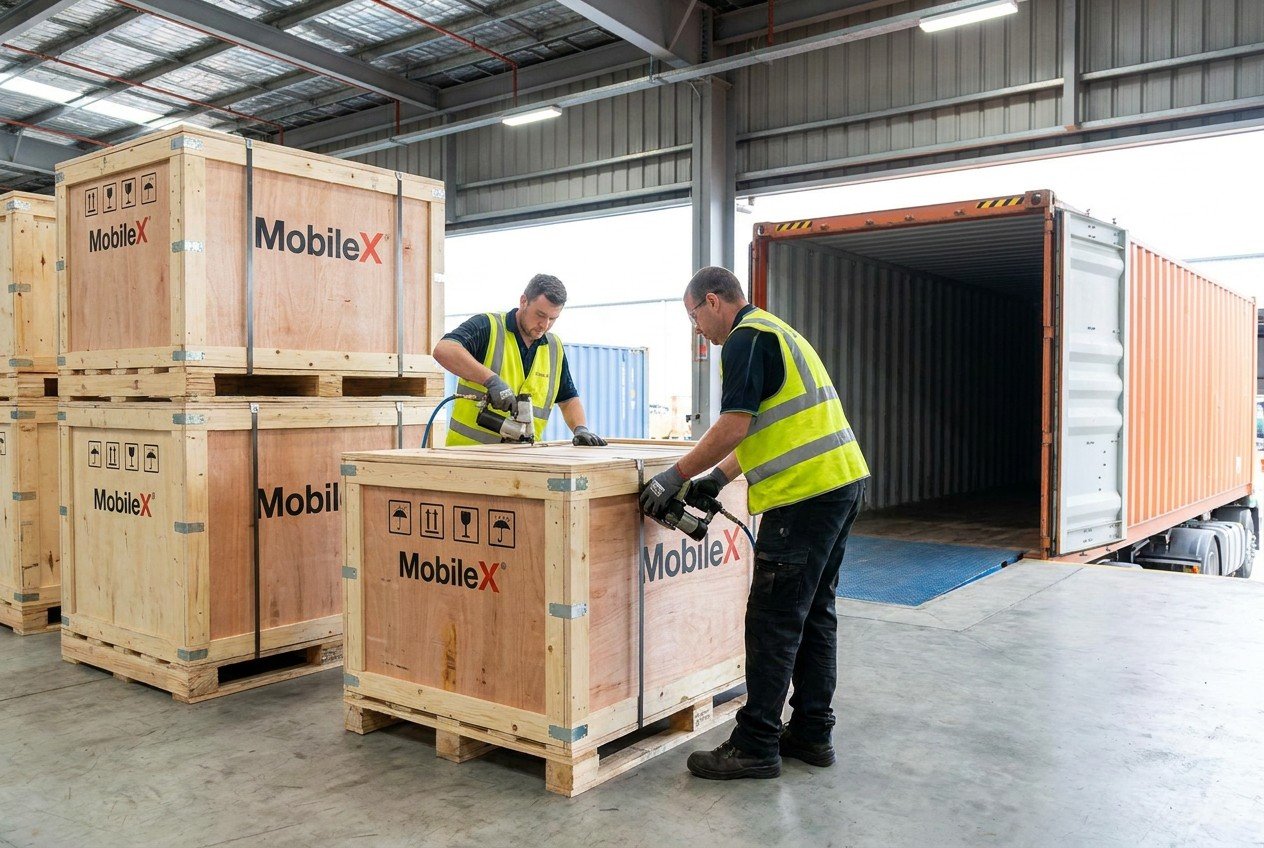
Before shipment, request:
- Final product photos
- Packing photos
- Crate or carton marking details
- Accessory and hardware list
- Installation video or guide
- Spare-part policy and warranty explanation
MobileX POD can provide installation video guidance for self-installation. Warranty and after-sales terms—including covered parts, the applicable support period, exclusions and local replacement responsibilities—must be confirmed in the formal quotation or signed contract for the specific project before payment.
Turn the photo request into an order-specific inspection
A supplier’s approved sample establishes a configuration; it does not establish that the shipment repeats it correctly. Before ordering, agree how the actual production units, their included components and their packages will be checked. This gives the buyer a basis for a dispatch decision instead of a folder of attractive photographs.
Start with the order lines: model or drawing revision, quantity, finish, electrical version and included options. Assign the production units to those lines. Keep unit count separate from package count: one pod may be split across packages, and a package identifier alone does not prove that its contents complete a unit. Use the order-specific packing list to connect them, without assuming a standard number of crates per pod.
| When to check | What the buyer can learn | What to record |
|---|---|---|
| While relevant parts are accessible | Whether the selected panels, glazing, finish, fittings and supplied accessories match the order reference. | Unit or component identity, approved reference, observed result and exceptions before wrapping conceals the item. |
| In the agreed assembly or test state | Whether the selected door, furniture and included operating functions can be demonstrated together. | Which units were checked, their assembled state, checks performed and result. A flat-packed set cannot demonstrate an assembled door’s operation while still packed. |
| At packing and dispatch readiness | Whether the checked goods and loose items are identifiable in the proposed shipment. | Order-line quantities, package references, hardware and accessory list, visible packing condition and unresolved items. |
Plan access to the important checks before arranging an inspection date. If a door-operation check requires a trial assembly, put that preparation in the inspection scope. Do not assume that a factory visit, a video call or an inspector’s fee automatically includes assembling every flat-packed unit. Keep functional demonstrations separate from the evidence supporting acoustic or other measured performance.
Make coverage visible, including configuration differences
SGS’s final random inspection service distinguishes batch checks and defined sampling from a general factory visit. For your order, identify the available units, the units selected and the checks performed on them. A chosen example is not the same as a documented random sample, and neither should be described as every unit having been inspected. Where statistical sampling is required, agree the applicable plan and acceptance criteria with the inspection provider.
Hypothetical order: Six pods share the same shell, but four use configuration A and two use configuration B with a different socket version and finish. First reconcile all six against the order lines. Then ensure the inspection plan addresses both configurations: seeing A’s socket and finish cannot settle B’s differences. The number selected for physical checks follows the agreed plan, not an invented rule that one example approves the whole order. If an issue is found, identify the potentially affected units and the necessary correction and recheck before deciding what can ship.
Choose a review method that can answer the question
Factory records, a live guided review and an on-site inspection can each provide useful evidence. For a live review, show the unit identity, the relevant detail and the requested operation rather than only a finished exterior. Use close views for the finish and connections; include the measuring instrument when a dimension is being checked. Photographs and video support what they actually show, not unseen surfaces or an unrecorded test.
QIMA’s guided-inspection description explains the distinction between remotely guided checks and an inspector examining products on site. Use that distinction when the decision depends on handling a part, checking a concealed area or comparing a physical reference. It does not require every MobileX purchase to use a third party.
Finish with a short decision record: checked configuration and units, results, open items, corrective work, recheck evidence and the buyer’s dispatch decision. A statement that a repair is planned is not the same as a passed recheck. Preserve the status of unaffected units separately. The pilot review guide covers approving the configuration; the delivery acceptance guide covers receipt and installation after shipment. For a MobileX quotation, include the inspection method, preparation and evidence you need alongside the model, quantity and destination so that this work can be scoped before the order.
7. Use a buyer checklist before paying the deposit
A good supplier should not be afraid of practical verification questions. If the supplier can answer clearly, show current evidence and prepare project-specific drawings or quotation details, the buyer has a much better basis for decision.
Before placing an office pod order, check these items:
- Company identity and export contact are consistent
- Product model, size and price basis are clear
- MOQ, lead time and customization scope are written
- Acoustic wording is realistic
- Drawing or layout is approved for custom projects
- Packing method and loading plan are understood
- Installation guidance is available
- Warranty and spare-part policy are explained
- Payment and trade terms are confirmed before deposit
Download the MobileX office pod factory verification checklist and use it before comparing quotations.
Where MobileX POD fits
MobileX POD is worth considering when the buyer needs a factory-direct office pod supplier from China with MOQ 1 sample support, standard MP1 / MP1+ / MP2 / MP3 model data, custom color, socket, voltage, logo and layout discussion, and export-ready communication for office, meeting, lactation, telemedicine, outdoor kiosk and custom modular pod projects.
For the best quotation, send product type, quantity, destination country, target size, color, voltage/socket requirement, logo requirement and any reference drawing or photo.
Useful next pages: