Office Pods With Air Conditioning: Clarify Cooling, Ventilation and Site Work
Before ordering an office pod with air conditioning, establish what will cool the occupied space, where the heat will go and how fresh air will reach the users. A pod that exchanges air with an air-conditioned office is a different proposal from a pod with dedicated cooling equipment. Compare those arrangements against the building's operating hours and the intended use before selecting equipment or approving openings.
For facilities buyers, designers and dealers, the useful question is not simply whether a quotation says "AC." It is whether the proposed pod, building services and installation work form a complete, workable arrangement. This guide explains what to compare and what information to request. Equipment selection and installation design belong with the responsible suppliers and qualified building-services professionals.
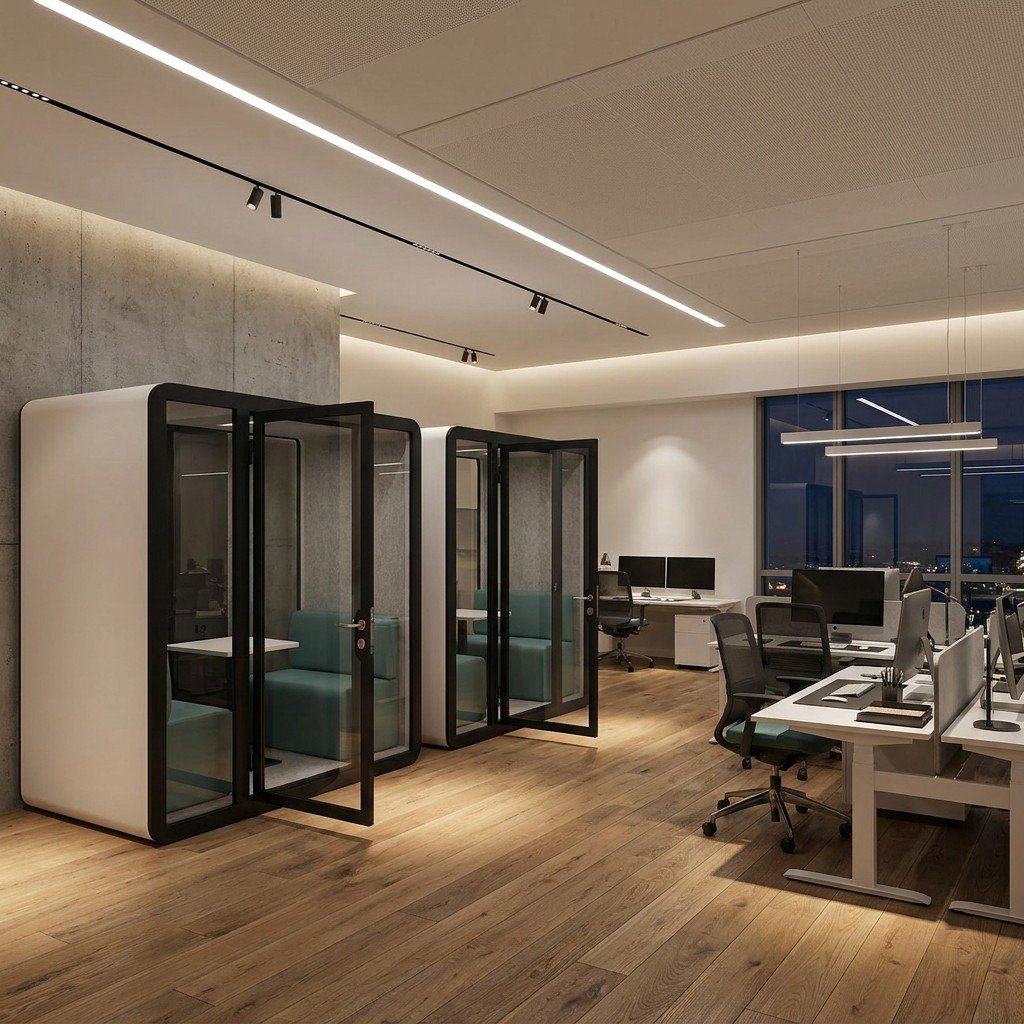
Separate cooling from the fresh-air question
Cooling removes heat from a space. Moving air through a pod can help exchange heat with its surroundings, but a fan-only arrangement does not itself provide a refrigeration system. If its incoming air comes from the office, the office's actual conditions matter.
The U.S. Department of Energy hosts an air-source heat-pump guide that describes cooling as transferring heat from inside a building to outside. The relevant procurement principle is to identify the heat-removal path, not just the device blowing air at the seat. That general explanation is not a sizing method for a pod.
Fresh-air provision needs a separate answer. A cooling unit may circulate air without supplying the required outdoor air. The UK's HSE workplace ventilation guidance advises checking how mechanical systems supply fresh air and discusses fresh-air provision when air is recirculated. It is UK workplace guidance, not evidence that a particular pod meets requirements in every country.
Ask for two descriptions: the pod's air path and the building's fresh-air provision. If a dedicated cooling unit is proposed, add its heat-removal path. A single arrow labelled "airflow" is not enough to distinguish these functions.
For fan counts and the difference between component and installed-system measurements, use the separate office pod ventilation guide. This article addresses cooling scope and its connection to the site.
Compare the arrangement, not the AC label
The following are procurement routes to investigate, not a list of standard MobileX configurations. A dedicated system or building connection first needs confirmation that it is suitable for the proposed pod and permitted at the site.
Scroll horizontally to compare all columns.
| Proposed arrangement | What the buyer is relying on | What must be demonstrated | When to reconsider it |
|---|---|---|---|
| Pod ventilation exchanges air with a conditioned office | The host office remains suitable during actual pod use | The incoming-air conditions, pod air path and occupied-use assessment match the proposed location and hours | The office cooling is off during use, or its conditions are unsuitable |
| Building services are specifically extended or coordinated for the pod | An agreed building-services design and site contractor | The proposed connection, fresh-air provision, controls, permissions and responsibility for final testing | No approved route or contractor can complete the connection |
| Dedicated cooling equipment is proposed for the pod | A named equipment configuration and a complete installation design | Suitable capacity selection, heat rejection, condensate arrangements where applicable, power, access and compatible pod interfaces | Equipment fits visually but the heat, drainage or servicing route is unresolved |
| Improve the host room or select another location first | The underlying room problem can be addressed before pod selection | The building team can provide suitable conditions at the intended operating times | The site cannot support the intended use even after practical changes |
This comparison can change the order of purchasing. When the host office is the limiting factor, buying a pod first may leave the building work unresolved. When dedicated equipment is feasible, the equipment information needs to reach the pod supplier before the shell and interfaces are finalized.
Describe the occupied conditions before asking for capacity
Give the reviewing team an account of the proposed use, rather than asking it to size cooling from the pod's exterior dimensions alone. Include the intended occupants, computers and screens, lighting, operating periods and the position relative to windows or other heat sources.
State what is known about the host room during the actual use period. Distinguish measurements from estimates and from information still needed from building management. A thermostat setpoint on a corridor wall is not a record of conditions at the proposed pod position.
HSE's thermal-comfort guidance considers factors including air and radiant temperature, air movement, humidity, clothing and work rate. It does not reduce comfort to a single temperature reading. For procurement, this is a reason to describe the use and surroundings clearly, rather than promise that one selected temperature will satisfy every user.
Useful inputs include:
- The proposed pod model or layout, intended occupants and typical activities.
- Equipment models or a clear list of devices that will operate together.
- Building cooling and ventilation hours, including evenings and weekends.
- Available information about temperature, humidity and sunlight at the location, with its date and conditions.
- Proposed door use, controls and any operating restrictions.
- A named person who can obtain missing building-services information.
Ask the qualified reviewer to state the assumptions behind the equipment selection and which project conditions still need checking. Do not replace that assessment with a universal cooling-capacity-per-pod rule.
Map the air path and responsibilities at the actual location
A pod fan can only exchange air with the air available at its inlet, while active cooling needs a defined way to remove heat. Before approving the location, place the host room's known supply and return or extract points on the same plan as the pod's proposed inlet, outlet, door, occupied positions and service access. Keep that air-path drawing separate from any refrigeration, condensate and power routes so that one line does not conceal several different systems.
HSE's workplace ventilation overview distinguishes mechanical systems that blow clean air into rooms from systems that extract stale air. Its improvement guidance also recommends understanding how the workplace system operates, whether it supplies fresh air and how it is maintained. These are general building-management principles, not proof of a MobileX model's airflow or a design rule for every site.
Scroll horizontally to compare all columns.
| Decision | Buyer or operator | Pod supplier | Building or mechanical team |
|---|---|---|---|
| Use and operating period | State expected occupants, tasks, equipment and session pattern | Identify the proposed model, ventilation configuration and evidence scope | State host-room cooling and fresh-air operation during those hours |
| Air path at the selected position | Provide the final location plan and nearby obstructions or circulation constraints | Mark the proposed pod inlet, outlet and service-access locations from the approved configuration | Review interaction with room supply, return or extract points and other building conditions |
| Dedicated cooling or site connections | Allocate permissions, procurement and site responsibilities | Review proposed openings, mounting and the boundary of pod supply | Select and install the site system, heat-rejection route, condensate and power work where applicable |
| Completion review | Agree realistic use scenarios and record unresolved observations | Provide configuration documents and address pod-scope deviations | Commission site work and assess it against the approved design criteria |
The table is a responsibility map, not a transfer of professional design duties. A party should only approve work within its competence and contracted scope. If the proposed air path, equipment route or owner cannot be identified, the location is not ready for final approval.
Verify the completed arrangement under the agreed use
Before handover, compare the installed arrangement with the approved drawing and quotation. Confirm that the identified pod openings and service access are not blocked by walls, packaging, furniture or later site work; operate the documented fan and control modes; and run the host building systems on the schedule expected during real pod use.
Then observe the agreed scenario with the expected number of people and relevant devices, using the planned door behavior. Record the location, date, operating mode and surrounding conditions with each observation. A short demonstration can reveal an obstructed path, unexpected control behavior or a mismatch between the quotation and installation, but it does not by itself establish air-change rate, carbon-dioxide performance, cooling capacity, indoor-air-quality compliance or long-session comfort.
The U.S. Department of Energy describes HVAC commissioning as verifying that building systems are installed and operate against the original design and engineering documentation. It also identifies blocked registers and unsuitable operating schedules as items worth checking. Apply that principle through the qualified project team and the selected equipment instructions; this article does not turn a buyer walk-through into technical commissioning.
If the project requires measured acceptance criteria, have the responsible professional define the method, instruments, conditions and pass/fail basis before testing. Keep the resulting site record with the final pod configuration rather than treating a fan sound, an open door or a brief feeling of cool air as proof of performance.
Resolve the routes that determine feasibility
Heat rejection and equipment position
Have the supplier identify every proposed equipment component and where it will be located. Ask where rejected heat will go, whether the host room is affected, and who has approved the proposed route. "Portable" or "self-contained" equipment still needs a configuration-specific installation review; the label does not resolve the receiving environment.
Keep the air inlet, outlet and service-access requirements attached to the actual equipment documentation. A generic clearance copied from another product is not a substitute. If the required locations cannot be accommodated, compare a different system or pod position before approving fabrication.
Condensate, power and openings
Where the selected cooling equipment produces condensate, identify the intended handling arrangement, its maintenance access and the person responsible for installing and checking it. Do not leave the destination of that water to be improvised after delivery.
For a mini-split example, the DOE-hosted guide describes separate indoor and outdoor components with connecting services, including refrigerant tubing, power and a condensate drain. This supports asking for the complete connection scope; it does not establish that a mini-split can be fitted to any MobileX model.
Obtain the proposed equipment datasheet and installation information. The responsible parties should then confirm supply requirements, mounting, openings, routing and local work. Electrical and refrigeration work should be allocated to appropriately qualified personnel under applicable local requirements. This article is not an installation procedure.
Access and the effect on the pod
Show how a technician will reach the equipment without blocking the door or treating occupied furniture space as permanent service clearance. Ask the pod supplier to assess proposed openings and mounting loads before they are added to a drawing. Also ask what review is needed for changes affecting the enclosure, sound paths, finishes or future dismantling.
Use the custom drawing and equipment-interface guide for the detailed drawing exchange. An agreed equipment location is a design input, not permission to cut an opening into an assembled pod.
Several rooms: separate cooling systems or one shared outdoor unit?
For several enclosed workspaces, compare how independently the rooms must operate before choosing the number of outdoor units. Separate systems can be worth evaluating when rooms need different operating modes or independent equipment servicing. A shared multi-split arrangement can be worth evaluating when the rooms can work within its operating limits and the site has a suitable location for a shared outdoor unit. Neither arrangement removes the separate fresh-air question.
Individual controls are not the same as independent heating and cooling modes. Daikin’s CTXM-R / 4MWXM-A product page describes individually controllable indoor units operating within the same heating or cooling mode. Its separate VRV range description identifies a heat-recovery model that can cool and heat simultaneously within one refrigerant circuit. These examples show why the selected system matters; they do not establish that every multi-split has the same limitation or that a heat-recovery system is suitable for a particular pod project. Neither is a confirmed MobileX equipment package.
Consider a hypothetical pair of rooms: a meeting space beside a sunny window and a separate room used for quiet desk work. The equipment designer should first establish their actual demands. If one genuinely needs cooling while the other needs heating at the same time, a shared system limited to one mode cannot satisfy both demands simultaneously merely because each room has a controller. Compare separate systems, a suitable system designed for simultaneous modes, or a different building-services arrangement. If the rooms require the same mode but different schedules or settings, an appropriately selected shared system may remain a useful option.
Draw the equipment dependency as well as the pipe route. With a shared outdoor unit, identify every room connected to it and what happens to those rooms during planned service of that unit. With separate systems, identify which equipment and connections are genuinely separate; several units supplied through a common site circuit are not automatically independent in every respect. A room that must remain available while another is being serviced makes the service boundary part of the purchase decision. This is a planning comparison, not a reliability claim or a prediction of downtime.
The physical trade-off also extends beyond the indoor unit. Compare the outdoor-unit positions, the actual routing to each room, condensate arrangements, service access and controls. Sharing outdoor equipment does not erase the individual room connections. Separate equipment adds positions and associated work that must fit the site. Ask the equipment designer to assess the named combination and intended simultaneous use, rather than adding indoor-unit headline capacities and treating that sum as confirmed delivered performance.
Price the same rooms and operating requirements in each offer. Identify the outdoor and indoor equipment, controllers, connecting services, installation and commissioning, then show any work required to keep an unaffected room usable during servicing. Do not assume that fewer outdoor units means a lower complete installed cost. MobileX’s part of the discussion is the proposed enclosure, agreed interfaces and the supply scope recorded in the project drawing and quotation; equipment selection and destination installation must have their own identified providers. You can begin with the rooms, use periods and independence you need, without having selected an equipment model.
Compare quotations at the same boundary
One supplier may quote a ventilated pod intended for a conditioned room. Another may quote a shell prepared for customer-supplied equipment. A third proposal may include named cooling equipment but leave site installation to a contractor. Their prices are not comparable until those boundaries are explicit.
Ask each offer to distinguish:
- Pod supply, including the stated ventilation configuration.
- Cooling equipment supplied, if any, identified by model and quantity.
- Provisions only, such as agreed mounting or routing preparation.
- Building alterations, connections and other work completed locally.
- Controls, commissioning, maintenance documents and the responsible parties.
For each item, identify whether it is included, optional, buyer-supplied or unresolved. An allowance without a selected system should remain labelled as an allowance. The base-scope and options comparison guide provides the wider quotation structure.
For a MobileX enquiry, separate the pod configuration you want from the cooling arrangement you would like assessed. Request written confirmation of what can be supplied and what remains site work. Do not infer dedicated cooling, an outdoor unit or building-system integration from a product-setting image or a ventilation description.
A late-working team: an illustrative decision
Consider a hypothetical office where a meeting booth will be used after the building's normal cooling hours. No temperature or equipment performance is assumed here.
The buyer's first question is whether building management can provide suitable conditions during those later sessions. If it can, the team can evaluate the proposed ventilated pod under that arrangement. If it cannot, the team must investigate a different operating location, changed building-service hours or an appropriately designed dedicated system.
A proposal for dedicated cooling then needs a feasible heat-rejection route, power and any required condensate arrangements. If the landlord will not permit the necessary work, an attractive equipment price does not make the installation feasible. The unresolved site condition should be settled before the pod order, not converted into an assumed supplier promise.
The same decision applies differently to a fully outdoor setting. Start with the indoor-versus-outdoor product-system guide; adding cooling does not establish weather suitability for an indoor pod.
Send a cooling-scope brief with the pod enquiry
The following is a buyer's working template, not a claim about an existing factory approval system:
- Project and destination: [site and country]
- Pod model or intended layout: [reference or drawing]
- Users and equipment: [occupancy and devices used together]
- Host-room conditions: [known information, dates and missing information]
- Use hours and building-service hours: [both schedules]
- Proposed cooling route: [host room, building connection, dedicated equipment or undecided]
- Equipment and interface information: [datasheets and marked locations, if available]
- Site permissions and installation responsibility: [named parties and outstanding decisions]
- Completion review: [who checks the finished arrangement and under what agreed conditions]
Start with the office pod product range or a custom modular pod discussion. Then send the project brief to MobileX POD so the requested pod supply can be separated from equipment selection and local installation work. A useful proposal should make those dependencies visible before you commit to the shell.